Your Guide to Digital Content Creation Services & Engaging Audiences
Think of digital content creation services as the creative engine that turns your brand's ideas into digital experiences people can actually feel. It’s the art and science of producing animations, immersive apps, and stunning CGI that doesn't just get seen, it gets results.
What Are Digital Content Creation Services?
At its heart, digital content creation is about professionally crafting digital media with a clear purpose and audience in mind. This is miles beyond basic graphic design; it's a field where technical wizards and creative storytellers come together. These services are what transform an abstract concept, like a new product idea or a complex training protocol, into something tangible and engaging. They build the assets that educate customers, launch products with a bang, or create unforgettable brand worlds.
The Scope of Modern Content Creation
The world of digital content is vast, with a whole toolbox of specialised outputs. It's about picking the right tool for the job. You wouldn't use a hammer to turn a screw, and you wouldn't build a simple infographic when you need a detailed 3D animation to show off a complex medical device. The main service areas you’ll encounter include:
- •3D/2D Animation: Bringing characters to life for TV, creating slick motion graphics for adverts, or building technical explainers that make sense of the complicated.
- •CGI (Computer-Generated Imagery): Crafting photorealistic visuals that are indistinguishable from reality, perfect for films, high-end advertising, and product visualisation.
- •XR (AR/VR/MR): Building immersive and interactive experiences for everything from hands-on training simulations to show-stopping marketing events.
- •Game & App Development: Designing and building interactive applications that entertain, inform, or solve a problem on any device.
As technology barrels forward, so do the possibilities. AI is now a powerful co-pilot in many of these workflows, and understanding what is AI generated content can offer a glimpse into where the industry is heading.
In a world saturated with information, strategic digital content creation helps you cut through the noise. It’s about making your message not just seen, but felt and remembered.
This isn’t just a niche industry; it’s exploding. In the UK alone, the content marketing market, a key driver for these services, hit USD 18.65 billion in 2024. Projections show it rocketing to USD 73.26 billion by 2033, a clear sign that businesses are doubling down on high-quality digital content to build real connections with their audiences.
Choosing Your Creative Toolkit
With so many options, how do you know where to start? This table breaks down the core digital content services, helping you match the right creative solution to your specific business challenge.
| Service Type | Best For | Primary Business Goal |
|---|---|---|
| 3D/2D Animation | Explaining complex processes, product demos, brand storytelling, entertainment. | Educate & Engage |
| CGI | Showcasing unbuilt products, creating impossible visuals, high-end advertising. | Visualise & Impress |
| XR (AR/VR/MR) | Immersive training, interactive marketing events, virtual product showcases. | Experience & Interact |
| Games & Apps | Building brand loyalty, gamified training, providing utility to customers. | Retain & Empower |
Each of these avenues offers a unique way to communicate with your audience. The key is aligning the medium with the message you want to deliver and the action you want your audience to take.
Bringing Ideas to Life with Animation and CGI
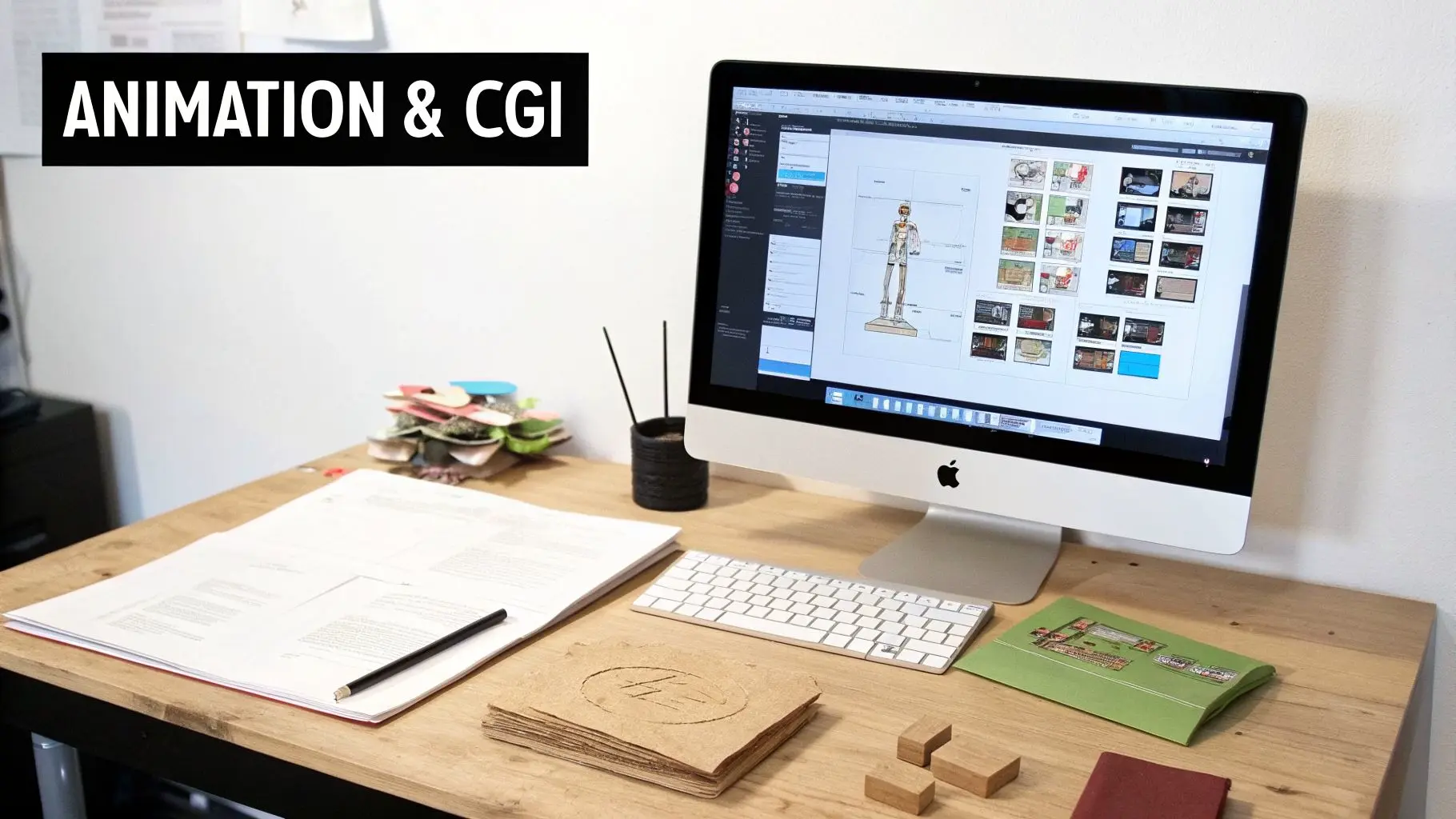
Animation and Computer-Generated Imagery (CGI) are fundamental tools for any modern business. Far from being just for kids' cartoons, they are powerful mediums for building worlds, explaining complex ideas, and injecting real personality into a brand. They are the engine behind today's most effective digital content creation services. Whether it’s a slick 2D explainer video that makes your software feel intuitive or a stunningly realistic 3D product render for your next big campaign, the mission is always the same: make the impossible feel real and tell a story that people remember. The style you choose is never just about looks; it's about what you need to achieve.
The Great Divide: 2D vs. 3D Animation
Choosing between 2D and 3D animation isn't just an aesthetic decision, it’s a strategic one. Each has its own strengths, perfectly suited to different objectives.
- •2D Animation: When you need clarity, charm, and character, 2D is often the perfect fit. It’s fantastic for creating engaging explainer videos, stylised brand stories, and eye-catching motion graphics. Because the workflow is generally more direct, it can also mean quicker turnarounds, which is ideal for fast-moving marketing campaigns. Think of it as storytelling through illustration, where clean lines and bold colours get your message across with punch and clarity.
- •3D Animation: If you need realism, depth, and intricate movement, 3D is the way to go. It’s the standard for creating believable character performances, detailed technical visualisations, and immersive product showcases that feel like you could reach out and touch them. The process is more layered, involving modelling, texturing, and rigging, but the reward is a world with tangible depth. This is what you choose when you need your audience to truly _believe_ what they’re seeing.
Seeing these techniques in action is the best way to understand their potential. A good look through a professional portfolio of animation services can offer some fantastic inspiration for your own projects.
The Production Pipeline in Action
Getting from a spark of an idea to a polished final animation is a structured, collaborative journey. This process, or 'pipeline', ensures the project stays on course, on budget, and true to the original vision. It all kicks off with a detailed brief and a solid script. From there, we move into visual development, where storyboards and concept art start to define the look and feel. Once everyone's on the same page, the real build begins: characters are designed, environments are constructed, and props are modelled.
The real magic happens during the animation stage, where our artists breathe life into everything, one frame at a time. This is followed by lighting, rendering, and compositing, the final steps where all the separate visual elements are layered and blended into a seamless, beautiful shot.
This methodical approach is what makes professional content stand out. It ensures every last detail, from a character’s fleeting expression to the way light catches a surface, is working to tell the story. It’s this level of craftsmanship that elevates a simple concept into a visual experience that truly connects with an audience.
Building Worlds with Immersive XR, AR and VR
It's time to think beyond the flat screen. eXtended Reality (XR) is the next frontier for actually connecting with your audience, and it's far from a futuristic gimmick. It's a powerful and increasingly practical set of tools for modern business. XR is simply the catch-all term for Virtual Reality (VR), Augmented Reality (AR), and Mixed Reality (MR), each offering a completely different way to build a connection. These technologies have become a core part of modern digital content creation services, letting businesses build entire worlds that customers can literally step into. Whether it’s an intricate training simulation designed to build real muscle memory or a jaw-dropping product demo on a bustling exhibition floor, XR turns digital content into a tangible, physical experience.
Distinguishing the Realities
Getting to grips with the difference between AR and VR is the first step to figuring out which one is right for your project. They each do very different jobs and create vastly different interactions.
- •Virtual Reality (VR): This is all about total immersion. VR completely replaces a user's surroundings with a fully digital environment. The moment the headset goes on, they are somewhere else entirely. This makes it incredibly powerful for detailed training scenarios, virtual property walkthroughs, or story-driven entertainment where you need the user's complete and undivided attention.
- •Augmented Reality (AR): Instead of replacing the world, AR adds to it. It overlays digital information and graphics onto your real-world view, usually through a smartphone or tablet. Think of it as enhancing reality, not escaping it. This is perfect for interactive retail where a customer can see a new sofa in their own living room, educational apps that bring museum exhibits to life, or on-site instructions for maintaining complex machinery.
XR shifts your content from something people passively watch to something they actively do. It’s the difference between telling someone about your product and letting them hold a virtual version of it in their own hands.
The journey from a spark of an idea to a fully-fledged XR app is a well-trodden path. It kicks off with intensive concepting and design work to map out every user interaction and story beat. From there, our developers get to work in powerful real-time game engines like Unity or Unreal Engine, where our artists and programmers build, test, and optimise the experience for the target hardware, whether that's a Meta Quest headset or a standard mobile phone.
Practical Applications Driving Real Results
The uses for XR are as diverse as the industries it serves. For highly technical sectors, VR provides a safe, repeatable space to train staff on dangerous or expensive equipment without any real-world risk. A surgeon can practise a complex procedure dozens of times, or an engineer can learn the maintenance routine for a wind turbine without ever leaving the ground. In the world of marketing and events, AR can be a real showstopper. Imagine a potential buyer pointing their phone at one of your brochures and seeing a full-scale 3D model of a new car appear right there in the room. That's the kind of memorable, 'wow' moment that creates a lasting brand impression and drives serious engagement. To get a feel for how these concepts become reality, taking a look at some real-world virtual and augmented reality projects is the best way to see the impact. Ultimately, whether it’s for training, sales, or pure entertainment, XR creates experiences that stick.
Mapping the Journey from Concept to Completion
Bringing a digital project to life isn't magic; it's a structured, collaborative process. Think of it as a journey that carefully transforms a simple idea into a polished final product, making sure quality and your original vision are locked in at every single stage. This production pipeline is the backbone of professional digital content creation services. It provides clarity, tames complexity, and keeps everything on track from the first chat to the final handover. It all kicks off with a deep dive into your goals. This initial strategy phase is all about defining what a 'win' looks like for you. We need to get crystal clear on the target audience, the key messages you want to land, and the core objectives of the project. This is where we lay the essential groundwork for everything that follows.
From Blueprint to Build
Once the strategy is set in stone, the real creative work can begin. The pipeline moves from abstract ideas to tangible assets in a series of well-defined stages.
- Concept and Storyboarding: This is the visual blueprinting stage. Scripts get finalised, and storyboards map out the entire narrative, shot by shot. For something interactive, like an app or a VR experience, this means creating user flow diagrams and wireframes to design the user's journey from start to finish.
- Asset Creation: With the blueprint approved, our artists and developers start building the individual components. This could mean modelling and texturing 3D characters, illustrating 2D backgrounds, or designing the user interface (UI) elements for an app. It's a meticulous process where every single visual element is crafted to match the established art direction.
- Animation and Development: This is where the static assets are brought to life. Animators create movement and performance, while developers write the code that makes an experience feel responsive and interactive. This is often the most time-intensive phase, where the personality and functionality of the final product truly start to take shape.
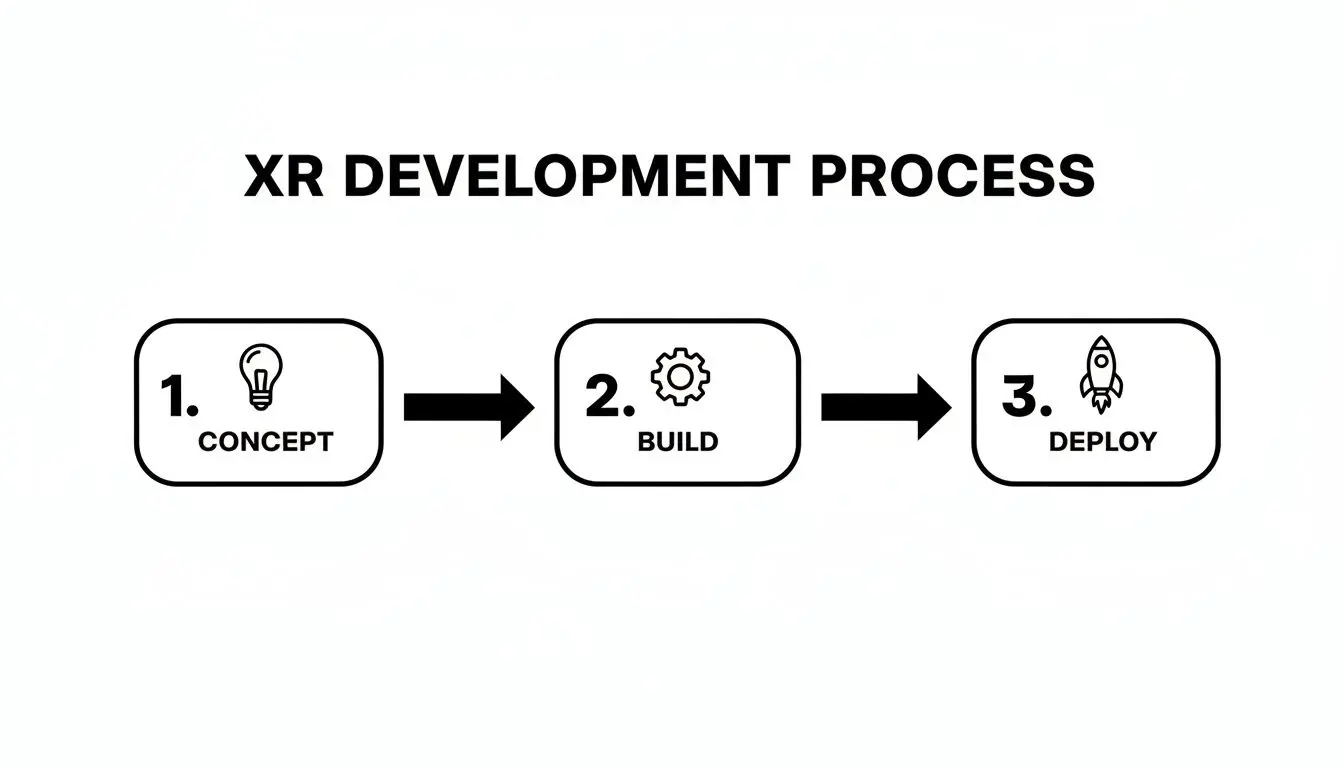 As the diagram shows, even though the steps are linear, the process needs careful management to get from that initial creative spark to a functional, deployed application.
 The Final Polish
The last leg of the journey is all about refinement. This is where a good project becomes a great one.Post-production is where all the separately created elements are brought together into a cohesive whole. It involves compositing visuals, colour grading to achieve the perfect look, and integrating sound design and music to create the right atmosphere.For interactive projects, this stage involves rigorous Quality Assurance (QA) testing to find and squash bugs, ensuring the user experience is smooth and intuitive. The final step is delivery, where the finished content is optimised and formatted for its intended platform, whether that’s a broadcast network, a mobile app store, or a VR headset at an event. This disciplined, step-by-step approach guarantees your vision is realised with absolute precision and polish.
How Digital Content Fuels Business Growth
Let's be honest, great content is much more than a pretty picture or a slick video. It's the engine that powers your business forward. When you invest in professional digital content creation services, you're not just buying an asset; you're building authority, educating your audience, and creating a direct path to measurable growth. The real magic, though, happens when you think strategically about repurposing. A single, high-quality CGI animation isn't just one video. It's the raw material for a dozen other high-performing pieces of content, think short, punchy clips for social media, eye-catching banner ads, and looping videos for your next exhibition stand. This approach stretches your investment further, making sure your core message hits home on every platform your audience uses.From Awareness to Action
Effective digital content meets your customers wherever they are in their journey. For instance, a beautifully crafted animated explainer video can take a complex product or service and make it crystal clear in just a couple of minutes. That clarity is powerful. It answers key questions upfront, shortens the sales cycle, and gives your sales team a consistent, compelling tool they can rely on. This same principle applies to building a brand on a massive scale. Just look at transmedia storytelling. A beloved character from a children's animated series can be thoughtfully extended into games, apps, and interactive experiences. This isn't just about entertainment; it's a savvy strategy for building a globally recognised brand with multiple, healthy revenue streams.The goal is to create content that doesn’t just interrupt, but _adds value_. It should solve a problem, answer a question, or provide a moment of delight that builds a lasting connection with your audience.The economic impact here in the UK is impossible to ignore. The digital advertising market, which is fuelled entirely by compelling content, generated an enormous USD 40,236.9 million in 2024. And it's not slowing down. That figure is forecasted to rocket to nearly USD 95,727.8 million by 2030, with smartphones claiming the lion's share of that spend. This mobile-first world only highlights the critical need for video ads, animations, and immersive content that looks and performs flawlessly on smaller screens. You can dig into more data on the UK digital advertising market outlook from Grand View Research. To make sure your content truly connects and gets people to act, a solid grasp of User Experience Design is absolutely vital. By thinking about how the end-user will actually interact with what you’ve made, you create experiences that are not only beautiful but also intuitive, effective, and ultimately, hit their business goals.
Choosing the Right Creative Partner
Finding the right studio for your project is probably the single most important decision you'll make. The best partner doesn't just follow a brief to the letter; they challenge it, improve it, and bring their own creative flair and technical know-how to the table. They effectively become a specialist extension of your own team, completely invested in bringing your vision to life. The first thing to do is look past the flashy showreel. A strong portfolio is a must, of course, but you need to understand _how_ they work. Do they have a clear, easy-to-understand production process? How do they handle feedback and the inevitable rounds of revisions? A solid, collaborative workflow is a huge sign that a studio can deliver on time and within budget, without any nasty surprises.Evaluating a Studio’s Credentials
To pick the right team, you need to do a bit of digging into their track record and technical skills. A slick website is one thing, but proven experience is what really counts when the pressure is on. Here’s a quick checklist to help you size them up:- •Technical Expertise: Do they have genuine, deep experience with the specific tools your project needs? Whether that's Unreal Engine for a complex VR simulation or advanced character rigging, they need to be experts.
- •Portfolio Quality: Does their past work match the style and quality you're aiming for? Hunt for projects that feel similar in scope and ambition to yours.
- •Case Studies and Client History: Don't just skim their case studies, read them. Do they clearly explain the project's goals, their process, and the results? A history of working with well-known clients is a good sign of their reliability.
- •Team and Culture: Does the studio feel like a good cultural fit? When you're in a creative partnership, clear communication and a good rapport are everything.
Writing a Brief and Spotting Red Flags
A well-crafted project brief is your best friend. It’s what ensures you get accurate quotes that you can actually compare, and it sets clear expectations right from the start. Your brief should cover your objectives, who you're trying to reach, key messages, your ideal timeline, and a realistic budget range. As you start talking to potential studios, keep an eye out for red flags. If a studio is vague about its process, reluctant to share detailed case studies, or won’t provide client references, be wary. True professionals are proud of their work and are happy to show you how they do it.
A great creative partner will ask you tough questions. They’ll dig into your brief, challenge your assumptions, and suggest better ways to hit your goals. This isn't them being difficult, it’s the mark of a team that's already thinking about your success.
Ultimately, this is all about finding a team you trust to be the guardian of your vision. For a much deeper dive into this, check out our complete buyer's guide to choosing an animation studio.
Got Questions About Digital Content?
Stepping into the world of professional digital content can feel like a big move. It’s natural to have questions about how it all works. Here are some straightforward answers to the things we get asked most often by businesses just like yours.
How Much Should I Budget for My Project?
This is the big one, isn't it? The honest answer is: it varies hugely. A snappy motion graphics video for social media is going to be a much smaller investment than, say, a multi-episode 3D animated series or a bespoke VR training app. The best way to get a real number is to first sketch out a clear project brief. Once you have that, you can have a proper chat with a studio to get a detailed, accurate quote that fits your vision.
What Is a Realistic Timeline for a Content Project?
Just like cost, the timeline is tied directly to the complexity of the job. A clean, concise animated ad might take shape in about 6-10 weeks. On the other hand, something more involved like an interactive experience or a full-blown VR simulation could be a 6-12 month journey. Any experienced studio worth its salt will give you a detailed production schedule right from the start, complete with key milestones so you’re never left guessing. This kind of content is more important than ever for connecting with people where they spend their time. In the UK alone, social media platform revenues are predicted to jump by 20.3% every year, hitting £12.5 billion by 2026. With 89% of UK internet users active on social media, there's a massive audience ready and waiting for compelling animations and immersive content. You can dig deeper into these UK digital trends over at DataReportal.
What Should I Include in My Project Brief?
A solid brief is the bedrock of a successful project. It’s your chance to get everything out on the table. Make sure you include your main business goals, who you’re trying to reach, the key messages you want to land, and any brand guidelines we need to follow. It’s also incredibly helpful to share any technical requirements, your ideal timeline, and a rough budget range. This helps the studio figure out the most effective way to bring your idea to life within your means.
A well-prepared brief doesn't just get you a faster quote; it ensures the creative team is aligned with your strategic objectives from the very first day. This clarity prevents costly revisions and keeps the project focused on delivering real business value.
Getting these fundamentals down on paper puts you in a fantastic position to start a conversation with a creative partner, kicking off your project with confidence and a shared vision.
At Studio Liddell, we've spent years turning ambitious ideas into stunning digital realities. Discover how our creative and technical expertise can elevate your brand.