How Does Discord Make Money: Nitro, Boosts, & Future Plans
Discord reaches hundreds of millions of people, yet its revenue model is unusually restrained for a platform of that size. That gap is the starting point for understanding how Discord makes money. The company has built a business around paid upgrades, community spending, and selective brand participation rather than flooding the product with traditional advertising. That choice matters commercially. An ad-light, user-funded platform produces different user expectations than a feed built to maximise impressions. People join Discord to talk, organise, play, attend events, and get access to experiences that feel worth their time. They expect relevance and participation. They are quick to reject anything that feels imported from standard campaign planning. For brand managers, studios, and producers, this changes the brief. Discord works best as a community environment, not a media slot. The practical opportunity is stronger retention, better feedback loops, and more credible fan relationships. The trade-off is equally clear. Attention usually has to be earned through utility, access, programming, or creator collaboration. If you want a broader framing before examining Discord specifically, Studio Liddell's guide to how apps make money and how monetization models shape user behaviour provides useful context.
Decoding Discord's Business Model
Discord built one of the largest digital gathering spaces in the market without turning the product into a standard ad machine. That matters because monetisation choices shape user behaviour, community norms, and the kind of brand activity people will tolerate. At a business-model level, Discord works like a freemium platform with layered paid participation. The free product drives reach and habit. Paid upgrades, community spending, and selected promotional products fund the business. If you want broader context on how this pattern compares with other consumer platforms, Studio Liddell's guide to app monetization models and how they shape user behaviour is a useful reference. For operators, the practical point is simple. Revenue comes from preserving the platform's utility, not from stuffing more ads into the interface.
Why this matters to brands
Discord is closer to a hosted community environment than a media buy. People show up to participate, coordinate, watch, play, ask questions, and gain access to something they care about. That changes what succeeds on the platform. Brands and studios usually get better results on Discord when they bring one or more of these:
- •Ongoing utility: support channels, event access, product updates, creator Q&As, feedback loops
- •Member value: exclusive content, early drops, gated roles, loyalty mechanics, live sessions
- •Interactive programming: game activations, XR showcases, fan events, collaborative challenges
- •Operational use: creator coordination, moderation workflows, playtesting, community research
The trade-off is real. Discord can produce stronger retention and better community signal than broadcast social channels, but it asks more from the team running it. Programming has to be consistent. Moderation has to be active. Access has to feel earned or useful.
The strategic read
A basic summary of Discord's revenue lines only tells part of the story. The more useful interpretation is that its business model creates incentives to protect trust, session quality, and community continuity. That is why Discord deserves attention from brand managers and producers building long-term audience relationships. The platform is commercially aligned with participation over interruption. If a studio treats Discord as infrastructure for fandom, collaboration, or interactive experiences, the model works in its favour. If it treats Discord like another placement channel, performance usually weakens fast.
The Core Philosophy A User-Funded Platform
Discord's model starts with a useful economic signal. A meaningful share of revenue comes from people who choose to pay for a better product, not from selling audience attention to advertisers. That matters because revenue shape influences product behaviour. On ad-led platforms, growth teams are pushed toward more impressions, more targeting surfaces, and more reasons to keep people scrolling. On a user-funded platform, the pressure shifts toward features that justify payment and retention.
The meaning of user-funded
In practice, user-funded means Discord has had stronger incentives to protect the core experience users spend time in. Cleaner interfaces, persistent communities, and better communication tools support the business more directly than aggressive ad load would. The contrast is straightforward:
| Platform logic | Typical outcome |
|---|---|
| Ad-funded | More pressure to maximise impressions, targeting, and feed activity |
| User-funded | More pressure to improve premium features people will choose to pay for |
For marketers, that changes the operating environment. Reach is less automatic. Trust matters more. Community operators cannot rely on interruption tactics that work on feed-based platforms because Discord users are there to participate, coordinate, and spend time with people they know. That is a harder environment for weak brand activity. It is a better environment for useful brand activity.
Why this philosophy matters strategically
Discord's server structure, voice culture, and role systems make more sense when viewed through that business lens. The platform works best when members feel ownership, continuity, and a clear reason to come back. Product choices that protect those conditions support both user retention and monetisation. For studios, this is one of Discord's strongest advantages. A community server can support fandom, live ops communication, playtesting, creator collaboration, and event programming in the same environment without every touchpoint feeling like an ad unit. That is particularly relevant for teams building multiplayer launches, creator-led drops, or XR experiences that need ongoing participation instead of one-off campaign traffic. For brands, the trade-off is operational. Discord gives you a higher-trust setting, but it also exposes low-value activity fast. If the server is inactive, overpromotional, or poorly moderated, members notice immediately. If it offers access, status, conversation, and recurring experiences, people stay.
Practical rule: Discord rewards brands that contribute to the room. It punishes brands that treat the room like media inventory.
That distinction is why Discord is more than a monetisation case study. Its user-funded model creates a platform where commercial success depends on keeping the social experience credible. For any brand manager or producer deciding whether to invest in community infrastructure, that is the point to pay attention to.
Primary Revenue Stream Discord Nitro
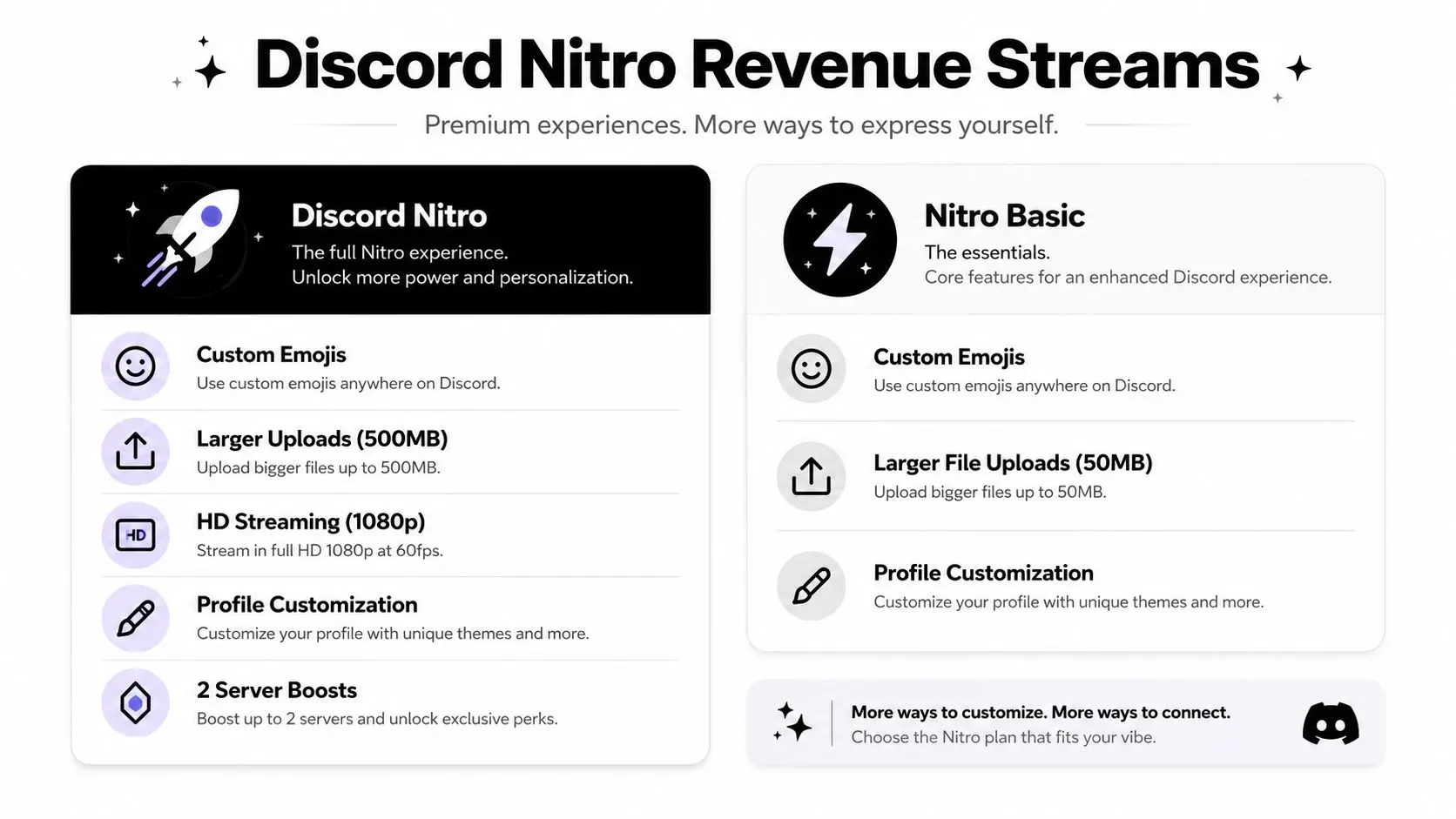
Nitro is the centre of Discord's monetisation model. It's the premium layer that turns a free communication platform into a paid product for power users, creators, and communities that need better media tools. In the UK, Discord Nitro is priced at £9.99 per month, and it provides 4K video and 500MB upload limits, according to City Index's overview of Discord's IPO context and monetisation. The same source states that Nitro generated an estimated $207 million globally in 2023, representing over 35% of Discord's total $575 million revenue that year.
Why Nitro sells
Nitro works because the features are concrete. Users don't need a hard sell to understand why larger uploads, higher-quality video, profile customisation, and better expression tools matter. If you stream gameplay, review motion work, share edits, move creative assets, or run community events, the upgrade is obvious. That's especially relevant for creative and technical teams.
- •Media sharing: A 500MB upload limit is materially more useful than the free tier's smaller cap when teams are passing around previews, assets, and revisions.
- •Video quality: 4K video matters for creators and communities where visual fidelity affects the experience.
- •Identity features: Custom emojis, animated avatars, and profile customisation sound cosmetic, but they reinforce belonging. In community products, identity is retention.
What Nitro tells us about Discord's strategy
Nitro is a good example of product-led monetisation. Discord doesn't wall off the whole experience. It leaves the core platform open, then charges for enhancements that heavy users can justify. That approach tends to work best when the paid features line up with real use cases. Discord has done that well. A gamer values better streaming. A creator values larger file transfers. A community leader values status and expression. A production team values fewer friction points.
Nitro isn't selling abstract premium membership. It's selling smoother participation.
The trade-off for brands and producers
There's also a strategic lesson here. Discord users are accustomed to paying for utility, not paying to avoid annoyance. That means premium experiences on the platform need to feel additive. If you're building a branded server, a fan community, or an interactive launch environment, the benchmark isn't “is this visible?” It's “does this improve the experience enough that people care?” Discord trained its audience to respond to practical upgrades. The same logic applies to branded activations.
Secondary Revenue Streams Server Boosts And More
Server Boosts matter because they turn community quality into a paid product. Nitro monetises the individual account. Boosts monetise the shared environment, which is a very different signal for anyone studying Discord's business model. According to this analysis of Discord's broader monetisation mix, Server Boosts cost £4.99 per month in the UK and enable 256-bit audio plus higher video bitrates. The same source says Boosts accounted for about 28% of Discord's revenue in 2024, and that UK gaming and animation servers showed 42% higher adoption than the global average. That matters for operators, not just fans. A boosted server is easier to use for live feedback, watch parties, team reviews, creator drop-ins, and community events where audio and video quality affect the experience. For studios, labels, publishers, and brand teams, that creates a practical lesson. If the server delivers ongoing value, members will often pay to improve the space itself.
Why the secondary layer matters strategically
This part of the model shows how Discord captures revenue without crowding the product with traditional ads. Users spend when they want better participation, stronger identity, or closer access to creators and communities they already care about. That keeps the commercial exchange aligned with the product experience. It also creates a higher bar for branded community design. A server that acts like a broadcast channel usually stalls. A server that helps people collaborate, attend events, get early access, or join interactive sessions has a clearer path to boosts, subscriptions, and other paid layers.
A quick view of the secondary layer
| Revenue stream | How it works | Why it matters |
|---|---|---|
| Server Boosts | Members pay to improve a server's capabilities | Best suited to active communities where media quality and live participation matter |
| Server Subscriptions | Creators offer paid access inside their server | Gives creators a native way to sell membership, gated content, and closer access |
| Commerce inside community | Developers and creators can turn engaged servers into a sales channel | Works best when trust, repeat participation, and clear value already exist |
The trade-off is straightforward. These revenue streams depend on community health. If conversation is thin, events are inconsistent, or the value proposition is vague, members have little reason to spend. Discord's secondary monetisation works best in servers with a defined job to do. That is why Discord is useful to study for teams building their own monetisation mix. The strongest models on community platforms usually tie payment to utility, access, or participation. Studio Liddell's guide to mobile app monetization models and where each one fits is a helpful comparison point if you are deciding what kind of paid layer makes sense for your own product or fan community. For XR activations, game launches, and creator-led communities, the practical takeaway is simple. Treat the server as part venue, part product, and part loyalty system. Discord makes money from users who want a better shared experience, and that is a useful benchmark for any brand trying to build something people return to rather than merely notice.
The New Frontier Sponsored Quests and Partnerships
Discord's most interesting shift is its move into opt-in promotional formats. Consequently, the answer to how does Discord make money starts to change. It's still user-funded at the core, but it's no longer purely subscription-led. In the UK, Discord's 2024 launch of Server Subscriptions, where creators keep 90%, and opt-in Quests has been underreported, according to Startupbooted's review of Discord's emerging revenue products. The same source states that only about 8% of creators in the UK use Server Subscriptions and that UK Quests generated about £12M ($15M) in sponsor revenue in 2024.

Why Quests feel different from normal ads
Traditional social advertising interrupts. Discord's Quests are designed to reward participation. Users complete an action tied to a title, stream, or experience and receive an in-platform or in-game benefit. That changes the psychology. For brands and publishers, this is an important distinction. The platform isn't inviting standard banner logic into the room. It's asking partners to build campaigns that users choose to engage with.
The closer a campaign gets to a task, reward, or shared event, the more it fits Discord's culture.
The opportunity for UK creators and studios
The underuse of Server Subscriptions in the UK is the practical opening. If only a small share of creators are using the format, there's room for organisations that can package access well. That could mean gated behind-the-scenes content, paid community channels, supporter tiers, or learning environments. For studios, XR teams, and game marketers, Quests suggest a different kind of activation model:
- •Launch support: Use quests around demos, streams, or milestones.
- •Community progression: Reward members for participation, not just for viewing.
- •Creator collaboration: Build programmes that help community leaders monetise without turning the server into an ad board.
The key discipline is restraint. Discord users will tolerate commerce when it feels earned, optional, and relevant. They'll resist campaigns that import feed-era ad habits.
The Business Model Under The Microscope
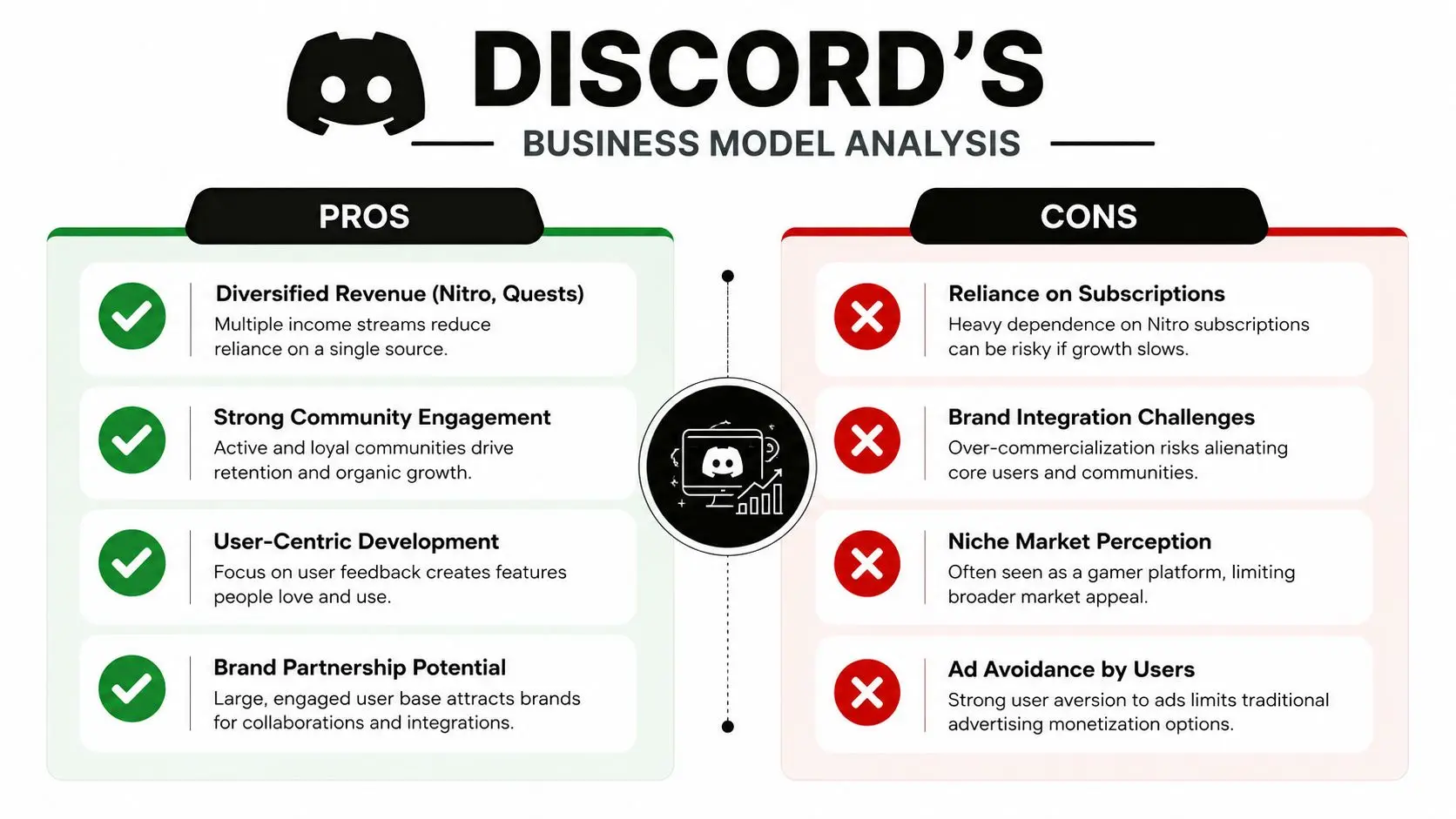
Discord's model is attractive because it protects community quality better than many ad-heavy systems. It's also fragile in ways that matter to operators, investors, and anyone building on the platform. According to Goldbuzz's discussion of Discord's UK revenue tension, Discord has historically lost money despite strong global revenue, and its UK user base is heavily skewed toward free users, with only about 3% to 5% paying for Nitro. The same source argues this creates a structural deficit in the UK market, especially alongside GDPR-related compliance costs.
Where the model is strong
Discord's strengths are practical, not theoretical.
- •Trust: A platform that hasn't historically centred itself on monetising user data starts from a stronger trust position.
- •Engagement quality: Communities gather around shared activity, not passive feed consumption.
- •Brand safety through structure: Servers, roles, moderation, and gated spaces give organisers more control than open social channels often do.
That combination is why Discord can be such a strong home for fandom, gaming, technical communities, and creator ecosystems.
Where the model gets harder
The weakness is concentration. A relatively small paying segment supports a very large free user base. That can work, but it leaves less room for error than an ad machine with broad monetisation per user. Here's the tension in simple terms:
| Advantage | Cost |
|---|---|
| Cleaner user experience | Lower revenue extraction per user |
| Higher perceived authenticity | Greater dependence on premium conversion |
| Community-led monetisation | Slower scaling than broad ad inventory |
Operational takeaway: Discord's business works best when premium features, creator commerce, and brand participation all feel native to community behaviour. The moment monetisation starts to feel imposed, the platform risks weakening the thing users came for.
The UK profitability gap matters here because it shows that global scale doesn't automatically guarantee regional sustainability. Compliance costs, local user behaviour, and monetisation mix all affect the outcome. For brands, that means Discord is best viewed as a high-quality environment with selective commercial pathways, not an infinitely scalable ad channel.
What Discord's Model Means For Your Studio Or Brand
Discord reaches a huge audience, but the practical value for brands is narrower and more interesting. It gives studios, rights holders, and community teams a place to build repeat interaction with people who choose to show up. That changes how you should measure success. Member retention, event participation, creator activity, and feedback quality matter more than raw reach. For a studio or brand, the opportunity is not "being on Discord." The opportunity is building a community layer that supports launch, live ops, customer insight, and commerce without breaking trust. That matters even more for games, media properties, and XR projects where the product improves when fans can gather, test, react, and contribute over time.
Five practical ways to use Discord well
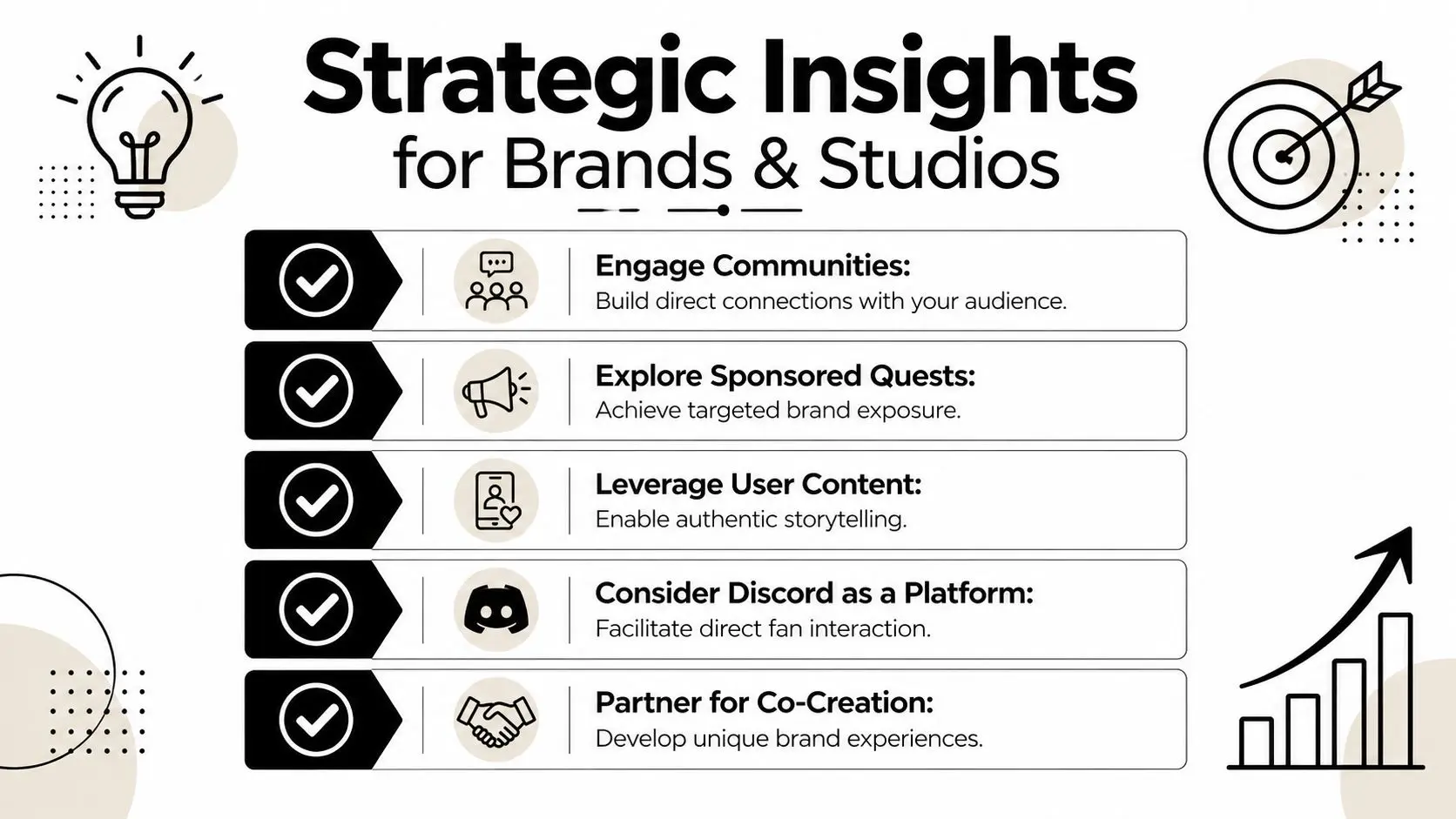
- •Build around repeat behaviour: Set up channels, roles, and rituals that give members a reason to return each week. Q&As, office hours, playtests, drops, and live watch-alongs usually outperform one-way announcement channels.
- •Treat access as a product decision: Early looks, gated rooms, premium roles, and subscriber perks need a clear value exchange. If the benefit feels thin, users will ignore it.
- •Use promotion carefully: Discord users respond better to opt-in activity than interruption. Sponsored activations, creator events, and reward-based participation fit the platform better than standard campaign thinking.
- •Plan for operations, not just hype: Moderation, channel architecture, onboarding, and event cadence determine whether a server stays useful after launch week.
- •Design for interactive formats: Voice, streaming, stage events, and role-based access make Discord a practical layer for multiplayer communities, fandom programmes, and XR activations that need live participation.
The commercial implication is straightforward. Discord's model rewards teams that can create ongoing value inside the community itself. Revenue can come from subscriptions, gated access, commerce, or sponsored participation, but only if the server already feels active and worth joining. If the community is weak, monetisation tools do not fix the problem. They expose it. That is why Discord works best inside a broader ecosystem. Content strategy, community design, and activation planning need to connect from the start. Studio Liddell's perspective on strategic content planning for modern user acquisition is relevant here because acquisition without retention usually produces a large server with low participation. I advise clients to treat Discord as a retained channel, not a campaign endpoint. Used well, it can support fandom growth, creator programmes, closed testing, premium memberships, and interactive experiences around a game, show, or branded world. Used poorly, it turns into a quiet server full of announcements nobody reads.