Hiring Mobile Application Developers in the UK: A Complete Guide
Before you even _think_ about searching for mobile application developers in uk, you need to pause. The most common mistake I see is people rushing to get quotes without a crystal-clear vision for their app. It’s a surefire recipe for blown budgets, missed deadlines, and a final product that looks nothing like what you imagined.
Defining Your App Vision Before Starting The Search

Before a single line of code is written, and certainly before you approach an agency, you need to nail down your project brief. Think of this as the architectural blueprint for your app. It’s more than a technical checklist; it’s the story of the problem your app solves, who it’s for, and why anyone should care. A detailed brief is your best tool. It allows potential developers to give you sharp, accurate quotes and realistic timelines. It also signals that you’re a serious partner who has done their homework, which is exactly how you attract top-tier talent.
Articulating Your App's Core Purpose
Let’s start with the basics. What is the single most important thing your app will do? Forget features for a moment and focus on the core value. Are you building a productivity tool, a community platform, or an entertainment app?
A clear purpose acts as your north star throughout the development process. When faced with difficult decisions about features or design, you can always return to the question: "Does this support our core purpose?"
For example, if your app's purpose is to "help busy parents find local, child-friendly activities," then every feature has to serve that mission. A complicated sign-up process would be a roadblock, but a simple, map-based search would be absolutely essential.
Pinpointing Your Target Audience
So, who are you building this for? "Everyone" is never the right answer. Getting specific with a detailed user persona helps you and your development team make smarter decisions about everything from the user interface (UI) to the overall user experience (UX). Think about these points when defining your audience:
- •Demographics: What’s their age range, where do they live, and how tech-savvy are they? An app for millennials in London will feel completely different to one designed for retirees in rural Scotland.
- •Pain Points: What problem are they struggling with right now that your app solves? How are they currently dealing with it, and why isn’t that good enough?
- •User Goals: When they open your app, what do they need to achieve, and how quickly can you help them do it?
Separating Must-Haves From Nice-to-Haves
One of the biggest project killers in app development is scope creep, that slow, gradual addition of features that weren't in the original plan. To avoid this, you need a prioritised feature list. A brilliant way to do this is with the MoSCoW method:
- •Must-Haves: These are the non-negotiable, core features. Without them, the app simply doesn't work or achieve its main purpose. Your Minimum Viable Product (MVP) will be built from this list.
- •Should-Haves: These are important features that add significant value but aren't critical for the initial launch.
- •Could-Haves: Desirable extras that would be great to include if time and budget allow. Think of these as candidates for version 2.0.
- •Won't-Haves: Features you’ve explicitly decided to leave out of the first release to maintain focus.
Lastly, as you shape your vision, you absolutely must consider your mobile app monetization strategies from the get-go. Will your app be free with ads, freemium, subscription-based, or a one-off purchase? This decision will fundamentally shape the design and feature set, ensuring your project is built on a commercially viable foundation from day one.
How to Find Top App Development Talent Across the UK

Alright, you’ve got a solid brief in hand. Now comes the exciting part: finding the right team to bring your vision to life. The UK’s tech scene is buzzing with talent, but the best partners aren’t always hiding in plain sight. Knowing where to look is half the battle. The landscape is huge, stretching from solo freelancers to boutique agencies and massive development houses. The best fit for you will really depend on your project’s scale, budget, and how hands-on you want to be.
Looking Beyond London
It’s easy to think of London as the be-all and end-all of UK tech, but you’d be missing a trick by only looking there. Some of the most exciting hubs for mobile application developers in UK are in cities that blend innovation with a more manageable cost of living. Seriously consider widening your search to these hotspots:
- •Manchester: A powerhouse in the digital and creative industries. You’ll find a deep pool of seasoned app developers and agencies here.
- •Bristol: This city is a magnet for creative tech and high-tech outfits, fostering a really collaborative and forward-thinking developer community.
- •Edinburgh: Scotland’s capital is booming, especially in fintech and data science, which means there’s a strong base of highly skilled developers.
Exploring these regions can uncover some absolute gems, agencies with incredible expertise that might offer more competitive rates than their London equivalents.
Navigating Online Platforms and Directories
Online platforms are a great starting point for finding and comparing potential partners. But they all work a bit differently, so it pays to know what each one is good for. Sites like Clutch, GoodFirms, and Toptal give you curated lists of agencies and freelancers, complete with client reviews and portfolios. They’re brilliant for building an initial shortlist and let you filter by location, skills, and budget, which saves a ton of time upfront.
A word of caution: while reviews are useful, they only tell part of the story. Use these platforms for discovery, but always, always follow up with your own digging to check their claims and get a feel for their culture.
The UK's app development scene is massive, with 15,282 businesses in the game. It’s a healthy, growing market, with revenues hitting an estimated £32.3 billion after growing at a rate of 10.9% per year for the last five years. That level of competition means you have plenty of quality options to choose from. Learn more about the UK's thriving app market statistics. For a more detailed look at the best places to search, check out our guide on the top 7 platforms for finding the best app development agencies in the UK.
The Power of Direct Outreach and Networking
Sometimes, the perfect partner isn’t listed on a directory at all. A bit of direct, targeted outreach can connect you with incredible developers who just aren’t on your radar yet. This is where LinkedIn becomes your best friend. You can search for developers with specific skills, like Swift for iOS or Kotlin for Android, or find the tech leads at agencies behind apps you personally admire. A thoughtful, personalised message about your project can open doors that a generic job post never will. And don’t forget the value of getting out there. Attending tech conferences or local developer meetups in places like Manchester or Bristol puts you face-to-face with the people who do the work. It’s a great way to gauge their passion and expertise in a way that you just can't in a formal interview. Building these connections is how you find candidates with the exact experience your app needs.
Getting a Real Look at Their Technical Skills and Portfolio
You’ve got your shortlist. Now the real work begins. It's time to dig deeper than the slick case studies and glowing five-star reviews to figure out if these mobile application developers in the UK can actually walk the walk. This is all about confirming their claimed expertise matches up with tangible, high-quality work. Think of a portfolio as more than just a gallery of screenshots; it should tell a story. When you’re looking at a project, you want to see a clear narrative. A top-tier developer or agency won’t just show you the finished app. They’ll explain the business problem they were hired to solve, the key decisions they made along the way, and the actual, measurable results they delivered.
Looking Beyond the Pretty Pictures
Don't let yourself be dazzled by a beautiful design. An app that looks great but constantly crashes or is a nightmare to navigate is, frankly, a failure. You need to get into the nitty-gritty of their past projects to understand their process and how they think strategically. As you review their work, ask yourself a few key questions:
- •Problem & Solution: Can they clearly describe the client’s original challenge and how the app they built was the specific solution? If they're vague, that's a red flag.
- •Results & Metrics: Did the app actually work? Look for hard numbers, user growth, engagement stats, revenue bumps, or efficiency gains. "The client was happy" doesn't count.
- •Technical Complexity: What were the biggest technical hurdles they had to jump over? This gives you a real insight into their problem-solving skills and whether they can handle complex integrations.
A great case study doesn’t just show you _what_ was built, but _why_ it was built that way. It should make you feel confident that the developer thinks like a business partner, not just a coder, focusing on real outcomes.
Checking Their Core Technical Chops
The performance and future-proofing of your app depend entirely on the code it’s built on. It's vital to check their skills in the specific technologies your project needs. Even if you're not a tech expert, you can still ask smart questions to get a sense of their knowledge. For native apps, you’ll want to see strong experience with the modern standards: Swift for iOS and Kotlin for Android. A developer's fluency here is non-negotiable if you want a robust, maintainable application. Also, ask them about their approach to architecture. Do they use scalable patterns like MVVM (Model-View-ViewModel) or VIPER? A well-architected app is far easier to update and scale as your user base grows. Bad architecture, on the other hand, just builds up technical debt that can cripple your project later on. It's also worth asking if they have any experience with modern tools for app development automation, as this can seriously speed up development and get you to market faster.
Spotting Genuine Advanced Tech Skills
Many app ideas today go beyond standard features. If your vision involves augmented reality (AR), real-time 3D, or complex AI integrations, you need a team with proven, specialised experience. This is an area where a lot of agencies tend to over-promise. For anything involving immersive experiences, look for specific projects using game engines like Unity or Unreal Engine. These are incredibly powerful for creating interactive 3D content, but they require a completely different skill set from traditional app development. Ask for concrete examples where they have:
- •Integrated a Unity or Unreal project inside a native mobile app.
- •Optimised real-time 3D models for smooth performance on phones.
- •Built AR features using ARKit (iOS) or ARCore (Android).
Be cautious of developers who talk about these technologies in fuzzy, high-level terms. Real experts can tell you about the specific challenges they ran into, like performance tuning, managing battery drain, and ensuring it worked on different devices, and exactly how they solved them. That’s the difference between textbook knowledge and battle-tested experience. To help you keep track of everything, we've put together a simple checklist to guide you through the evaluation process. It's a structured way to make sure you cover all the important bases before you make a decision.
Developer Evaluation Checklist
Use this table to systematically assess each potential partner, ensuring you don't miss any critical details.
| Evaluation Area | Key Questions to Ask | Red Flags to Watch For |
|---|---|---|
| Portfolio Depth | Can you walk me through a project similar to ours? What were the key challenges and how did you solve them? | The portfolio only shows simple, template-based apps with no clear business objectives or results. |
| Technical Stack | What is your experience with Swift/Kotlin and modern architectural patterns like MVVM? | They primarily use older technologies (e.g., Objective-C) or cannot explain their architectural choices. |
| Advanced Features | Show me an example of a project where you integrated Unity/Unreal or a complex API. | They have no live examples of advanced features or discuss them only in theoretical terms. |
| Problem Solving | Describe a time a project went off-track. What did you do to get it back on course? | They blame the client for issues or cannot articulate a structured approach to problem-solving. |
Going through these checks gives you a much clearer picture of a developer's true capabilities, helping you find a partner who can not only build your app but build it right.
Decoding App Development Pricing and Timelines
Let's talk about the two biggest hurdles for any app project: money and time. Getting a solid grip on the financial side of things is non-negotiable. It helps you set realistic expectations, negotiate with confidence, and make sure your project stays on track without any nasty last-minute surprises. If you're looking to hire mobile application developers in UK, getting this right from the very start is absolutely paramount. The UK's mobile app scene isn't just busy; it's booming. In 2024 alone, the industry pulled in around £11.1 billion. That number speaks volumes about the sheer demand for quality mobile apps across every single sector. And it’s not slowing down. Projections show the market is set to grow at a compound annual growth rate (CAGR) of 14.85% over the next ten years, rocketing towards an incredible £50.9 billion. You can dig deeper into these UK mobile app development growth trends on 5star-designers.co.uk. This chart really brings that growth to life, showing just how much the UK mobile app market is expected to expand between now and 2034.
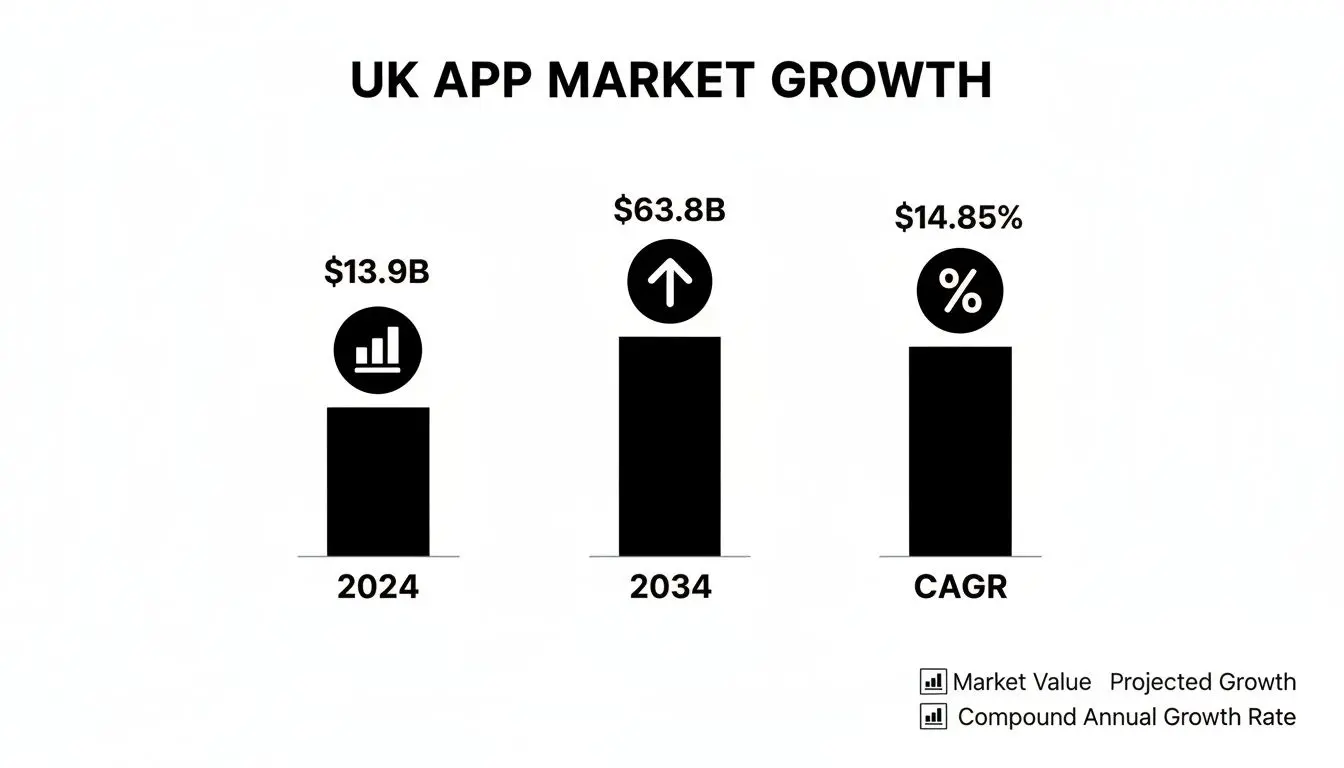
It’s clear that investing in high-quality app development isn't just a good idea, it's a strategic move for businesses aiming to stay relevant and competitive.
Common Pricing Models Explained
Once you start getting quotes, you'll likely run into three main ways agencies structure their pricing. Each has its place, and the best fit really boils down to how well-defined and complex your project is.
- •Fixed-Price: Perfect for projects where you know _exactly_ what you want, down to the last detail. You agree on one price for the whole job upfront. It’s brilliant for budget certainty but can be rigid if you need to make changes along the way.
- •Time & Materials (T&M): This is where you pay for the actual hours the team puts in. It's the go-to model for bigger, more complex projects where the scope might shift or evolve. You get maximum flexibility, but you’ll need to keep a close eye on the budget.
- •Retainer: Think of this as having a development team on subscription. You pay a set monthly fee for a guaranteed block of their time. This works best for ongoing work after launch, like rolling out new features, fixing bugs, and making continuous improvements.
Choosing the right model is a strategic decision. A fixed price works for a simple MVP, while T&M is better suited for an ambitious platform with evolving features like XR or AI integration.
Realistic Timelines for Different App Types
How long will it take? The honest answer is: it depends. Timelines can vary wildly based on an app's complexity. A polished, market-ready app is a serious undertaking, and trying to rush the process is often a recipe for a buggy, poor-quality product. Here are some ballpark figures to give you an idea:
- •Simple MVP (Minimum Viable Product): 3-5 months. This is your core concept with just enough features to test the waters with real users. Think basic functionality and a clean UI/UX.
- •Medium Complexity App: 6-9 months. Now we're talking about custom UI, integrating third-party services (like payment gateways or social media logins), and more advanced functionality.
- •Complex, Feature-Rich App: 10+ months. This is the realm of enterprise-level platforms, apps with real-time 3D rendering in Unity or Unreal Engine, or projects needing a hefty backend infrastructure.
Of course, these are just guides. The actual timeline will be influenced by the size of the team, the tech they're using, and how quickly you can provide feedback. For a more detailed breakdown, have a look at our complete guide to app development in the UK from concept to launch.
Uncovering the Hidden Costs of App Development
Your budget doesn't end when the app goes live. This is a classic rookie mistake. Many first-time app owners get caught out by the ongoing costs needed to keep an app running smoothly, securely, and up-to-date. Make sure you factor these into your financial plan from day one:
- •Ongoing Maintenance: This covers everything from fixing bugs and tweaking performance to making sure the app works flawlessly on new devices as they're released.
- •Server and Hosting Fees: Your app's backend and user data have to live somewhere. This means recurring monthly or annual costs for servers.
- •Mandatory OS Updates: Apple and Google roll out major operating system updates every year. Your app will need to be updated to stay compatible, and that requires developer time.
- •Third-Party Service Subscriptions: Does your app use services for analytics, push notifications, or maps? Many of these come with their own subscription fees.
Nailing the Interview to Find True Experts
The portfolio and initial checks are just the warm-up act; the interview is the main event. This is your chance to look past the polished case studies and see if the developer's skills on paper hold up in the real world. A great interview reveals not just _what_ they know, but _how_ they think, solve problems, and communicate under pressure. This isn't about asking "tell me about yourself." It's about deploying a strategic mix of technical, behavioural, and process-based questions to get a complete picture of who you might be partnering with. For any business aiming to hire the best mobile application developers in UK, getting this stage right is absolutely critical.
Go Beyond Textbook Technical Questions
Anyone can memorise definitions. What you need is someone who can apply concepts when it really matters. So, move away from simple "what is X?" questions and start using scenario-based challenges that test their problem-solving instincts. Here are a few examples that reveal a much deeper level of understanding:
- •"Imagine you've spotted a significant memory leak in our iOS/Android app. Walk me through your process for diagnosing and fixing it. What tools are you reaching for first?" This immediately shows you their practical debugging skills and whether they're familiar with essential tools like Instruments (for iOS) or Android Profiler.
- •"We need to build a new feature that syncs data in real-time across multiple devices. What architectures and tech would you consider, and what are the trade-offs of your preferred approach?" This probes their knowledge of scalable architecture, APIs, and concepts like WebSockets, pushing them to justify their choices.
- •"How would you make sure our app's UI stays buttery smooth, even when it’s crunching large datasets or running complex animations on an older phone?" This question gets right to the heart of performance optimisation, a non-negotiable skill for a great user experience.
These questions don't have a single "right" answer. You're listening for a logical thought process, an awareness of different options, and the ability to articulate _why_ they'd make certain technical decisions.
See How They Handle Real-World Hurdles
Technical brilliance is only half the story. You also need a partner who can communicate clearly, collaborate with your team, and navigate the inevitable bumps in the road. Behavioural questions are your best tool for uncovering these crucial soft skills. Try digging into their experience with questions like these:
- •"Tell me about a time you had a major disagreement with a project manager or client about a feature. How did you handle it, and what was the result?"
- •"Describe a project that started to fall behind schedule. What specific steps did you take to get it back on track?"
- •"Walk me through how you’d approach working with a messy, poorly documented legacy codebase. What’s your process for making sense of it?"
Their answers will tell you a lot about their communication style, how they manage conflict, and whether they take ownership when things get tough. You want to see people who focus on collaborative solutions, not on pointing fingers.
What to Ask When Interviewing an Agency
When you're interviewing an agency, your focus needs to broaden slightly to include their team dynamics, communication, and project management workflows.
An agency partnership lives or dies by its process. A team with a well-defined, transparent workflow is far more likely to deliver on time and on budget than a disorganised one, no matter how talented their individual developers are.
Make sure you ask about their preferred project management style, whether it’s Agile, Scrum, or Kanban. A team that embraces an Agile approach, for example, will involve you in regular "sprints" and feedback loops, perfect for projects that need to evolve. Key questions to ask an agency include:
- •"Who will be my day-to-day point of contact, and what's your standard frequency for updates?"
- •"How do you handle scope changes or new feature requests once the project is underway?"
- •"What tools do you use for project management and client communication (e.g., Jira, Slack, Asana)?"
Getting a feel for their internal processes is vital. For more on this, our article on how to choose an app development service dives deeper into what separates a good agency partner from a great one. Finally, think about giving them a practical code review. Instead of a generic brain teaser, provide a small, self-contained problem that’s relevant to your project. Asking them to talk you through their solution is a fair and respectful way to see their code quality, structure, and problem-solving approach in action. It gives you a genuine insight into the quality of work you can expect.
Securing Your Project with a Strong Development Contract

You’ve sifted through portfolios, grilled the candidates, and finally found the right development partner. Great. But don’t rush to the finish line just yet. This last part, getting a solid contract in place, is absolutely critical. A well-drafted development agreement isn't just a piece of paper; it’s the bedrock of your project, protecting your idea, your budget, and your business. This legal document is where you and your developer get on the same page about what’s being built, who’s responsible for what, and when everything is due. Without it, you're building on a foundation of handshakes and hope, a very risky place to be when serious money is involved.
Defining Deliverables and Acceptance Criteria
Avoid vague phrases like "the app needs to be finished." This is a recipe for disaster. Your contract must spell out precisely what ‘done’ looks like. This is where acceptance criteria become your best friend, a simple, clear checklist of what must be true for a feature or milestone to be signed off. For every stage of the build, get specific:
- •Functionality: "The user can successfully purchase an item using a debit card through the Stripe payment gateway."
- •Performance: "The home screen must fully load within 2 seconds on a standard UK 4G connection."
- •Compatibility: "The app must operate without visual or functional bugs on the two most recent versions of both iOS and Android."
This approach removes all the guesswork and subjectivity. The work either meets the standard, or it doesn't. It also gives you a clear, objective system for releasing payments, which should be tied directly to hitting these pre-agreed milestones.
Protecting Your Intellectual Property
Pay close attention here, because this is the single most important clause in the entire document. You must ensure that you, the client, own 100% of the Intellectual Property (IP). That means everything: the source code, the UI/UX designs, the databases, and any other assets created specifically for your project.
Without a crystal-clear IP ownership clause, the developer could legally own the code they wrote for you. They could reuse it, sell it, or stop you from taking it to another developer down the line. This is a deal-breaker.
Make sure the agreement explicitly states that all IP is "assigned" to your company once payment is made. It’s also wise to include a Non-Disclosure Agreement (NDA), either within the main contract or as a separate document signed before any detailed discussions begin. This binds the developer legally to keep your big idea and business plans under wraps.
Warranties and Post-Launch Support
What happens if a show-stopping bug surfaces a week after you’ve launched? A good contract plans for this. It should include a warranty period, typically 30 to 90 days, where the developer is on the hook to fix any defects in the code they delivered, at no extra cost to you. This covers you for any immediate teething problems. But what about six months from now? For long-term peace of mind, the contract should also outline the options for ongoing support and maintenance. This might be a monthly retainer for proactive updates or a simple hourly rate for ad-hoc work. Getting this sorted now means you have a clear plan for keeping your app running smoothly long after the launch party.
Common Questions About Hiring App Developers
When you start looking to hire mobile application developers in the UK, a few key questions always pop up. Getting clear answers to these early on can make the whole process smoother and give your project the best chance of success. Let's start with the big one: cost. How much does it actually cost to build an app? The honest answer is, it varies wildly depending on what you need. A straightforward Minimum Viable Product (MVP) to test your idea could start anywhere from £25,000 to £50,000. If you're building something more complex with a bespoke UI and multiple API integrations, you're more likely looking at £75,000 to £150,000+, especially if it involves advanced tech like real-time 3D or AR. Another major decision is _who_ to hire. You've generally got three paths: freelancers, a local agency, or an offshore team. Each has its own set of trade-offs.
- •Freelancers: Great for flexibility and often a lower upfront cost. They're ideal for smaller, well-defined tasks, but you might find they lack the broad skillset of a full team.
- •UK Agencies: You get the complete package, designers, developers, testers, and project managers, all under one roof. Communication is seamless, and they have an instinctual grasp of the local market. This comprehensive service naturally comes at a premium.
- •Offshore Teams: The lower cost can be very appealing. However, be prepared for potential hurdles like significant time zone differences, communication barriers, and challenges in ensuring consistent quality control.
How Long Does App Development Take?
Timelines are just as critical as the budget. And just like cost, the duration is tied directly to the app's complexity. A basic MVP can often be turned around in 3-5 months from the initial concept to launch day. For a more sophisticated application with a complex backend and several third-party integrations, a timeline of 6-9 months (or even longer) is more realistic. It's also vital to remember the hidden extras, things like user testing, feedback loops, and the app store approval process can easily add several weeks to your schedule.
Ultimately, choosing the right development partner is a balancing act between your budget, your timeline, and the level of hands-on collaboration you need. For complex, business-critical projects where clear communication and impeccable quality are non-negotiable, a UK-based agency is often the most reliable way forward.
At Studio Liddell, we bring years of experience to the table, creating high-quality, engaging applications and digital experiences that deliver results. Find out how our expert team can bring your vision to life by exploring our services at https://studioliddell.com.