Hiring a Mobile App Developer UK: Your 2026 Guide to Success
So, you've got a brilliant idea for an app. That's the exciting part. Now comes the real work: finding the right people in the UK to build it. Getting this step right is the difference between a successful launch and a project that drains your budget and goes nowhere.
Finding the Right UK Mobile App Developer
Your success hinges on moving from a raw idea to a concrete plan _before_ you even think about hiring someone. You need to know what you're building, who it's for, and what your non-negotiables are.

When you start looking for a developer in the UK, you’re stepping into a massive and growing industry. The UK’s app development market is set to become a £32.3 billion powerhouse by 2026. This boom is great news because it means the UK is absolutely brimming with world-class talent. The bad news? The sheer number of freelancers, agencies, and studios can feel overwhelming if you don’t have a clear strategy.
Your Critical First Steps
Before you even open a search browser, you need to get your own house in order. This foundational work is what separates the serious projects from the wishful thinkers. It will save you an incredible amount of time, money, and frustration. Get clear on these three core questions:
- •What is the app's core purpose? What is the single biggest problem your app solves for a user? Nail this down.
- •Who is your target audience? Be specific. "Everyone" is not an audience. Are they busy professionals, students, parents, tradespeople? This focus will guide every design and feature decision.
- •What is the must-have feature set? This is your Minimum Viable Product (MVP). What are the absolute essentials your app needs to function and provide value on day one?
Answering these turns your vague idea into a workable project brief. If you want to connect with pre-vetted talent efficiently, working with a specialist mobile staffing agency can be a smart shortcut.
Your project brief is your single most important document. A vague idea leads to vague quotes and a high risk of project failure. A detailed brief attracts serious, professional developers who can provide accurate estimates.
Understanding Your Development Path
The technical approach you choose has a huge impact on your budget, timeline, and what you can do with the app down the road. While we'll dive into the tech stack later, it helps to have a high-level overview of your main options from the get-go. This basic knowledge helps you ask the right questions when you start talking to potential partners. If you're looking for a deeper comparison of your options, check out our guide on the top platforms for finding app development agencies in the UK. To help orient your decision, here’s a quick comparison of the main development routes.
Initial Development Paths at a Glance
| Approach | Best For | Typical UK Cost | Speed to Market |
|---|---|---|---|
| Native (iOS/Android) | Performance-critical apps, complex features, best user experience. | High | Slower |
| Cross-Platform | Reaching both iOS & Android users with a single codebase, budget efficiency. | Medium | Faster |
| Progressive Web App (PWA) | Simple functionality, discoverability via web, no app store needed. | Low | Fastest |
Having this initial context allows you to start your search with a clearer vision and more realistic expectations. It’s the first step towards finding a partner who can truly bring your mobile app to life in the UK market.
Defining Your App's Scope and Technical Needs
So, you have a brilliant idea for an app. That's fantastic, but an idea is just the starting line. To turn that spark into a real, successful product, you need a rock-solid plan. This plan, what we in the industry call the project scope, is your single most important tool. It’s what you’ll use to get accurate quotes from a UK mobile app developer and, crucially, to avoid the dreaded ‘scope creep’, that slow trickle of changes that can sink your budget and schedule.

Think of your scope document as the architectural blueprint for your app. Without it, you're building on guesswork. A clear scope gets you and your development partner on the same page about exactly what's being built, why it's being built, and how every piece of it should work.
Start with a Minimum Viable Product (MVP)
It’s tempting to throw every feature you’ve ever dreamt of into the first version. Resist that urge. The most successful apps nearly always start small by defining a Minimum Viable Product (MVP). This is the leanest, most stripped-back version of your app that solves one core problem for your ideal customer. Why launch an MVP first?
- •You get to market much faster. Start building a user base and generating buzz while your competitors are still planning.
- •You gather invaluable user feedback. Instead of spending a fortune on features you _think_ users want, you learn from their actual behaviour.
- •You control your initial investment. Building a focused product is dramatically more cost-effective and less risky.
Your MVP brief needs to map out your core user flows. Think step-by-step: what journey does a user take from opening the app to getting what they came for? For every step in that journey, list out the essential features required to make it happen.
Choosing Your Technical Foundation
Once you've nailed your MVP, your next big conversation with any mobile app developer in the UK will be about the technology stack. This isn't just geek-speak; it's a decision with huge consequences for your budget, performance, and ability to grow in the future. The UK app market is moving fast. We're seeing a huge rise in cross-platform frameworks like Flutter and React Native, which allow developers to use a single codebase for both iOS and Android. This approach can slash development costs by up to 30-40% and get your app into users' hands much quicker. At the same time, with pressures from GDPR, building privacy-first apps is non-negotiable, while new technologies are creating more opportunities for interactive tools like those we've developed for clients such as English Heritage and Merck. You can get a broader view of market trends over on IBISWorld.
The choice of tech stack is not just a technical detail; it’s a business decision. The right stack aligns with your budget, timeline, performance needs, and long-term vision.
Let's break down the main routes you can take.
Native vs. Cross-Platform vs. PWA
Knowing the pros and cons here will help you have a much more productive chat with potential developers. Native Development (iOS & Android) This is the traditional route: building two completely separate apps, one for Apple's iOS (using Swift) and one for Google's Android (using Kotlin).
- •The Good: You get the absolute best performance, the slickest user experience, and total access to device features like the camera or GPS. It feels 'right' on each phone.
- •The Bad: It's the most expensive and time-consuming option because you're paying to build and maintain two different products.
Cross-Platform Development (React Native, Flutter) This approach involves writing the code once and deploying it across both iOS and Android from that single codebase.
- •The Good: It's much kinder on the budget, gets you to market faster, and is simpler to maintain. It's a brilliant balance for most business apps.
- •The Bad: For incredibly complex animations or graphically heavy apps, you might see a slight performance drop compared to native.
Progressive Web Apps (PWAs) These are essentially websites that are supercharged to look and feel just like a mobile app. Users can even 'install' them on their home screen without ever visiting an app store.
- •The Good: No app store review process to worry about, you can update it instantly, and it’s accessible to anyone with a web browser and a URL.
- •The Bad: They have limited access to the phone's hardware and might not feel quite as buttery-smooth as a 'true' app.
And for the kind of highly immersive work we specialise in at Studio Liddell, like AR and VR experiences, the conversation often shifts to game engines. A project's entire production pipeline hangs on the choice between Unity or Unreal Engine, influencing everything from visual fidelity to the types of developers you need on your team.
Budgeting for App Development in the UK
Let's talk about the elephant in the room: money. Getting your budget wrong is the fastest way to kill a great app idea before it even gets off the ground. To get it right, you need a frank and honest view of what app development actually costs in the UK. This isn't just about the first build; it's about planning for the whole life of your app. Several things will directly shape the final price. The big ones are your app's complexity, the technology you choose (like native iOS/Android or cross-platform), and the experience of the UK mobile app developer you hire. It’s no surprise that a senior developer at a top London agency will have a different day rate than a junior freelancer based elsewhere. This planning is all happening in a market that's absolutely booming. By 2026, the UK app development scene is expected to hit a massive £32.3 billion, with forecasts pushing that to USD 36.29 billion by 2030. What's driving this? A huge part is e-commerce, making up 73% of retail activity, alongside explosive growth in gaming and productivity apps. We're looking at an estimated 8.5 billion downloads in 2025 alone. For businesses that find the right development partner, this growth represents a massive opportunity. You can explore more about these UK app development trends.
Understanding Cost Ranges and Timelines
To give you a better sense of the numbers, here are some typical project estimates based on how complex the app is. Of course, these are just ballpark figures, you'll only get a precise quote with a detailed project brief. But they're a vital starting point for your financial plans. Here’s a look at what you can generally expect.
UK App Development Cost & Timeline Estimates (2026)
This table outlines the typical cost and timeline ranges for app development projects in the UK, broken down by complexity.
| App Complexity | Estimated Cost (GBP) | Estimated Timeline |
|---|---|---|
| Simple (Basic features, single platform, minimal backend) | £25,000 - £50,000 | 2 - 4 Months |
| Mid-Range (Cross-platform, user accounts, API integrations) | £50,000 - £120,000 | 4 - 7 Months |
| Complex (Advanced features, multiple integrations, custom UI/UX) | £120,000+ | 7+ Months |
These figures generally cover the core phases of a professional project:
- •Discovery & Strategy: Deep-dive workshops to nail down goals, scope, and user journeys.
- •UI/UX Design: Crafting wireframes, mockups, and interactive prototypes.
- •Development & Coding: The actual build of the application.
- •Testing & QA: Hunting for bugs and making sure everything runs smoothly.
- •Deployment: Getting the app submitted to the Apple App Store and Google Play Store.
These estimates provide a solid foundation, but they don't tell the whole story.
Remember, the initial development cost is only part of the story. Failing to account for ongoing expenses is a common and costly mistake that can jeopardise your app's long-term viability and success.
Planning for Ongoing Costs
Getting your app launched is the starting line, not the finish. If you want your app to stay secure, work properly, and remain relevant, you have to budget for continuous support and maintenance. These aren't optional extras; they're essential for protecting your investment. Here are the main ongoing costs you need to plan for:
- •App Maintenance: A good rule of thumb is to budget around 15-20% of your initial development cost annually. This covers essentials like updating the app for new iOS and Android operating systems, fixing bugs that crop up after launch, and applying security patches.
- •Hosting & Backend Services: Your app's data has to live somewhere. This includes server costs, database management, and any subscriptions for third-party services like Stripe for payments or Google Maps for location features.
- •Marketing & User Acquisition: People won't find your app by magic. You’ll need a dedicated budget for marketing to attract new users and keep them coming back.
- •Future Feature Development: Once real users start giving feedback, you'll uncover fantastic opportunities for new features and improvements. This should be planned as a separate, ongoing development budget.
By baking these costs into your financial model from the very beginning, you give your app the resources it needs to succeed long after launch day. For a more detailed breakdown, check out our comprehensive app development pricing guide.
How to Find and Vet Your Development Partner
You’ve got a solid brief and a realistic budget. Now for the most critical part of the journey: finding your development partner. This isn’t just about hiring a coder; it's about choosing a strategic partner who will live and breathe your project and help guide it to a successful launch. Finding the right mobile app developer in the UK means taking a structured approach, starting with a wide search before narrowing it down with some serious vetting.
Where to Look for UK App Developers
The UK has a brilliant ecosystem of app development talent, but you need to know where to find them. Where you look will depend on the size of your project, your budget, and how hands-on you plan to be.
- •Agency Directories: Sites like Clutch, The Manifest, and GoodFirms are fantastic starting points. They offer verified client reviews, portfolios, and details on service focus, letting you quickly shortlist established UK agencies with a proven track record.
- •Freelance Marketplaces: For smaller, tightly-defined projects or when you just need an extra pair of hands for your in-house team, platforms like Upwork and Toptal are worth a look. Toptal, in particular, is known for its tough screening process, giving you access to top-tier freelance talent.
- •Your Own Network: Never underestimate the power of a good referral. Ask trusted business contacts for recommendations. If there's an app you particularly admire, find out who built it. Most agencies are proud of their work and will have it showcased on their site.
Once you have a shortlist of 3-5 potential partners, it’s time to start digging deeper.
The Vetting Checklist: What to Really Look For
Moving from a longlist to a shortlist means getting past the slick homepage and assessing their real-world experience, technical chops, and whether they’re a good fit for you long-term. When you're choosing a mobile app developer, solid third-party vendor risk management is non-negotiable for protecting your interests. Use this checklist to evaluate each candidate methodically:
- Portfolio Deep Dive: Look past the shiny visuals. Do they have concrete experience building apps with features like yours or in your industry? If you need complex API integrations, you should see clear examples of that in their past work.
- Client Testimonials & Case Studies: Are their testimonials specific? Vague praise like "they were great to work with" means very little. What you want is, "they helped us boost user engagement by 40%." Don't be afraid to ask if you can speak to one or two of their previous clients.
- Technical Expertise: Look at the tech stacks they favour. Do they align with what your project needs, whether that’s native iOS/Android, cross-platform with React Native, or something more specialised like Unity for immersive experiences? A good partner will explain _why_ they recommend a certain technology for your specific goals.
- Process & Communication: How do they actually run their projects? Ask about their approach to discovery, design, development, and testing. A transparent, collaborative process is a huge green flag for a professional and organised team.
A great portfolio shows what they've done. A great process shows how they'll do it for you. Prioritise partners who can clearly articulate their project management and communication workflows.
Creating a Request for Proposal (RFP)
If you want quotes you can actually compare, you have to ask everyone the same questions. An RFP standardises the information you get back, which makes your decision-making far more objective. Your RFP should include:- •Your detailed project brief and scope document.
- •Your estimated budget range and ideal timeline.
- •Specific questions about their team, process, and proposed technical approach.
- •A request for a high-level project plan and a detailed cost breakdown.
This whole process ensures you’re comparing apples with apples, not just a random assortment of pitches. This flowchart really brings home how project complexity is the main driver of cost and timeline, the very things an RFP is designed to clarify.
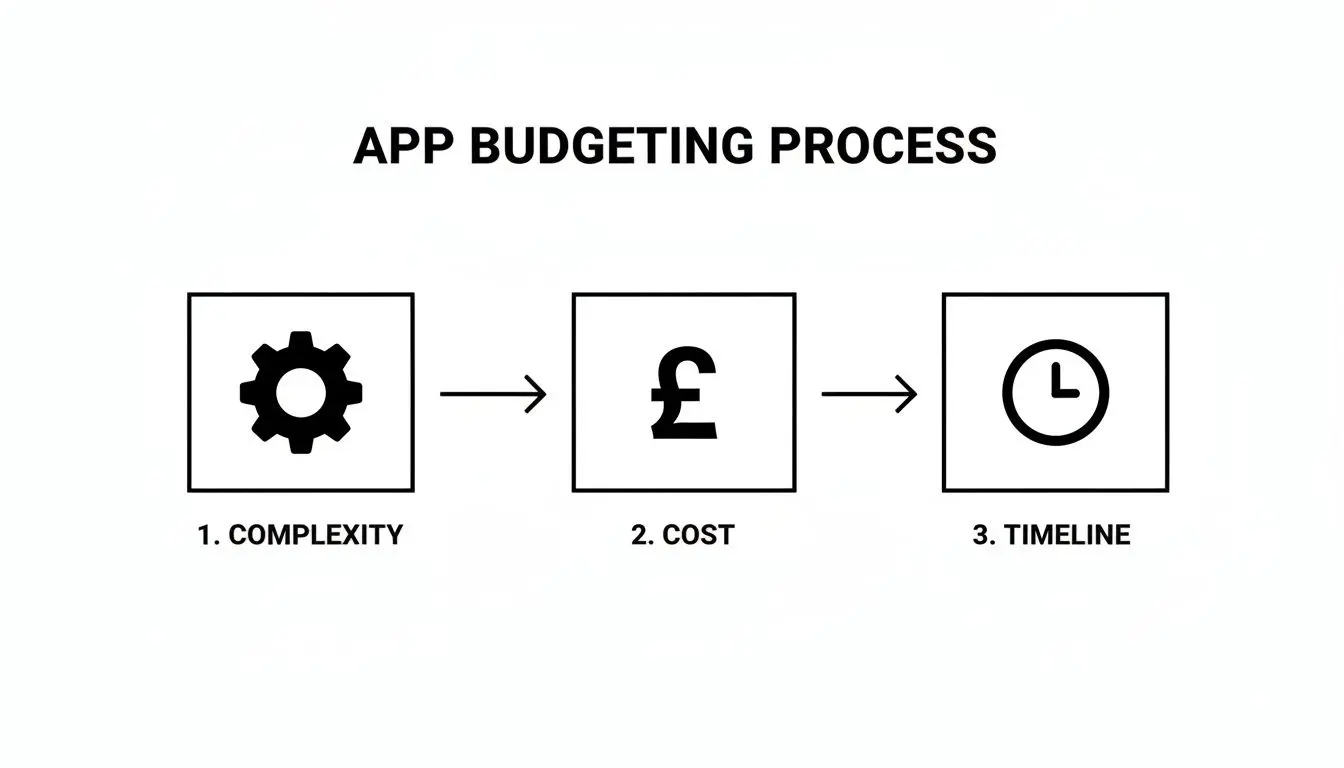
As you can see, the cost and timeline are a direct result of complexity, which is why a detailed brief is so essential for getting accurate proposals back.
Key Interview Questions to Ask
The final interview is your chance to get a feel for the people behind the proposal. Go beyond the technical questions and probe for problem-solving skills and cultural fit.
- •"Can you walk me through a time a project went off the rails and how your team got it back on track?"
- •"How do you handle client feedback, especially if it goes against your own technical recommendations?"
- •"Based on what you know so far, what do you see as the biggest risk in our project?"
Their answers will tell you far more about them as a potential partner than any simple coding test ever could. Finding the right mobile app developer in the UK isn't just about technical skill; it's about finding a team that's as invested in your success as you are.
Your Legal and Security Checklist
It’s easy to get caught up in the excitement of design and features, but overlooking the legal and security side of your app is a critical mistake. Get this wrong, and you risk exposing your intellectual property, breaking user trust, and facing some eye-watering legal and financial penalties. Let’s be clear: building a secure, legally compliant app isn’t a final-step task. It’s something a professional development partner will weave into the project from the very first conversation. It's how you protect your investment and build a product people will actually trust.
Protecting Your Intellectual Property
Before you spill the beans on your brilliant app idea, you need to protect it. The first step is always a Non-Disclosure Agreement (NDA). This is a simple but legally binding contract that stops a potential developer from sharing your confidential information. Never, ever get into the nitty-gritty of your app's unique selling points without one signed. Once you’ve chosen your partner, the next vital document is the development contract. Get this properly reviewed by a legal professional who knows tech. Pay special attention to these parts:
- •Intellectual Property (IP) Ownership: The contract must state, without any ambiguity, that you own 100% of the source code and all related IP once the final payment is made. Anything less is a massive red flag.
- •Payment Schedule: Payments should be tied to clear, tangible milestones. Think completion of the UI design, or delivery of the first testable version. This keeps everyone focused and protects your budget.
- •Termination Clause: This spells out the conditions for ending the agreement. It’s your safety net if the project goes completely off the rails or the relationship sours.
- •Warranties and Support: Define how long the developer will fix bugs for free after launch. A standard warranty is usually 30 to 90 days.
User Data Protection and UK GDPR
In the UK, handling user data isn't just good manners, it's the law. The UK General Data Protection Regulation (UK GDPR) is not to be trifled with. Getting it wrong can lead to hefty fines and destroy your app's reputation before it even gets going. From the very first design sketch, you have to think about what data you’re collecting, why you need it, and how you'll keep it safe.
Under UK GDPR, you are the 'data controller,' and your developer is the 'data processor.' This means you are ultimately responsible for ensuring all data is handled legally and securely, even if the developer is the one building the system.
This responsibility is a big deal. You need to work with your developer to bake "privacy by design" into the app. This means only collecting data you absolutely need (data minimisation) and ensuring the backend architecture is a fortress against breaches. For a deeper dive, have a read of our guide to essential security for apps. Your app also needs to present two key legal documents clearly to every user:
- •Privacy Policy: This tells users exactly what data you collect (like names, emails, or location), what you do with it, how long you keep it, and who you might share it with (e.g., analytics services). Transparency is everything.
- •Terms of Service (ToS): This is the official agreement between you and your users. It outlines the rules for using your app, what happens if they're broken, and protects your right to suspend accounts for misuse.
Getting the legal and security foundations right from day one is one of the smartest investments you can make. It’s the bedrock of any successful, trustworthy app.
Common Questions About Hiring App Developers
When you’re looking to bring a mobile app to life, it’s completely normal to have a list of questions as long as your arm. This is a serious investment of time and money, and the path isn't always clear. We've been in this game since 2019, and we tend to hear the same queries from founders and business leaders time and again. So, let's cut through the noise. Here are the most common questions we get, along with some straight-talking answers based on our experience.
What's the Difference Between Hiring Models?
One of the first forks in the road is deciding who you'll actually partner with to build your app. Each route, freelancer, agency, or in-house, caters to very different needs, budgets, and how hands-on you want to be.
- •Freelancer: Hiring a lone developer is perfect for small, tightly-defined tasks. Think of it as bringing in a specialist for a specific job. It's flexible, but be prepared to step into the project manager role yourself.
- •Agency: An agency, like us at Studio Liddell, gives you a full, managed team under one roof. You get designers, developers, testers, and a project manager who handles everything. This is the go-to for complex projects where you need a partner who can offer strategic guidance from start to finish and be held accountable for the result.
- •In-house Developer: Bringing someone onto the payroll is a long-term play. This makes sense for businesses that plan on continuous development and have the infrastructure for recruitment, salaries, and all the associated costs.
The right choice really boils down to whether you need a quick task done, a whole project delivered, or a permanent new member of your team.
Do I Really Own the Source Code?
Let’s be crystal clear: the answer to this must be yes. This is non-negotiable. However, you can't just assume it will happen. This ownership has to be explicitly written into your contract. Any reputable UK developer or agency will have no problem transferring 100% of the intellectual property (IP) and source code to you once the final invoice is settled.
Before you sign anything, hunt down the clause on IP ownership. If it's wishy-washy, confusing, or even hints that the developer keeps any rights to the code they're writing for you, that’s a massive red flag. You're paying them to create an asset for your business; you must own it outright.
Without complete ownership, you’re stuck. You can't update the app, switch developers, or sell your business without being tethered to the original creator. It's a huge business risk that's easily avoided.
How Much Does App Maintenance Cost in the UK?
Getting your app launched is a fantastic milestone, but it's the starting line, not the finish. To keep your app secure, functional, and live on the app stores, you absolutely must budget for ongoing maintenance. Ignoring it is like buying a brand-new car and skipping all its services, it’s only a matter of time before something goes wrong. A solid rule of thumb is to budget 15-20% of your initial development cost annually for maintenance. This fund typically keeps the lights on by covering:
- •Operating System Updates: Making sure your app doesn't break when a new version of iOS or Android rolls out.
- •Security Patches: Protecting your app and your users' data from new vulnerabilities.
- •Bug Fixes: Squashing any little gremlins that pop up after launch.
- •Minor Tweaks: Making small usability improvements based on user feedback.
Think of it as an insurance policy on your investment, ensuring your app continues to be a reliable, valuable asset.
Should I Build for iOS or Android First?
This is a classic question, and the answer always comes back to one thing: who are your users? Here in the UK, the market is pretty evenly split between iOS and Android, so there’s no universal "right" answer. You have to dig into your specific target audience. To help guide that decision, here’s a simple way to think about it:
| Platform | Best if Your Target Audience... | Key Consideration |
|---|---|---|
| iOS First | ...is younger, has a higher disposable income, or is heavily engaged in design-focused communities. | Users are generally more willing to pay for apps and in-app purchases. |
| Android First | ...is broader, more diverse demographically, or located outside major urban centres. | Android has a slightly larger global market share and offers more hardware variety. |
For many businesses, the most sensible and cost-effective route is actually cross-platform development. By using a framework like React Native or Flutter, a `mobile app developer uk` can build one codebase that runs beautifully on both iOS and Android. This lets you reach your entire audience from day one without doubling your budget, giving you the best of both worlds.
At Studio Liddell, we don't just build apps; we build digital experiences. Our heritage in animation and real-time development since 2019 gives us a unique perspective on creating engaging, high-performance applications. Whether you're extending a brand to a new platform or starting from scratch, our team provides the strategic and technical expertise to guide your project from concept to launch. Run a cross-platform ideation sprint with us today.