Your Guide to Hiring a Mobile App Developer in UK
Thinking about where to hire your mobile app developer? While the global talent pool is vast, there's a strong case for keeping it local. Partnering with a developer right here in the UK is about more than just convenience, it’s a strategic choice that can give your app a serious competitive edge. It all comes down to shared context. A local team lives and breathes the same culture as your users, meaning your app will feel right from day one.
Why Hiring in the UK Gives You a Competitive Edge

Choosing a development partner is one of the biggest calls you’ll make for your project. And while you can find talent anywhere, there are real, practical benefits to working with a UK-based team that you just can't get from an offshore partner. A UK developer gets the little things that make a big difference, the regional quirks, the humour, and what British consumers actually expect. This means you won’t waste time explaining subtle market details that a local team already understands instinctively. It closes the gap between an app that works and an app that connects. And let's be clear: the UK app industry is a powerhouse. It's not just a handful of studios; it's a thriving part of our economy. Take a look at the numbers. The UK app scene is more than just a niche market; it's a massive and growing opportunity for businesses ready to invest.
| UK App Market at a Glance 2026 | |
|---|---|
| Metric | Figure |
| Projected Market Revenue | £32.3 billion |
| UK Smartphone Penetration | Nearly 90% of the population |
These figures, drawn from sources like the IBISWorld report on app development, show just how much potential there is. When you have a massive, engaged audience that spends hours on their phones daily, you have the perfect environment for a successful app.
The Strategic Value of Local Collaboration
Beyond getting the culture right, there are some hard-nosed, practical reasons why hiring a mobile app developer in the UK is a smart move. These factors directly affect your project’s speed, security, and overall chance of success.
- •No More Weird Hours: Working in the same time zone is a game-changer. It means no more 10 PM calls or waiting overnight for an answer to a simple question. Problems get solved in real-time, feedback is instant, and your project keeps moving forward.
- •Built-in GDPR & Data Know-How: UK developers live and breathe GDPR and UK data protection laws. This isn’t just an item on a checklist; it's baked into their process. Getting it wrong can mean huge fines and a loss of user trust, so having a partner who builds compliance in from the start is priceless.
A UK-based team doesn't just build your app, they build it for a UK audience. This deep-seated understanding of local market dynamics and regulatory standards is a powerful asset that offshore teams often struggle to replicate.
When you put it all together, you get an app that's not only technically sound but also perfectly tuned for success right here at home.
Translating Your Vision Into a Winning App Brief
Before you even start looking for a mobile app developer in the UK, you need to get your idea out of your head and down on paper. A vague concept like "an app for local communities" is a fast track to disaster, leading to endless scope creep, blown budgets, and a final product nobody is happy with. Every successful project we've worked on started with a crystal-clear brief. This document becomes your project's north star. It’s what you'll use to attract the right development partners and make sure everyone is working towards the same goals from day one. It forces you to answer the hard questions early, saving you a world of pain, time, and money later on.
Defining Your Minimum Viable Product
First things first: focus only on what's absolutely essential. This is your Minimum Viable Product (MVP), the leanest version of your app that solves one core problem for your target user, and solves it well. It’s easy to get carried away dreaming up dozens of features, but a successful launch is about nailing one thing perfectly. Ask yourself: what is the single most important action a user must be able to perform? Everything else is just noise, at least for version one. This disciplined approach stops your project from becoming a bloated, unfocused mess. For a food delivery app, the MVP isn't about loyalty schemes or social sharing. It’s about three simple things:
- •A user can browse local restaurants.
- •A user can place an order.
- •The restaurant receives that order.
That's it. Everything else can be added later, guided by what real users are actually asking for.
Crafting User Stories to Map the Journey
With your MVP defined, it’s time to bring it to life with user stories. These are just simple sentences that describe a feature from your user's point of view. They follow a brilliant, straightforward format: "As a [type of user], I want to [perform an action] so that I can [achieve a goal]."
A well-crafted brief isn't just a list of features; it's a story about how people will interact with your product. User stories ensure that the development team understands the why behind every feature, leading to a more intuitive and user-centric final app.
Let's imagine a hypothetical fitness app to see how this works in practice:
- •As a new user, I want to create an account with my email so that I can save my workout progress.
- •As a logged-in user, I want to browse a library of workout videos so that I can find one that suits my fitness level.
- •As an active user, I want to mark a workout as complete so that I can track my weekly activity.
These stories create a shared language between you and your developer. They turn abstract ideas into concrete tasks that a team can actually estimate and build. For more detailed guidance, check out our complete guide to app development in the UK, which dives deeper into this process. Putting in the effort to create a thorough brief is the single best investment you can make in your app's success.
Choosing the Right Tech Stack for Your App
Once you’ve got a solid brief, the next big conversation with any potential UK mobile app developer will be about technology. This isn't just a technical detail; it's a core strategic choice that will shape your budget, timeline, and how well your app performs down the line. The good news is you don’t need to be a software engineer to get your head around the options. A good development partner will walk you through it, but knowing the landscape helps you ask the right questions and make a call that actually fits your business goals. The technology you pick dictates everything, from how fast the app can be built to the kind of experience your users will have. This flowchart shows how your initial brief starts to guide those first big project decisions.
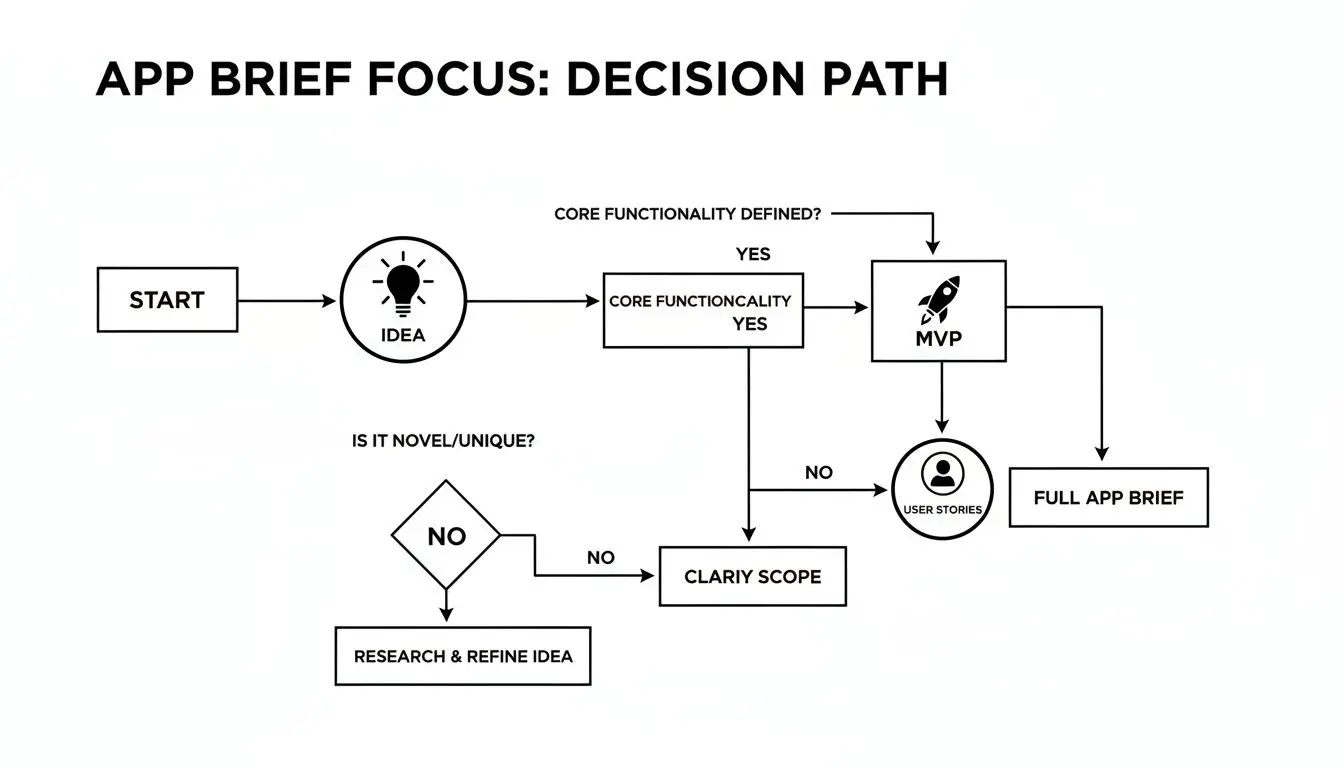
As you can see, a clear idea sharpens into a focused MVP and detailed user stories, which really form the foundation of your app.
Native vs Cross-Platform Development
The first fundamental choice is whether to build natively for iOS and Android separately or to use a cross-platform framework that covers both at once.
- •Native Apps (Swift for iOS, Kotlin for Android): This means creating two distinct apps using the official programming language for each operating system. The payoff? You get the best possible performance, flawless integration with device hardware (like cameras and GPS), and a UI that feels perfectly at home on an iPhone or an Android device.
- •Cross-Platform Apps (React Native, Flutter): Frameworks like these let developers write the code once and deploy it across both iOS and Android. This can seriously reduce development time and cost, which makes it a fantastic option for getting an MVP out the door or for apps that don't need intense graphical power.
So, which is right for you? It really depends on the project. If you're building a straightforward content-delivery app, going cross-platform is incredibly efficient. But for an app that needs buttery-smooth animations or has to access complex device hardware, native is almost always the better path.
When Game Engines Enter the Picture
Sometimes, even the best traditional app frameworks just won't cut it. This is where powerful game engines like Unity and Unreal Engine come in, offering capabilities that go far beyond standard app development.
These aren't just for games. For any project demanding high-fidelity 3D visuals, complex physics, or immersive virtual or augmented reality experiences, Unity and Unreal are the go-to tools. They provide the raw power needed for advanced training simulations, architectural visualisations, and interactive product configurators.
For instance, at Studio Liddell, we use these engines to build everything from award-winning VR short films like Aurora to complex technical training simulations for industrial clients. This specialised expertise is vital for projects that aim to do more than just present information, they need to truly immerse the user. This diverse UK mobile application market is set for some serious growth, projected to reach USD 32,860 million by 2030. While the Apple Store currently holds a majority of the revenue share, the Google Store is the fastest-growing segment, showing just how important it is for developers to have a versatile strategy. You can learn more about these trends from Grand View Research's market analysis.
How to Vet Partners and Evaluate Their Portfolios
A slick website is no substitute for proven capability. When you start looking for a mobile app developer in UK, you'll come across plenty of agencies with polished homepages. Your job is to dig deeper and find out who has the actual skill to bring your vision to life, which means learning how to critically evaluate their work beyond just looking at pretty screenshots. Think of their portfolio as an evidence locker, not a photo album. You aren't just glancing at the final product; you're looking for proof of the journey. A portfolio that only shows off shiny app store images is a bit of a red flag. What you really want to see are comprehensive case studies that break down the entire process from start to finish.
Look for Depth and Relevance
As you review a developer’s past projects, your main goal is to match their experience with your specific needs. Are you building an e-commerce app? Then you absolutely need to see they have a track record of building apps with secure payment gateways, inventory management, and a seamless checkout process. It's also worth looking for variety in their work. A portfolio that shows a range of technical skills across different industries is a strong signal of an adaptable and experienced team.
A great portfolio tells a story of problem-solving. A case study showing a 50% increase in user engagement or a successful integration with a complex legacy system is far more telling than a simple project description. It demonstrates that the developer doesn't just build features, they deliver business results.
Ask the Right Questions
Once you have a shortlist of potential partners, it’s time to start asking insightful questions that go beyond the surface. These questions are designed to uncover their real-world problem-solving skills and creative execution. Here is a checklist of what to ask when you're discussing a specific project from their portfolio:
- •What was the original brief and what were the key business goals?
- •What was the single biggest technical challenge you faced on this project, and how did you overcome it?
- •How did you measure the project's success against the initial goals?
- •Can you walk me through the decision-making process for the tech stack you chose?
- •Who on your current team worked on this project?
This line of questioning helps you distinguish a team with genuine, hands-on experience from one that just talks a good game. It moves the conversation from what they can do to what they have done. For more advice on this, check out our guide on how to choose an app development service. For a comprehensive guide covering the entire process, including sourcing and interviewing, you can also refer to this proven playbook for hiring remote developers.
Getting The Paperwork Right: Costs and Contracts

This is where things get serious. A well-drafted contract isn't just a formality, it’s the foundation of your entire project. It protects you and your chosen mobile app developer in UK from crossed wires and mismatched expectations later on. Think of it as the blueprint for your partnership. It does far more than just name a price; it clearly defines what gets delivered, when payments are due, and how you’ll handle any bumps in the road. Nailing this part is absolutely critical for a smooth ride.
Fixed-Price vs. Time and Materials
One of the first big decisions is how you’ll structure the payment. There’s no single “best” way; it all comes down to how well-defined your project is from the start.
- •Fixed-Price Contracts: This is your best bet if you have a rock-solid, incredibly detailed brief where the scope is set in stone. You agree on a single, total cost for the whole project, which gives you complete budget certainty from day one.
- •Time and Materials (T&M) Contracts: If your project is more complex or you expect it to evolve, T&M is the way to go. You pay an agreed-upon hourly or daily rate for the work done. This gives you the flexibility to pivot, iterate, and adapt as you get user feedback or new ideas emerge.
For a straightforward MVP with a clear list of features, a fixed-price deal often makes sense. But for bigger, more ambitious projects that involve research, experimentation, or user testing, a T&M model usually fosters a much more collaborative and realistic partnership.
What Your Development Contract Must Include
Let’s get down to brass tacks. Your contract needs to be watertight, leaving absolutely no room for interpretation. Beyond the pricing model, make sure these clauses are in there and crystal clear:
- •Detailed Deliverables: A precise checklist of every single feature, screen, and function.
- •Payment Milestones: A clear payment schedule tied directly to completing specific project stages.
- •Intellectual Property (IP) Ownership: A crucial clause confirming that you, the client, will own all the final code and design assets once the final payment is made.
- •Testing and Acceptance: How will the app be tested, and what are the specific criteria that define a "finished" and accepted piece of work?
- •Post-Launch Support & Maintenance: What level of support is included for bug fixes and OS updates after your app is live, and what are the associated costs?
A classic mistake is getting the IP ownership clause wrong. You'll own the final product, but the developer often retains the rights to their own pre-existing code libraries they use to build it. Your contract must explicitly grant you a perpetual, royalty-free licence to use any of that underlying code that’s essential for your app to function.
To help you get a handle on what your app might cost, we've put together a rough guide. These figures can give you a starting point for building a realistic budget and assessing the quotes you receive.
Sample App Development Cost Estimates in the UK (2026)
This table gives a general overview of estimated costs for different app complexities, which can help you budget more effectively for your project.
| App Complexity | Estimated Cost Range (£) | Typical Timeline |
|---|---|---|
| Simple App | £25,000 - £45,000 | 2, 4 months |
| Medium App | £45,000 - £120,000 | 4, 9 months |
| Complex App | £120,000+ | 9+ months |
Remember, these are just ballpark figures. The final cost will always depend on your specific feature set, the technology used, and the team you hire. For a more granular look at what goes into these numbers, check out our in-depth guide on how much app development costs in the UK. Ultimately, a strong budget and an even stronger contract are the two best tools you have to protect your investment and set your project up for success.
The Final Handshake: Your Pre-Launch Checklist & Red Flags
You’re on the home straight. Before you commit and sign with a mobile app developer in the UK, it’s worth running through one last check. Nailing these details now isn't just about ticking boxes; it’s about laying the groundwork for a transparent, professional partnership where everyone is on the same page. Think of it as agreeing on the rules of engagement. A little bit of admin at this stage can prevent a mountain of headaches and miscommunication down the line. It ensures everyone knows who to talk to, how you'll track progress, and what "done" actually looks like.
Your Pre-Launch Engagement Checklist
Before any code gets written, make sure you and your development partner have a clear understanding on these points:
- •Key Contacts: Who is the main point of contact on your side and theirs? You need one person with the authority to give final sign-off and a dedicated contact for any technical questions.
- •Communication Channels: Decide on your tools. Will day-to-day chat happen on Slack, with formal approvals via email? Will you be tracking tasks and progress in a tool like Jira or Asana?
- •Meeting Rhythm: Agree on a regular schedule for check-ins. A weekly or bi-weekly call is pretty standard to see what’s been done, tackle any roadblocks, and look ahead to the next sprint.
- •Project Management Flow: How do they actually manage their work? A professional studio will have a well-oiled process for moving tasks from a backlog, into development, and through to completion.
Critical Red Flags to Watch For
Even if the portfolio looks fantastic and the contract seems solid, some warning signs can pop up late in the process. Keep your wits about you during these final discussions. These issues often point to deeper problems that could completely derail your project later on.
Poor communication is the number one predictor of project failure. If a potential partner is slow to respond, vague in their answers, or disorganised before they’ve even won your business, imagine what they’ll be like when a real problem arises.
Here are a few definite warning signs you can't afford to ignore:
- •Vague Contract Terms: If the clauses around IP ownership, payment milestones, or specific deliverables feel fuzzy, push for absolute clarity. Any reputable developer will provide a watertight contract that protects both parties.
- •Portfolio Mismatches: You ask a detailed question about a project in their portfolio, and the person you’re speaking to draws a blank. This can be a huge red flag that the key talent who actually did that work has since left the company.
- •Resistance to a Phased Approach: Be wary of any developer pushing for one enormous, all-or-nothing project. A partner who is genuinely invested in your success will almost always recommend starting with an MVP to test the waters, not just chase the biggest possible first invoice.
Frequently Asked Questions
When you're looking to hire a mobile app developer in the UK, a few common questions always pop up. Here are some straight answers based on our years of experience in the industry.
How Long Does It Take to Develop an App?
This is the classic "how long is a piece of string?" question. The timeline hinges entirely on what you want the app to do. A lean Minimum Viable Product (MVP) with just the core, essential features can often be turned around in 3, 4 months. If you’re looking for something more advanced with backend integrations, third-party APIs, and a completely custom UI, you’re probably looking at a 6, 9 month project. For large-scale enterprise platforms or complex games with heavy animation and logic, it's not unusual for development to take over a year.
Who Owns the Intellectual Property?
This is a big one, and you need to get it right. As the client paying for the work, you should own the final Intellectual Property (IP). However, this isn't automatic, it must be spelled out clearly in your contract. Most development agencies, including us, use pre-existing code, libraries, and internal tools to build projects more efficiently. We retain the rights to that foundational code but grant you a permanent licence to use it as part of your final product. Always, always clarify IP ownership before you sign anything.
What Are Ongoing Costs After Launch?
Getting your app onto the store is a huge milestone, but it’s far from the end of the journey. You'll need to budget for the running costs that keep your app alive and well. These typically include:
- •Server hosting and database management.
- •Subscriptions for third-party services (like payment gateways or mapping APIs).
- •Regular maintenance to fix bugs and adapt to new OS updates from Apple and Google.
- •Future development for new features you want to add.
As a solid rule of thumb, plan to budget around 15, 20% of the initial development cost each year just for maintenance.
For more general hiring advice and resources, you can also find helpful information on Hire-Sense's homepage.
Ready to turn your app idea into a reality with a trusted UK partner? Studio Liddell has been delivering high-quality digital productions since 2019. Book a production scoping call