Does TV Advertising Work in 2026? the Evidence-Based Guide
UK evidence says TV advertising can increase campaign effectiveness by 40%, and one major UK profit study found TV delivers an average £5.61 profit ROI for every £1 spent. So yes, TV advertising works, but the strongest case for it in 2026 isn't reach alone. It's profit. That answer still surprises many executive teams because most media discussions remain trapped in a false short-term frame. TV is often judged against channels that report immediate clicks, same-day conversions, and tidy dashboard attribution. But UK evidence points to a different economic reality. TV's value often appears later, across delayed sales, stronger overall profit, and broader market impact that isn't visible if you only measure the first few weeks. The more useful question isn't, does TV advertising work. It's whether your measurement model is built to capture what TV does.
The Profit Evidence Behind TV Advertising
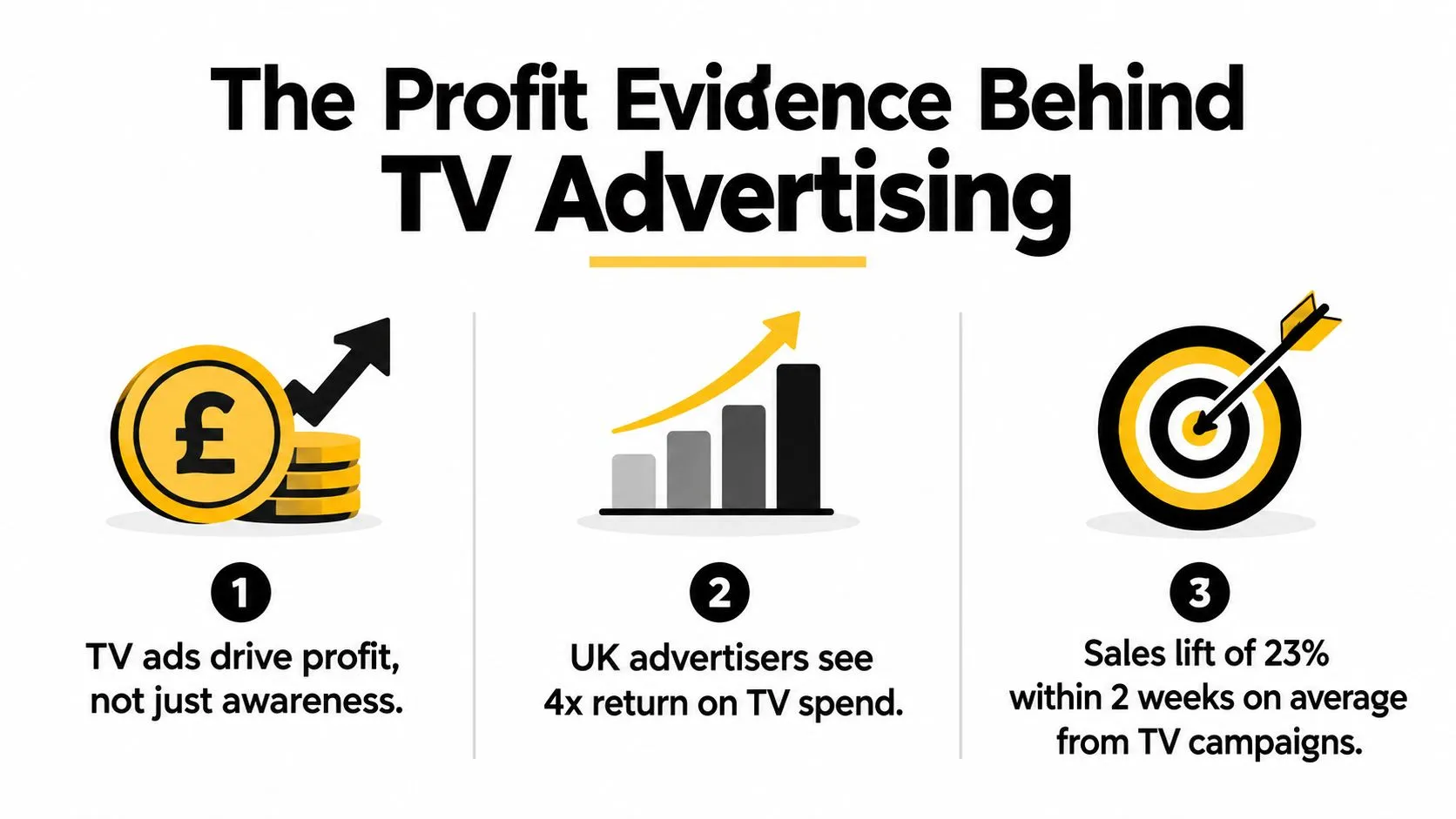
The cleanest way to assess TV is to start where finance teams start. Profit, not impressions. A 2024 UK study summarised by Marketing Beat found that TV delivered 54.7% of all advertising-generated profit while taking 43.6% of total advertising investment, and generated an average full-profit ROI of £5.61 for every £1 spent on TV advertising. The same study found that 58% of advertising's total profit generation occurred after the first 13 weeks. That matters because it shifts TV out of the "awareness cost" bucket and into the "long-tail profit engine" category (UK TV profit analysis).
What the ROI numbers actually mean
A separate UK analysis using Ebiquity and Gain Theory's Profit Ability framework found that TV generated 71% of total advertising-generated profit over a three-year window, with an average profit ROI of £4.20 for every £1 spent. It also found that 86% of TV campaigns remained profitable after three years (three-year TV profit evidence). Those aren't vanity metrics. They suggest two practical conclusions.
- •TV pays back over time: If your board reviews channels only on immediate return, TV will often look weaker than it really is.
- •TV keeps working after the media burst ends: Profitability that holds across years points to durable brand and demand effects, not just one-off response spikes.
- •TV deserves a finance-grade evaluation: Channels that create delayed profit shouldn't be judged with same-week conversion logic alone.
Practical rule: If your attribution window ends too early, TV can look expensive precisely when it's actually compounding value.
Why the lag matters more than most marketers admit
The underappreciated issue isn't whether TV drives response. It's that much of TV's commercial impact lands after the reporting window that many businesses use by default. Thinkbox's UK Profit Ability findings, summarised in a UK trends report, reinforce this point. TV accounted for 54.7% of all advertising-generated profit with an average full-profit ROI of £5.61 per £1 spent, while a separate UK advertising analysis in the same source showed profit ROI rising from £1.87 within 13 weeks to £4.11 over two years (UK trends in TV profitability). That pattern changes how executives should think about media planning. TV isn't just a launch mechanic. It's often a delayed multiplier.
| Measure | What it suggests |
|---|---|
| Early profit window | TV can look modest if judged too soon |
| Longer profit window | TV's contribution becomes materially larger |
| Multi-year profitability | TV often behaves like a brand-growth asset, not just a short-response channel |
A sceptical CFO doesn't need another argument about "brand love". They need evidence that TV can create attributable business value over time. On the UK evidence, it can.
Why TV and Digital Are Not Competing Channels
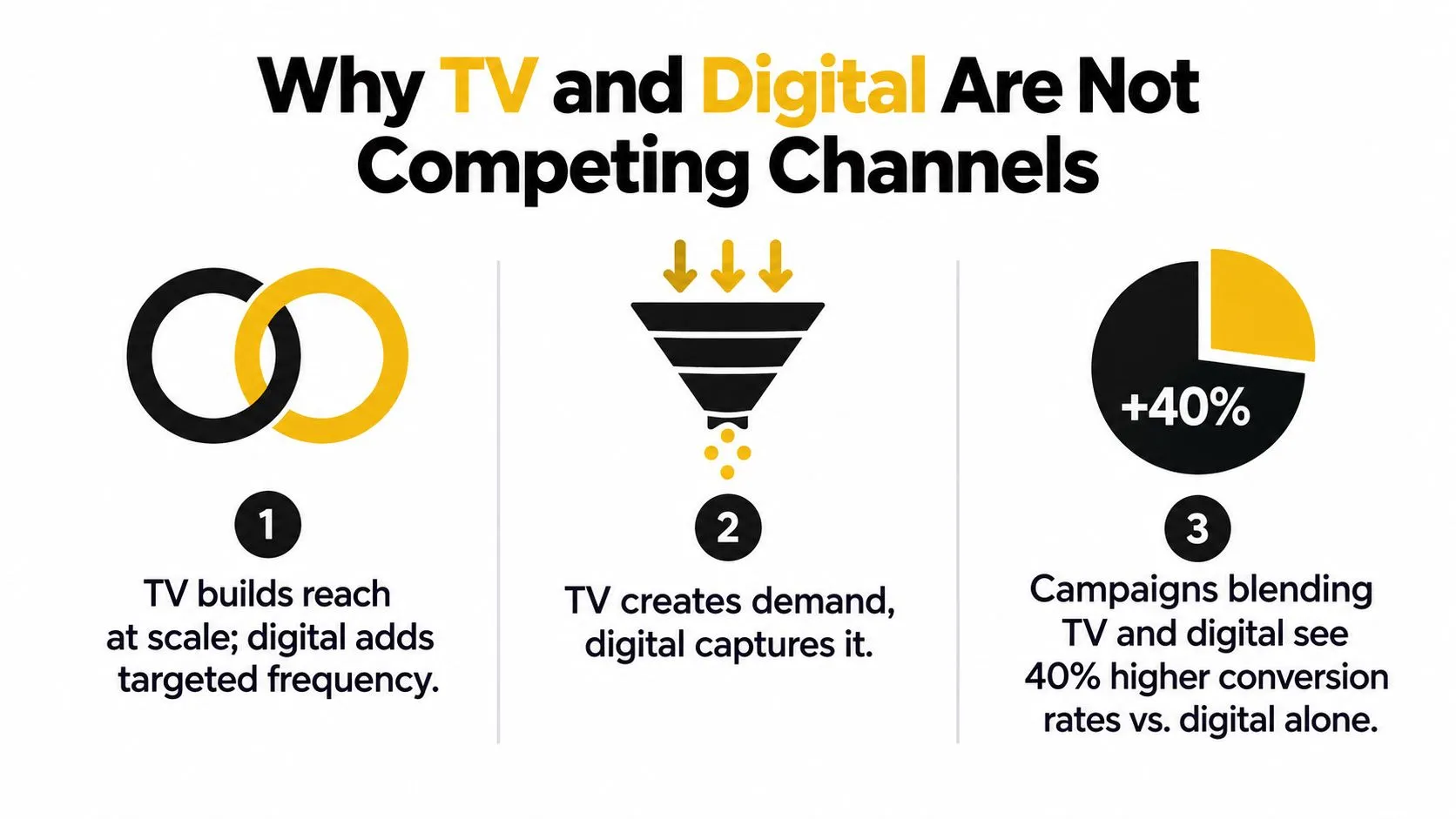
The TV versus digital debate usually starts in the wrong place. It assumes both channels are trying to do the same job. They aren't. TV is typically strongest when a business needs broad demand creation, category presence, credibility, and memory at scale. Digital is typically strongest when a prospect is already close enough to act, search, compare, click, or convert. When leaders force a winner-takes-all choice between them, they often end up overfunding capture and underfunding creation.
Different jobs in the same growth system
A practical way to think about this is to separate channels by role.
| Channel type | Primary job | Typical strength |
|---|---|---|
| TV | Create demand | Reach, salience, trust, memory |
| Paid search | Capture existing intent | High-intent conversion |
| Paid social and online video | Reinforce and retarget | Frequency, audience refinement |
| Site and landing pages | Convert demand | Action, lead capture, sales |
This is also why many modern growth teams are moving toward a broader revenue model rather than evaluating channels in isolation. If you want a useful framework for that commercial view, Crescade's revenue engine marketing guide is worth reading because it treats channels as coordinated parts of one system rather than rival line items.
Why false comparisons produce bad budget decisions
When marketers compare TV and digital only by direct last-click outcomes, digital usually wins on paper. But that's often because digital platforms capture intent that another channel helped create.
TV often creates the demand that search and paid social later collect.
That doesn't make digital less valuable. It makes digital measurement incomplete when viewed on its own. A good example of this wider commercial thinking appears in advice around creator and video monetisation strategy, where businesses need to understand how one channel can strengthen another rather than asking each platform to perform every role alone. Studio teams dealing with monetised content ecosystems often face the same challenge, which is why this perspective on unlocking advertising revenue on YouTube is relevant beyond YouTube itself. For senior decision-makers, the implication is straightforward:
- •Use TV when you need scale: It's built for broad market presence.
- •Use digital when you need capture: It turns active intent into measurable action.
- •Judge them together: question is whether the combined system grows revenue more effectively than either channel on its own.
A media mix isn't efficient because every channel does the same thing cheaply. It's efficient because each channel does a different job well.
Debunking the Awareness Myth
The most persistent misunderstanding in boardrooms is that TV is useful for awareness but weak on commercial outcomes. UK evidence doesn't support that simplification. Parliamentary evidence from the Institute of Practitioners in Advertising found that TV advertising increases campaign effectiveness by 40%, more than any other medium, and that the effect strengthened over time. During 1980 to 1996, adding TV produced an average 12% increase in business effects, rising to 40% during 2008 to 2016. The same evidence reported an average 2.6% market share point gain per year when TV advertising was used (UK parliamentary evidence on TV effectiveness).

Those findings matter because they push TV out of the soft-metrics category. Campaign effectiveness and market share aren't awareness proxies. They're business outcomes.
Awareness is only the visible surface
TV certainly builds recognition. But that's the first-order effect, not the whole effect. When TV changes memory structures across a broad audience, it can alter what buyers notice later, what they search for, what they trust, and what they choose when purchase timing arrives. Some of that value shows up quickly. Some of it appears much later. That's exactly why narrow attribution models understate it. Three implications follow from the UK evidence:
- •TV can change market position: Market share movement is a hard commercial outcome.
- •TV's contribution has improved, not faded: The historical uplift data suggests TV remained potent even as the media environment changed.
- •TV should be assessed beyond recall studies: If a board still files TV under "brand only", it's using an outdated planning model.
The real myth is about timing
Another version of the awareness myth says TV may influence perception, but not enough to justify current costs unless sales move immediately. That argument collapses when you look at delayed return.
If a channel creates profit after the reporting window closes, the problem isn't the channel. It's the reporting window.
Many teams make a strategic error. They compare TV against channels designed for instant feedback, then conclude TV is underperforming because it doesn't compress all value into the first burst of measurement. The smarter test is whether TV creates outcomes your business can feel later in the P&L, not just in the first dashboard review. The earlier evidence on lagged profit strongly suggests that it does. For sceptical executives, this is the key reset. TV isn't just an awareness tax you pay before performance channels do the work. In many cases, TV is one of the forces making later performance possible.
Total TV and the Modern Measurement Landscape
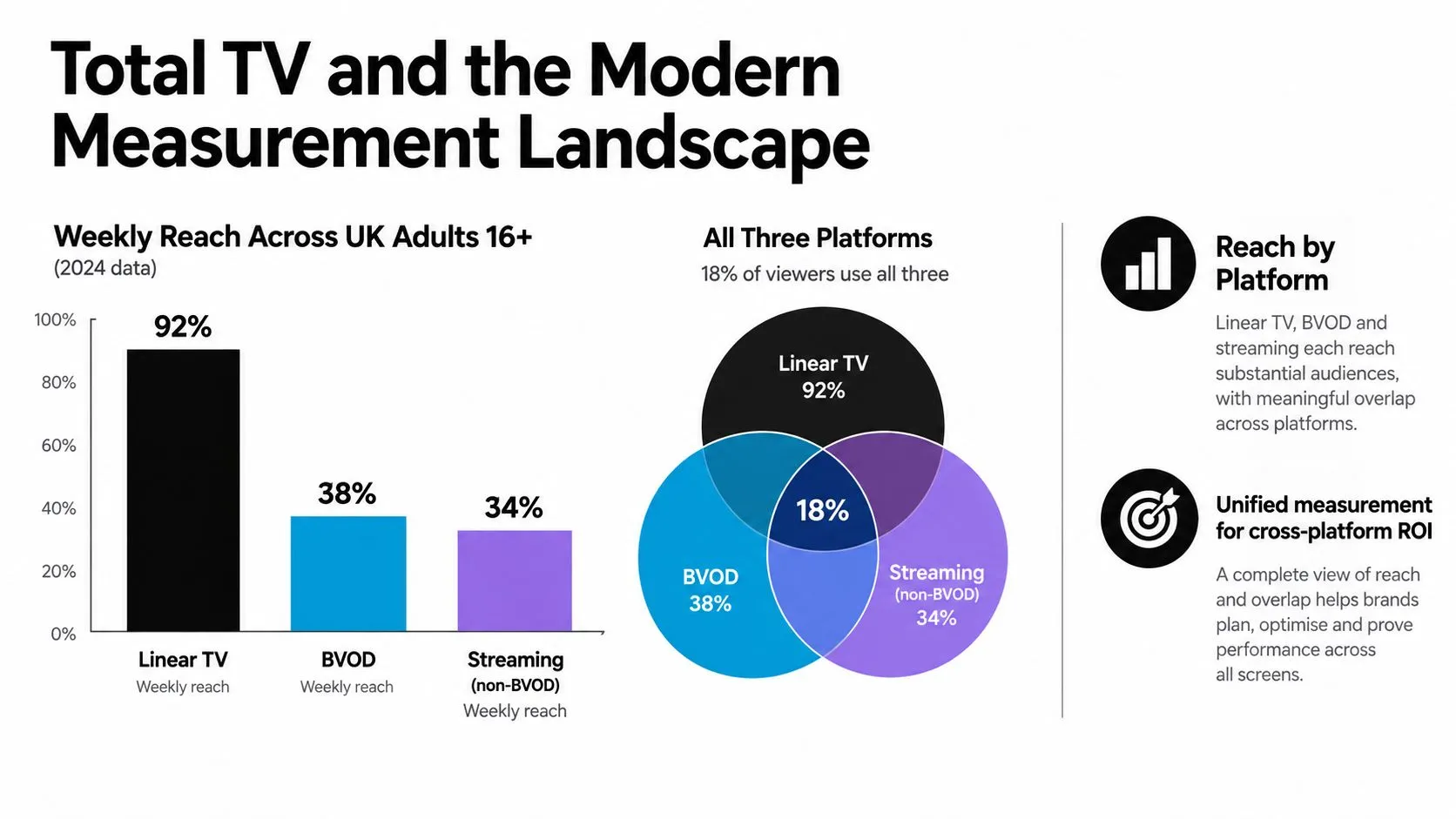
One reason people still ask whether TV works is that they imagine "TV" as a single legacy format. That's no longer how serious advertisers buy or measure it. The market has moved toward Total TV, which treats linear TV and broadcaster video on demand as part of one viewing system. That reflects how audiences consume content and how media teams increasingly plan campaigns.
What Total TV evidence shows
A UK Total TV effectiveness study found that Total TV delivered 54% of all media-driven profit across the brands studied, based on more than £100 million of UK TV investment across 13 brands over 12 months (UK Total TV effectiveness findings). That matters for two reasons. First, it gives decision-makers a profit outcome across a blended TV environment rather than forcing an outdated linear-only analysis. Second, it supports the view that broad reach combined with repeated exposure can still convert into measurable commercial return when planned coherently.
Why modern TV is easier to evaluate than many assume
The fragmentation argument goes like this: audiences are split across formats, so TV is harder to measure and therefore harder to justify. That logic is becoming less persuasive. Unified frameworks are doing the opposite. They are making TV easier to evaluate in business terms because they examine combined exposure and combined outcomes instead of siloed viewing. A useful way to think about Total TV is this:
- •Linear TV supplies scale: It remains a strong route to broad population reach.
- •BVOD sharpens planning: It adds flexibility, targeting, and extension around broadcaster environments.
- •Unified analysis improves accountability: Executives can assess one coordinated video system rather than a collection of disconnected buys.
Broad reach isn't old-fashioned if it still converts into profit. It's just undercounted when teams measure channels separately.
There's also a practical production implication here. Campaigns built for today's TV ecosystem need disciplined technical delivery, not just a strong creative idea. UK broadcaster guidance remains exacting. BBC Studios' content delivery guidance specifies that After Effects projects should be 1920x1080, match the programme frame rate, use a 1:1 pixel aspect ratio, follow ITU-R709 colour space, and be wrapped as QuickTime .mov files (BBC Studios content delivery guidance). For more formal file delivery, the UK DPP AS-11 specification is built on MXF OP1A, with AVC-Intra Class 100 for HD and IMX at 50 Mb/s for SD (DPP technical specifications). That detail matters because "TV strategy" isn't only a planning question. It also requires broadcast-ready execution.
How Cross-Channel Incrementality Is Being Measured
The most interesting development in UK media measurement isn't another claim that TV works. It's the shift toward measuring what TV contributes that digital alone doesn't. That changes the conversation. The old argument asked whether TV could be measured like digital. The newer one asks whether digital has been taking too much credit for outcomes that began somewhere else.
What the new measurement systems are doing
Origin is one of the clearest examples of that shift. It measures second-by-second TV exposures alongside online video and display across about 2,500 UK homes, which moves the industry toward deduplicated, outcome-based analysis rather than separate platform claims (Origin cross-media measurement approach). A related development is Lantern's 2026 beta, which is designed to connect TV exposure with online actions such as search, site visits, app use, and purchase behaviour, as described in the same Origin material. That's the strategic leap. TV no longer sits outside measurable action. It sits earlier in the action chain.
Why this matters to executives
A board doesn't need second-by-second exposure data because it's fashionable. It needs it because capital allocation improves when each channel gets fair credit. If your team already works through multi-channel reporting challenges in software or subscription businesses, the same logic appears in frameworks for SaaS marketing ROI tracking. The key lesson is consistent across categories. You need measurement that separates correlation from contribution. Consider how this changes practical media diagnosis:
- •A search spike after TV exposure might mean search captured demand that TV helped create.
- •A site visit pattern linked to broadcast timing can reveal response paths that last-click models miss.
- •A purchase sequence across channels can show that TV didn't close the sale, but materially improved the chance of closure.
The right question isn't "Which channel got the last touch?" It's "Which channels increased the probability of a profitable outcome?"
That is why the old TV-versus-digital framing is becoming less useful. Once incrementality is measured properly, the more strategic question becomes where TV adds lift that another channel can't produce by itself.
When to Choose TV Advertising for Your Strategy
TV isn't automatically right for every business. But it becomes much more attractive when a company needs broad demand creation, category legitimacy, or a step-change in market presence. The decision should be strategic, not ideological. If your team is asking whether TV belongs in the plan, use criteria that connect media choice to the growth problem you're trying to solve.
Situations where TV tends to make sense
- •You need scale, not just efficiency: If growth now depends on reaching a wider market rather than extracting marginal gains from existing demand, TV deserves consideration.
- •Your brand sells beyond a narrow niche: TV is stronger when the audience is broad enough to benefit from mass reach.
- •You already have conversion infrastructure: TV works better when search, site experience, sales operations, and follow-up channels are ready to capture the demand it helps create.
- •You can evaluate beyond immediate response: If finance only accepts same-week payback logic, TV may be undervalued internally even when it performs commercially.
Situations where caution is sensible
Not every organisation is ready. If your proposition is still unclear, your landing experience is weak, or your measurement discipline is poor, TV can amplify inefficiencies just as easily as strengths. A useful test is organisational readiness:
| Question | Why it matters |
|---|---|
| Is the offer clear to a broad audience? | TV has limited room for complex explanations |
| Can the business absorb increased demand? | Media works best when operations are ready |
| Are you measuring profit over time? | TV value often appears later |
| Is creative built for broadcast standards? | Production quality affects delivery and trust |
For teams weighing production implications alongside media planning, this guide to TV commercial production is a sensible operational companion because it connects strategy with the practical realities of making broadcast-ready work. One more consideration matters. Creative fit. TV is expensive to waste on generic messaging. If the proposition doesn't stand out, no amount of media logic will save weak creative.
Building a TV-First Growth Plan
The strongest TV strategies in 2026 won't treat TV as an isolated awareness burst. They'll treat it as the first force in a coordinated growth system. That means planning for delayed profit, not just launch-week response. It means setting measurement windows that are long enough to detect TV's full contribution. And it means connecting TV exposure to the channels that harvest demand later, especially search, site journeys, app behaviour, and sales follow-up. A disciplined plan usually has three traits:
- •Profit-based evaluation: judge TV on commercial return over time, not clicks alone.
- •Cross-channel design: expect TV to influence what other channels later convert.
- •Operational readiness: align creative, measurement, and fulfilment before launch.
If your acquisition team still evaluates channels in silos, it helps to revisit broader growth principles such as user acquisition strategy for modern growth. TV is most valuable when it isn't asked to do every job, but is given the job it does best. The verdict is straightforward. TV advertising still works in the UK. It works in a way many dashboards still fail to capture. --- Studio Liddell produces TV commercials, animation, motion graphics, and immersive digital content that support modern campaign strategy across broadcast and connected channels. If you're evaluating how TV creative should work within a measurable growth plan, visit Studio Liddell to see the studio's production capabilities and current work.