Design and Branding Services That Build Modern Brands
A marketing director commissions a new logo, approves the artwork, and feels the job is finished. Six months later, the same brand needs to appear in a television advert, a mobile app, a VR training module, a retail stand, social cut-downs and an interactive product demonstration. The logo survives, but the system around it doesn't. That gap is where modern design and branding services earn their value. A useful brand must guide strategy, copy, interface design, motion, 3D, immersive experiences and day-to-day production without forcing every team to reinvent the rules. The UK design economy already operates across this wider business field. The Design Council reported that it generated £97.4 billion in GVA and supported 1.97 million jobs in 2019, while digital design represented 866,000 jobs. The same evidence found that 77% of designers worked outside traditional design sectors, including finance, retail and construction. (Design Council evidence submitted to Parliament) This is a practical buying guide for marketing leads choosing a partner. It focuses on deliverables, production decisions, costs, timelines, studio diligence and the point where branding meets animation, XR and responsible AI. For a useful sweep of current brand strategy thinking, keep the curated brand strategy tweet roundup nearby, but judge a studio by what it can build and deliver, not by how polished its opinions look online.
Why Branding Matters More Than a Logo in 2026
A logo is an identifier. A brand system is an operating tool. The difference becomes obvious when a campaign moves between channels. A static mark might look fine on a website header, yet fail as a broadcast sting, a 3D object, an app icon or an animated transition. A serious partner should define how the brand behaves when it moves, scales, responds, speaks and shares space with content. The wider UK market supports this view. The UK creative industries contributed £124 billion in GVA in 2023, equal to 5.2% of UK GVA, according to the government's creative industries framework. (UK creative industries key findings) Design is no longer a small agency discipline sitting at the edge of a business. It supports products, services, communication and digital experiences across the economy.
The practical test
Ask what your identity needs to do after launch.
- •Broadcast: Can the mark become a title sting, channel ident or endboard without looking like a simple logo fade?
- •Digital product: Do typography, colour tokens and icon rules work inside an app interface?
- •Immersive content: Can the identity survive a headset, real-time engine, spatial UI or physical installation?
- •Campaign production: Can internal teams create new assets without requesting a fresh design decision every time?
- •Commercial communication: Does the brand help explain value, build confidence and support conversion?
A proposal that only lists logo concepts and a PDF guideline document hasn't answered those questions. It has priced an artwork exercise, not a production-ready identity.
Why this matters to the buyer
The Design Council reported that designers were 29% more productive than the average UK worker in 2016, generating £50,328 in GVA per worker compared with £39,111 elsewhere in the economy. Digital and advertising designers generated almost £67,000 per head, while product and industrial designers exceeded £74,000 per head. (UK design productivity research) Those figures don't prove that every rebrand will produce a particular commercial return. They do show why design capability deserves strategic attention rather than being treated as decoration.
Practical rule: Buy a brand system against the channels it must support, not against the number of logo options in the presentation.
Defining Design and Branding Services in Practice
Design and branding services work best as a layered system. Strategy sits at the top, identity gives the strategy a recognisable form, and production rules make that form usable across every medium. UX, motion and XR shouldn't be bolted on after the identity is approved. They should be tested against the same strategic foundation. Think of a brand as a stage set. Strategy is the script, telling the organisation what it stands for, who it needs to reach and why it deserves attention. Identity is the costume, giving the brand a distinct visual and verbal presence. The visual system is the lighting, adapting the same performance to a close-up, a wide shot, a mobile screen or an immersive environment.
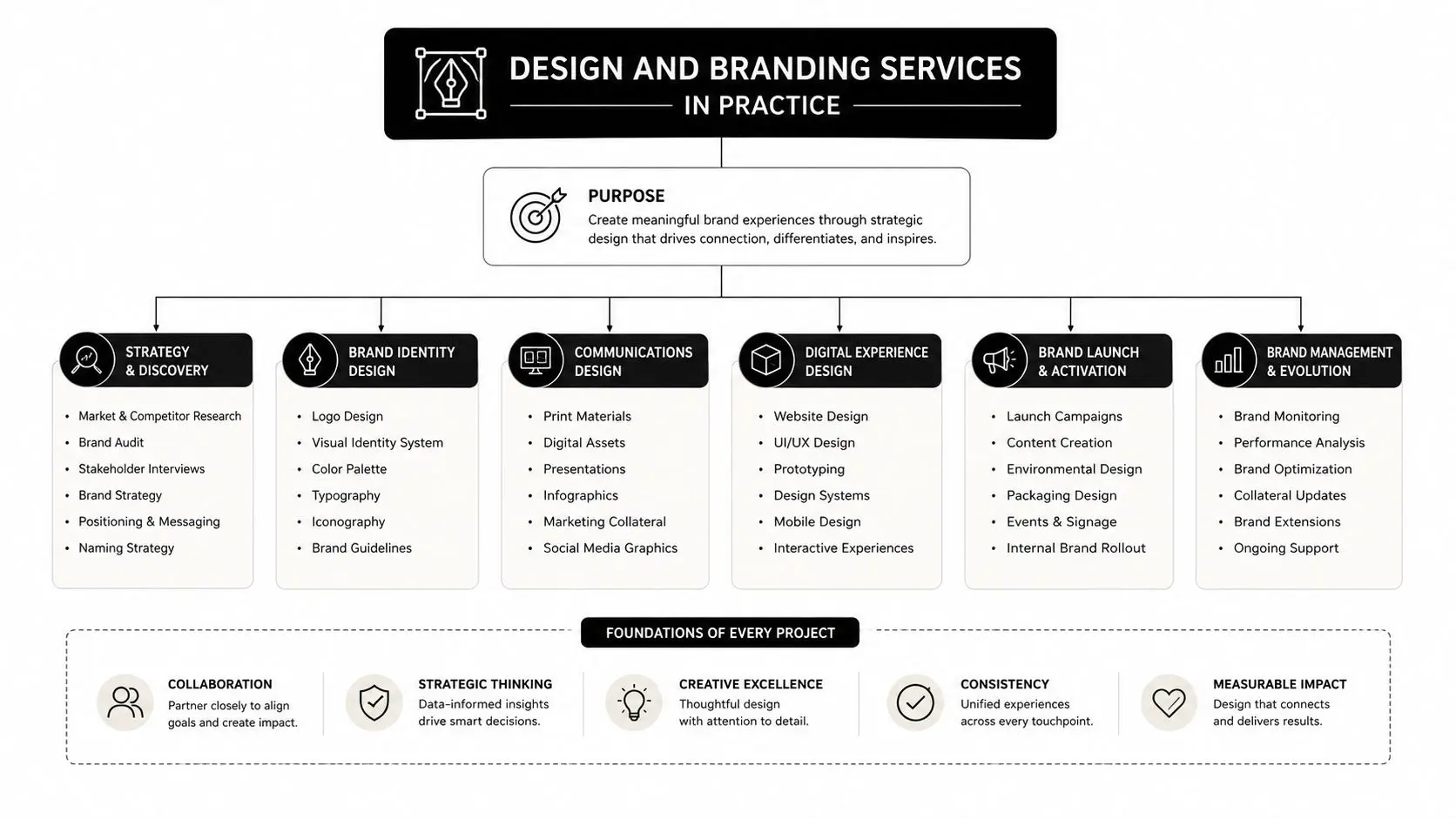
The layers you're buying
Brand strategy should clarify positioning, audiences, brand promise, differentiators, proof points and messaging priorities. It gives senior stakeholders a decision framework. Identity design translates that thinking into logo architecture, typography, colour, imagery, layout, iconography and tone of voice. It answers how the brand should look and sound. A flexible visual system defines behaviour. Motion principles establish pacing, transitions and logo animation. Digital rules cover interface states, responsive layouts and asset formats. XR rules account for spatial scale, 3D surfaces, lighting and interaction. Production support turns the system into usable assets. That might include social templates, animated stings, 3D brand elements, presentation tools, campaign toolkits and engine-ready files for interactive work. The UK Brand Consultancy market was estimated by IBISWorld at £2.0 billion in 2026, with 2,195 businesses and revenue forecast to grow at 3.5% annually from 2021 to 2026. (IBISWorld UK industry data) That is a competitive market. Buyers should expect specialist capability, clear production thinking and a system that can travel beyond a brand book.
Core Deliverables You Should Expect From a Studio
A branding proposal becomes easier to assess when it names the artefacts, owners and decisions. “Full brand development” means very little until the studio explains what your team will receive. Start with the strategic layer. A positioning statement gives the board a concise basis for decisions. Audience maps help teams prioritise needs, objections and contexts. A messaging ladder connects the central proposition to supporting claims, proof points and channel-specific language. The identity layer should be equally concrete. Look for logo lock-ups, clear-space rules, typography hierarchy, colour tokens, image direction, icon rules and a brand voice guide. If motion matters, the scope should include movement principles, transition behaviour and examples, not just a promise that the logo can be animated later.
A buyer's scoring table
| Deliverable | Primary User | Business Outcome |
|---|---|---|
| Positioning statement | Leadership and marketing | Consistent strategic decisions |
| Audience maps | Marketing, sales and UX teams | Better prioritisation of needs |
| Messaging ladder | Copywriters and campaign teams | Clearer communication across channels |
| Logo lock-ups | Marketing and production teams | Reliable use across formats |
| Type system and colour tokens | Designers and developers | Consistent digital and campaign output |
| Motion principles | Animation and video teams | Recognisable movement without rework |
| Brand voice guide | Content and customer-facing teams | More coherent language |
| Asset library | Internal teams and suppliers | Faster, controlled production |
| Social templates | Content teams | Repeatable campaign execution |
| 3D brand kit | Motion, games and XR teams | Identity that works in spatial media |
| XR-ready visual system | Interactive producers | Fewer late-stage adaptations |
| Brand guidelines | Everyone using the identity | A shared operating reference |
The distinction between an identity asset and a production asset matters. A logo file answers a narrow recognition problem. A 3D brand kit, motion toolkit or social template answers a recurring delivery problem. Review the logo design project information as one example of the identity layer, then ask how the proposed work extends into motion, interfaces and immersive output. A studio should be able to show that connection rather than making your digital team establish it after handover.
How the Production Process Runs
A credible engagement starts with decisions, not moodboards. The studio should interview stakeholders, audit existing assets, review competitors and understand the audience before presenting visual routes. That work produces a brief covering priorities, constraints, audiences and approval ownership.
From discovery to a usable direction
Discovery creates a written foundation. Competitive and audience research then informs territories, references and moodboards. Concept exploration must test whether a route can support a website, campaign, motion sequence, app interface and immersive scene, not just whether stakeholders like the first presentation. Identity development turns the selected territory into a working system. The studio defines logo behaviour, typography, colour, layout, imagery, voice and motion examples. Prototyping exposes weaknesses early. Put the brand on a print page, social post, moving endboard, app screen and AR or VR surface before approval. That multi-format testing is the point at which a static identity becomes a production-ready brand. Ask for working examples, not only polished guidelines. A route that fails in motion or spatial media will create adaptation costs after handover. AI has a supporting role in this process. Teams can use it for controlled variant generation, asset resizing, reference exploration and early look development. Human creative direction must set the brief, select the route, check originality, protect confidential material and approve the final work. AI can accelerate options, but it does not own judgement, accountability or brand meaning. Studio Liddell describes AI services for creative production alongside its wider animation, XR and digital production capability.
The handover is part of the product
Final delivery should include organised files, naming conventions, export specifications, usage rules and documentation. If a motion team, developer or external production supplier cannot locate the right asset or understand its intended use, the brand is not operational. Review the motion graphics production approach for brands when the identity needs to work in title sequences, logo stings and campaign cut-downs. Before signing, ask the studio to show its approval workflow, revision boundaries and handover format. Production discipline protects the budget.
Pricing Models and What They Really Cost
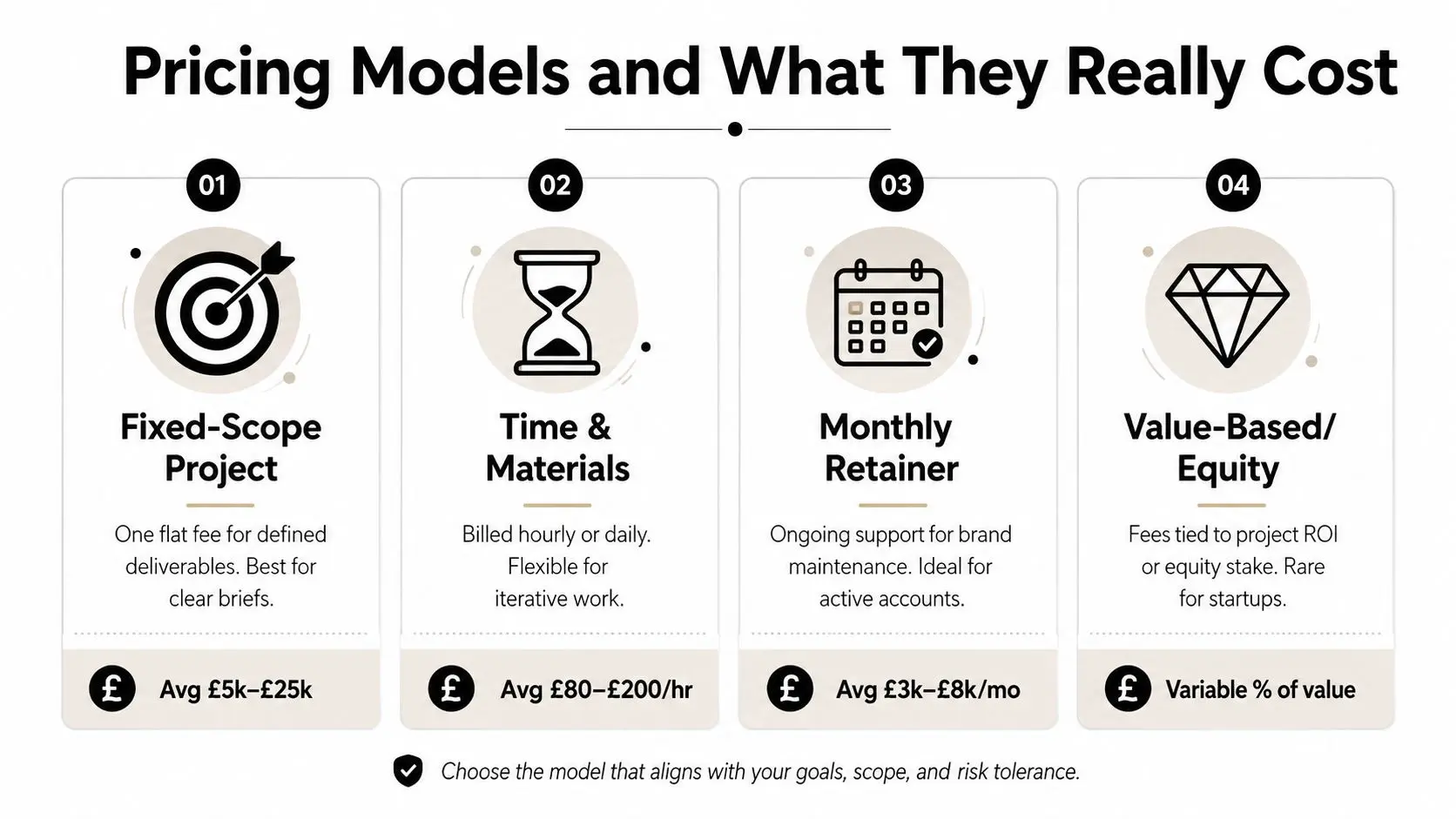
The right pricing model depends on how clearly you can define the work. A fixed fee reduces budget uncertainty, but it only works when deliverables, decision-makers and revision limits are clear. Time and materials suit research, prototyping and open-ended technical development, where the final route isn't known at the outset. A monthly retainer fits an active brand with constant production needs. It can cover campaign adaptations, social assets, motion support, presentation design and ongoing guidance. Value-based or equity-linked arrangements belong to unusual transformational projects, particularly where the studio is helping shape an important IP or commercial proposition and both parties can define value responsibly.
Match the model to the brief
The ranges shown in the supplied pricing visual are useful as sanity checks, not universal UK rate cards. It presents a fixed-scope project at £5,000 to £25,000, time and materials at £80 to £200 per hour, a monthly retainer at £3,000 to £8,000 per month, and value-based or equity-linked work as variable. Treat these as decision aids, not promises. For animation, format and complexity change the economics sharply. UK guidance places a 2D explainer around £3,000 to £8,000 per minute, while a 3D explainer commonly sits at £5,000 to £20,000 or more per minute. Typical timelines are three to six weeks for 2D and six to twelve weeks for 3D, reflecting modelling, texturing, rendering and approval work. (UK explainer video cost guidance) Basic motion graphics projects can start around £3,000, while specialist work can exceed £50,000. A trusted-studio budget for a 60 to 90 second explainer is commonly framed at roughly £8,000 to £20,000. (UK animation cost breakdown)
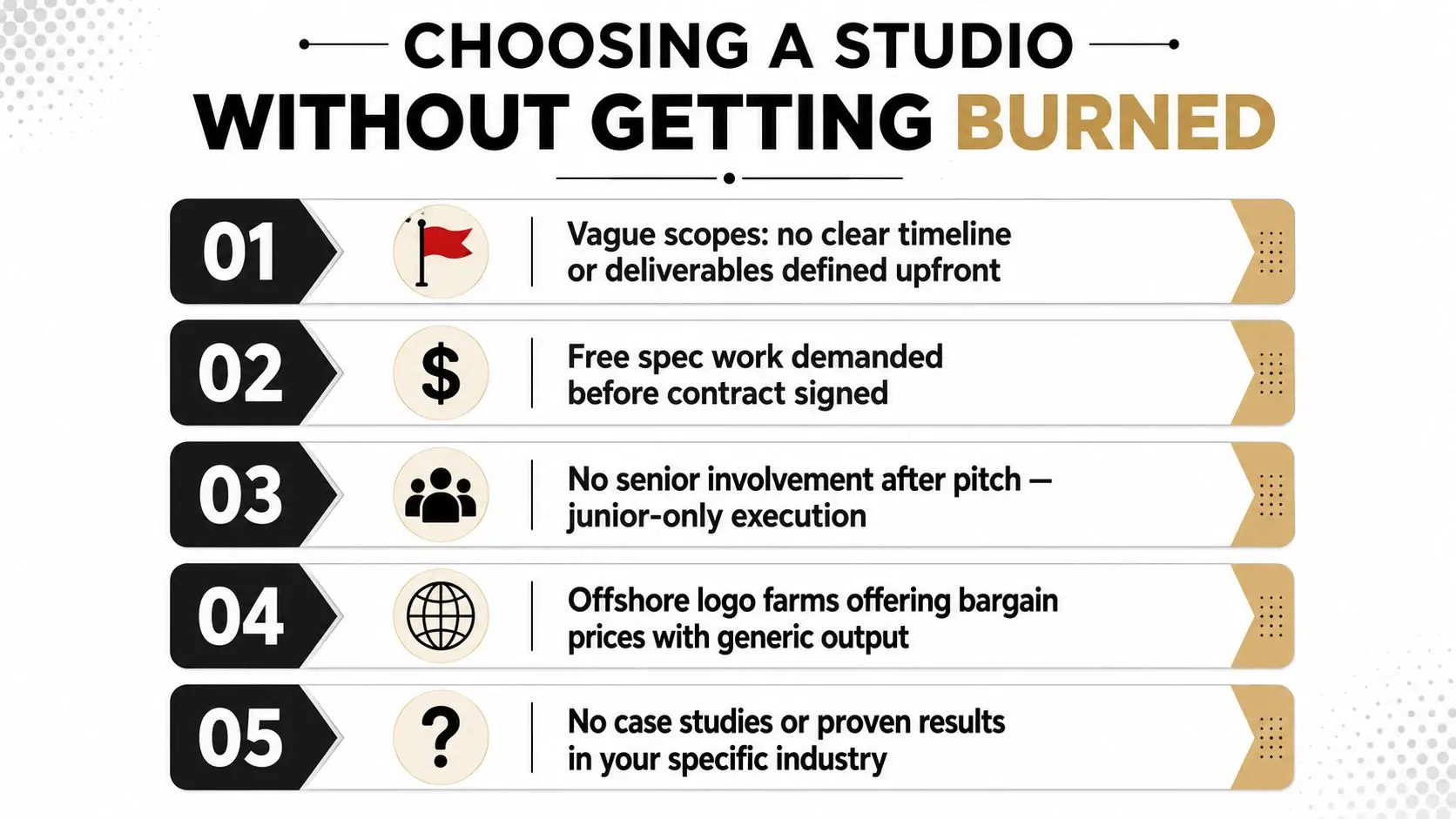
Choosing a Studio Without Getting Burned
Cheap branding becomes expensive when the output creates rework. A bargain logo package may leave your team without responsive lock-ups, motion rules, source files, licensing clarity or a usable asset library. You then pay again when a campaign, product team or XR producer needs to make the identity work in a new environment. The first red flag is a vague scope. If the proposal doesn't define deliverables, review points, approval owners and exclusions, you can't compare it properly. The second is free spec work demanded before a contract. A studio should demonstrate relevant thinking through its portfolio and proposal, not ask you to extract unpaid creative development.
The diligence that matters
Ask who will do the work after the pitch. Check the named team's CVs, production roles and availability. Request references from clients who bought a similar combination of strategy, identity and production. Review the contract before discussing the first concept:
- •Intellectual property: Confirm what transfers, when it transfers and what third-party licences remain restricted.
- •Revision limits: Define the number and type of review rounds, plus the cost of changed direction.
- •Approval workflow: Name the people who can approve strategy, design and final production.
- •Cancellation terms: Check kill fees, postponed work and payment for completed stages.
- •File handover: Specify source files, exports, fonts, textures, 3D assets and documentation.
- •Live work: Ask to see work in use, not only selected frames from a showreel.
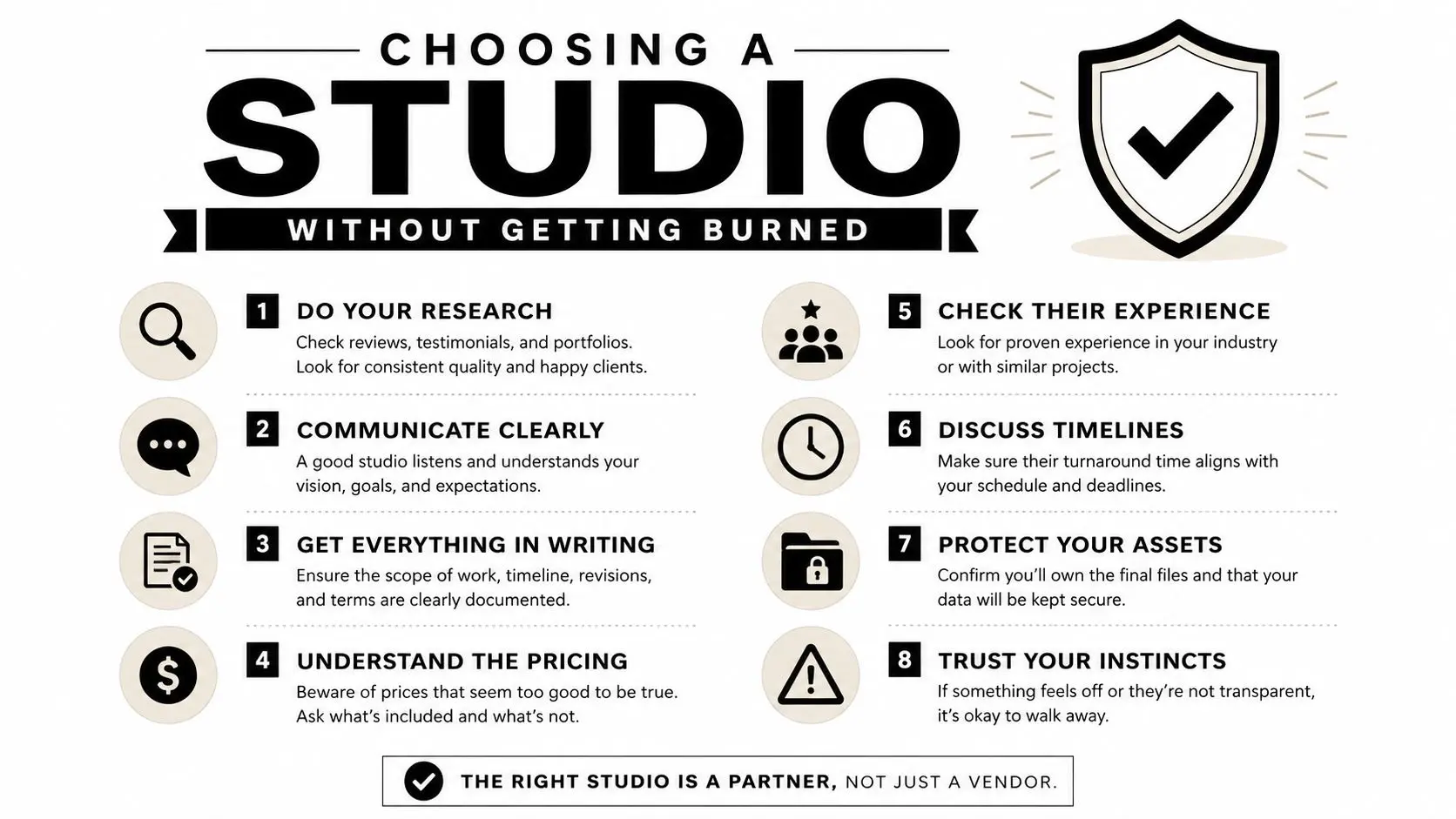
A studio's process should make risk visible. If it can't explain how it handles conflicting stakeholder feedback, late copy, technical constraints or format changes, the polished pitch has little practical value.
Where Animation, XR and AI Change the Brief
A brand built for static layouts behaves differently from one built for production. In a broadcast sting, the identity needs a rhythm, transition logic and sound relationship. In a VR environment, it needs legible materials, spatial scale, lighting behaviour and assets that perform inside the chosen real-time engine. The same principle applies to retail and exhibitions. An AR layer might reveal a product demonstration, guide a visitor through a configurator or add spatial content to a physical stand. The branding brief therefore needs to define tracking conditions, hardware, interaction states, analytics requirements and fallback behaviour, not just the colour palette.
A production example
A marketing team may approve a beautiful gradient and a distinctive symbol. The animation team then discovers that the gradient doesn't reproduce well across render pipelines, the symbol has no sensible 3D construction and the type system becomes unreadable on a headset display. A motion-first brand system tests those issues before the campaign reaches production. AI can help generate controlled versions of backgrounds, resize campaign assets and support look-development. It still needs a human-led system for selection, consistency, rights management and final approval. The buyer should ask what the studio automates, what it protects manually and how it records the approved source of truth.
A brand that travels into motion and XR isn't automatically more valuable. It is more useful when those channels are part of the business plan.
Bringing It Together and Choosing Your Next Step
The right question isn't “What does a logo cost?” Ask what must the brand support after launch. If the answer includes an app, broadcast, retail, social, games or XR, commission a system that anticipates those environments from the beginning. Write a one-page brief with the audience, commercial problem, channels, required deliverables, stakeholders, technical constraints and approval process. Use the hiring checklist above to test each prospective partner. Then decide whether your scope suits a fixed project, time and materials, a retainer or a more unusual value-based arrangement. Speak to two or three studios before committing, but don't compare only the headline fee. Compare the questions they ask, the production risks they identify, the people assigned to the work and the clarity of their handover. A scoping conversation is an audition for the relationship. The studio should help you understand the work before it tries to sell you the answer. --- Studio Liddell provides identity and brand services alongside 2D and 3D animation, motion graphics, XR design and development, interactive production and AI-assisted creative workflows. Visit Studio Liddell to share your brief and book a production scoping conversation focused on the brand system your business needs.