Augmented Reality Service for UK Businesses
When you hear "augmented reality service," what comes to mind? For many, it's a fuzzy, futuristic concept. But in 2026, it's a practical creative and technical partnership that brings digital magic into the real world, right through the screens of our smartphones and tablets. An AR service isn't a single off-the-shelf product. It’s a complete solution built by blending strategy, 3D content creation, and software development to solve real business problems, whether that’s increasing dwell time at an exhibition, training staff, or engaging customers in completely new ways.
Decoding the Modern Augmented Reality Service
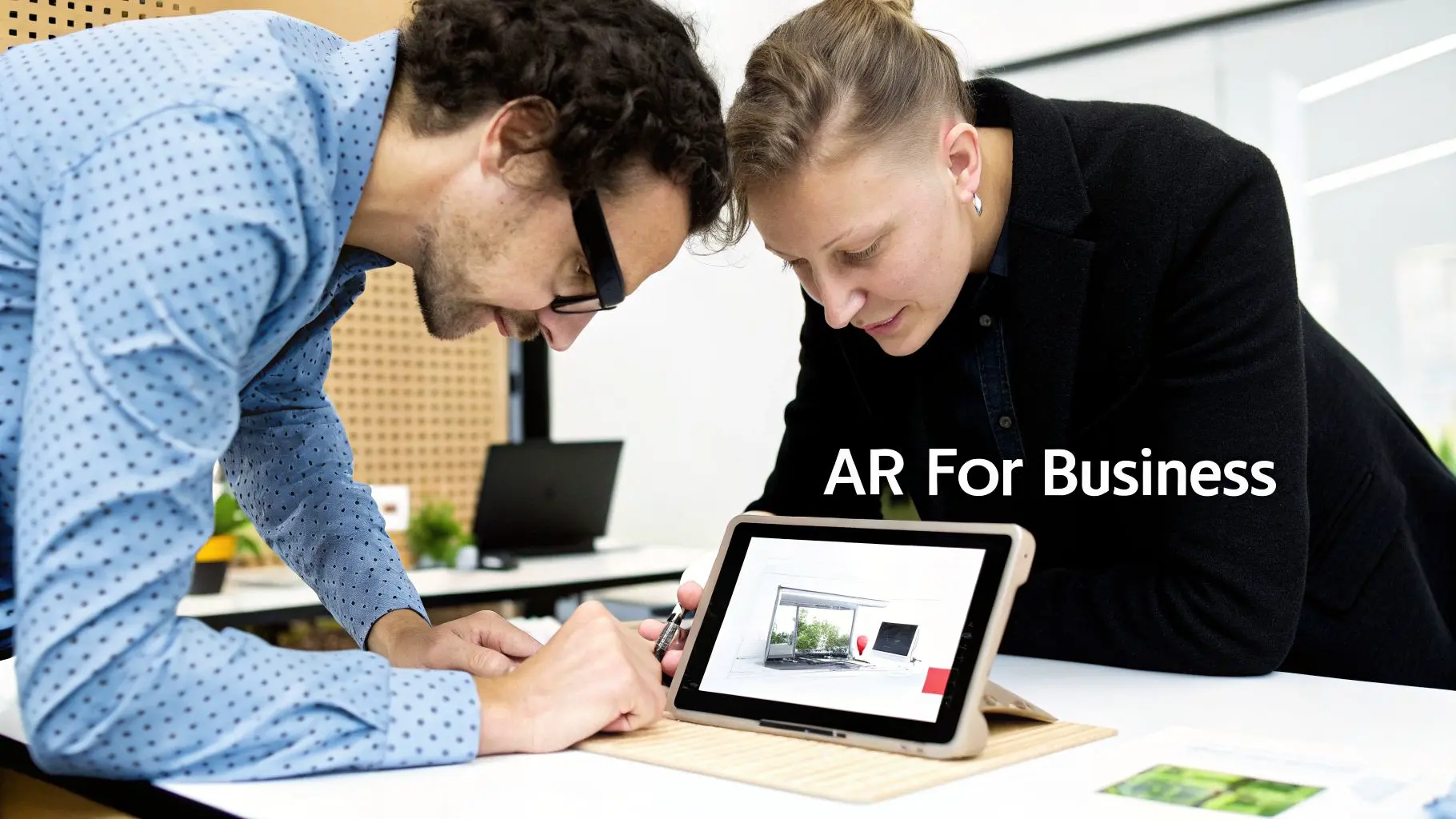
Think of an augmented reality service as a way to overlay useful, interactive digital information onto your view of the physical world. It’s not like virtual reality (VR), which whisks you away to a completely artificial environment. AR simply enhances the reality you’re already in. It’s the digital superpower that lets an event attendee explore a product configurator on their phone, or a customer see exactly how a new sofa will look in their living room before they buy it. At its heart, this kind of service is all about creative problem-solving. A business and a studio team up to pinpoint a challenge, maybe low stand footfall, complex training needs, or just flat customer engagement, and then build a custom AR experience to tackle it head-on.
The Creative and Technical Mix
So, how does an idea become an interactive reality? The journey usually kicks off with a strategic workshop to nail down clear goals and success metrics. Once the 'why' is established, the studio's creative team gets to work designing and building all the digital assets. This could involve anything from creating intricate 3D models of machinery for a training simulation to designing animated characters that guide a customer through a product setup. These assets are then brought to life using powerful game engines that handle the heavy lifting of rendering and interaction. The two main development platforms you'll hear about are:
- •Unity: A true workhorse, Unity is known for its incredible flexibility and cross-platform muscle. It's a go-to choice for building AR apps that work seamlessly across both iOS and Android devices, especially for optimising experiences for hardware like the Meta Quest.
- •Unreal Engine: When you need jaw-dropping visuals, Unreal Engine is the answer. It’s celebrated for its high-fidelity graphics and photorealistic rendering, perfect for creating hyper-realistic AR experiences that truly wow users.
The final piece of the puzzle is getting the experience into your audience's hands. This could be through a bespoke mobile app, a simple web-based solution (WebAR) that runs in a browser, or an integration into a stand at an exhibition. To give you a clearer picture, here’s a quick breakdown of the core components and their roles.
Core Components of an AR Service
| Component | Description | Business Application |
|---|---|---|
| Strategy & Discovery | A collaborative process to define goals, target audience, and key performance indicators (KPIs). | Ensures the AR experience solves a real business problem and delivers a measurable return on investment. |
| 3D Content Creation | The design and production of all virtual elements, like models, animations, and user interfaces (UI). | Creates the visual magic, from a realistic product visualisation to an engaging, animated brand mascot. |
| Software Development | The technical build of the AR application, integrating the 3D assets and programming the logic. | Brings the experience to life, making it interactive, stable, and easy to use on target devices. |
| Platform Deployment | The process of launching the experience, whether on app stores, the web (WebAR), or at physical events. | Makes the AR experience accessible to the end-user, ensuring a smooth and frictionless launch. |
| Analytics & Support | Ongoing tracking of user engagement and performance, plus maintenance and updates. | Provides valuable data (e.g., dwell time, interaction rates) to measure success and inform future improvements. |
These elements work together to create a cohesive and effective AR solution tailored to specific business needs.
Marker-Based vs. Markerless AR
It's also useful to know the two main flavours of AR, as they suit different goals. Marker-based AR relies on a specific physical image, like a QR code on an exhibition stand, a logo, or a product label, to trigger the digital content. When your device's camera spots the marker, it knows to overlay the animation or 3D model right on top of it. This is brilliant for interactive packaging, business cards, or event promotions. Markerless AR, on the other hand, is more sophisticated. It uses a device's camera and sensors to understand the physical space around it, detecting surfaces like floors and walls. This allows it to place and "anchor" virtual objects in a room without needing a physical trigger. This is the technology that powers "try before you buy" furniture apps and on-stand product demonstrations.
An AR service transforms a brand's relationship with its audience from passive observation to active participation. It gives customers the tools to explore, configure, and visualise products in their own context, bridging the gap between digital content and the physical world.
AR is no longer a futuristic gimmick; it’s a practical tool that businesses across the UK are using right now to get tangible results. It helps solve real-world operational challenges, from making training more efficient to boosting sales conversions. To see how this technology is reshaping brand engagement and growing in the market, you can explore the possibilities of Augmented Reality Marketing. You can also get more practical insights from a guide to augmented reality experiences and how they are brought to life. By adding this powerful digital layer to reality, businesses are forging more meaningful connections and providing undeniable value.
How AR Is Driving Growth Across UK Industries
Augmented reality has officially moved from the 'what if' column to the 'what's next' column. This isn't just a fun gimmick anymore; it's a serious business tool that's delivering real, measurable results for companies all over the UK. Across the board, businesses are using AR to tackle old problems in new ways, create unforgettable customer experiences, and unlock some serious growth. The ways it's being used are as varied as the industries themselves, proving its value goes far beyond just a novelty factor. Take retail and exhibitions, for example. This is where AR is really hitting its stride. A recent report estimates that the AR market in UK retail is on track to pump £1.2 billion into the economy, thanks to a huge 45% jump in adoption by major brands. That’s backed by hard data showing a 22% lift in conversion rates for businesses that have brought AR into their sales process. You can dig into more augmented reality statistics that paint a very similar picture.
Redefining Retail and Exhibitions
For any business selling physical products, whether online or at a trade show, the biggest hurdle has always been the imagination gap. How do you close the distance between a product image and a customer’s real-world context? Augmented reality is the answer. The most powerful applications we’re seeing are the virtual product demonstrator and configurator.
- •For Exhibitions: Imagine an attendee at your stand. Instead of looking at a static product, they can use a tablet to view a full-scale 3D model, change its colours, add accessories, and see it in action. This not only increases stand dwell time but also creates a memorable, interactive experience that generates qualified leads.
- •For Retail: A customer shopping for a new sofa can use their phone to place a true-to-scale 3D model right in their living room. Suddenly, they can see for themselves if it fits and if the colour works. That’s a huge confidence booster that drives conversions and reduces returns.
When you let customers bring your products into their own world, you change the entire game. Shopping and exploring go from being passive activities to hands-on experiences that build trust and get people to the next step.
Boosting Efficiency in Manufacturing and Engineering
In the UK’s industrial sectors, it all comes down to two things: efficiency and safety. An augmented reality service is a powerful tool for improving both, helping to streamline how things get done and giving the workforce a serious upgrade. Just think about the headache of maintaining complex machinery. In the past, a breakdown might mean flying a specialist technician across the country, racking up costs and losing valuable production time. Now, with AR-powered remote assistance, a local engineer can simply put on a pair of smart glasses. Their view is streamed live to an expert anywhere in the world. That expert can then talk them through the fix, overlaying digital notes, diagrams, or instructions directly onto the engineer’s real-world view of the machine. This "see-what-I-see" approach cuts equipment downtime, saves a fortune on travel, and gets things fixed right the first time. It's also an incredible on-the-job training tool, letting junior staff learn from the best in a safe, guided way.
Bringing History to Life in the Heritage Sector
The UK is packed with incredible history, but let's be honest, sometimes ruins are just... ruins. Augmented reality is breathing new life into these sites, creating deeply engaging experiences for visitors that are as educational as they are entertaining. Heritage sites are now using AR to:
- •Reconstruct historical buildings: Visitors can point their phone at an ancient ruin and see a full 3D model of how it once stood, right there in the landscape.
- •Reveal hidden stories: AR can trigger animations of key historical moments or even bring virtual characters to life to share tales of what life was like hundreds of years ago.
- •Create interactive exhibits: Museum artefacts can be scanned to unlock more information, 3D models of related objects, or even interactive games.
This doesn't just keep visitors engaged and on-site for longer; it makes history feel alive and exciting, especially for younger generations. By layering digital stories onto physical places, AR is turning static historical sites into dynamic, interactive classrooms.
Your AR Production Journey from Concept to Launch
Turning a great idea into a working augmented reality experience isn't magic; it's a structured, collaborative journey. A proper augmented reality service doesn't just build an app for you. They partner with you through a clear production pipeline, making sure every step aligns with your business goals and delivers real, measurable results. Understanding this process helps demystify AR creation. It gives you a transparent roadmap from the first sketch to the final launch. If you're just dipping your toes in, offerings like lunabloomai's Starter App can be a really accessible way to start this journey.
Phase 1: Discovery and Strategy
Every great AR project starts with a conversation, not code. This first phase is the most important one because it lays the groundwork for everything that follows. A good studio will sit down with you to get to the heart of what you want to achieve. We focus on a few key questions:
- •What problem are you really trying to solve? Maybe you want to increase stand dwell time, make employee training more efficient, or create a buzz at an event.
- •Who is your audience? Knowing their tech-savviness and how they'll actually use the experience is crucial.
- •What does success look like? We work with you to define clear Key Performance Indicators (KPIs) so we can measure the project's real-world impact.
The outcome here is a full strategy document and a detailed project scope. This gets everyone on the same page about the "why" before we even think about the "what" and "how," which saves a lot of headaches and expensive changes down the line.
Phase 2: Concept and Storyboarding
With a solid strategy locked in, the creative fun begins. This is where we start turning those abstract goals into something you can see and interact with. The creative team will brainstorm visual styles, user interactions, and story flows that fit the project’s aims perfectly. We'll create visual mock-ups and storyboards to map out the entire user journey. Think of it as a low-tech way to test big ideas. We refine the user experience (UX) and make sure the AR interaction feels natural and engaging. We might sketch out how a user triggers the AR, spins a 3D model, and finds more information, all before a single line of code is written.
Phase 3: Asset Creation and Development
Once you’ve signed off on the concept, the production floor kicks into high gear. This phase moves along two parallel tracks that have to work in perfect sync: asset creation and technical development. The infographic below gives you a bird's-eye view of how a typical AR production process flows, moving from initial discovery through to the final build.
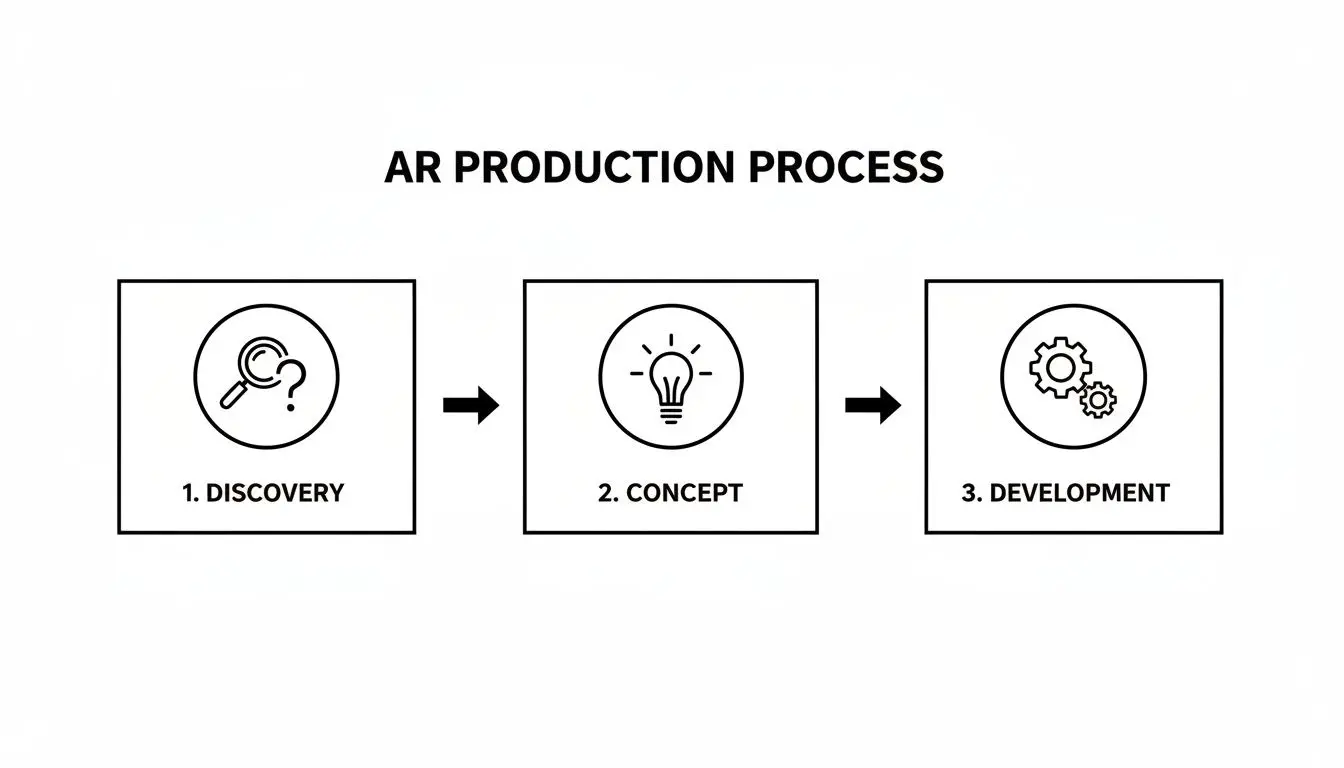
As you can see, each step builds on the last, creating a logical and goal-focused production cycle. Our artists get to work building all the 2D and 3D digital pieces, everything from detailed product models and animated characters to the user interface (UI) buttons and menus. At the same time, our developers start building the app’s logic, using powerful engines like Unity or Unreal Engine to manage the tracking, rendering, and all the interactive elements. For a closer look at the nuts and bolts, you can read our guide to AR development from concept to launch.
Phase 4: Testing and Deployment
The final stage is where we polish the experience until it shines. Before any AR app goes live, it has to go through some serious quality assurance (QA) testing.
The goal of testing isn't just to find bugs; it's to validate the entire user experience. We test for performance on different devices, check for intuitive navigation, and ensure the AR interaction is stable and seamless.
This means we’re testing on a whole range of target devices (different iPhones and Android models, for example) to guarantee it works smoothly for everyone. Once the experience is bug-free and fully optimised, we handle the deployment, whether that’s submitting to app stores, launching it on the web, or plugging it into an existing platform. Our job doesn't end at launch, either. We keep an eye on the analytics and offer support to make sure your project is a long-term success.
Boosting Your Team with AR Training and Remote Support
While AR is fantastic for grabbing customer attention, some of its most valuable applications are happening inside businesses, changing how teams learn and solve problems. For any industry that relies on skilled labour, think engineering, manufacturing, and field services, AR is quickly becoming the go-to tool for improving efficiency, safety, and sharing knowledge.
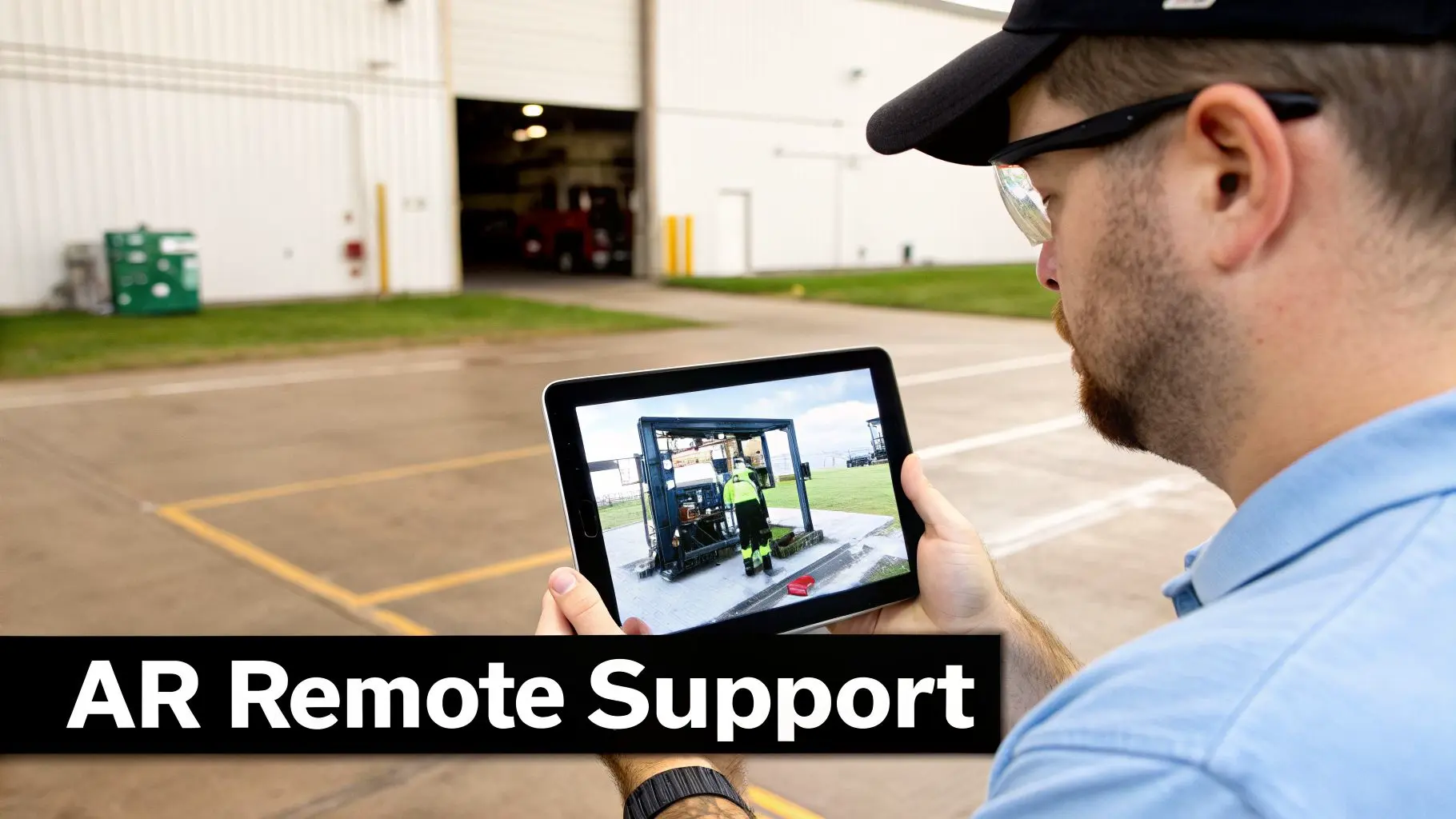
The concept is beautifully simple. AR overlays digital instructions directly onto real-world equipment. It's about taking knowledge out of a dusty manual and putting it into an interactive, step-by-step guide right in your line of sight. This kind of hands-on, in-the-moment guidance massively cuts down on errors and training time. This isn’t some far-off idea; it’s already delivering results. The UK's manufacturing industry has embraced AR, with 32% of firms using the technology by 2026. This move has unlocked an estimated £800 million in annual efficiency savings. You can explore the market insights on Avasant.com to see just how widespread this trend has become.
The Remote Expert in Action
Picture this: a junior engineer is on-site, facing a complex machine breakdown. The old way meant hours, maybe even days, of downtime waiting for a senior specialist to travel out. Today, the "Remote Expert" model flips that scenario on its head. The engineer just needs a pair of AR smart glasses or a tablet. Their real-time view is streamed directly to a senior expert, who could be in an office hundreds of miles away. The expert sees exactly what the engineer sees and can offer live guidance instantly. They can:
- •Annotate the live video feed, drawing circles around the right valve to turn or highlighting a component that needs checking.
- •Share technical diagrams or schematics that pop up as floating overlays in the engineer’s view.
- •Guide the repair step-by-step, confirming each action and preventing costly mistakes before they happen.
This "see-what-I-see" capability is a total game-changer. The machine is back up and running in a fraction of the time, travel costs vanish, and the junior engineer gets priceless on-the-job training from the best in the business.
Tangible Returns on Investment
Let's be honest, any new tech investment comes down to the bottom line. And for training and support, an augmented reality service delivers clear, measurable financial wins. For instance, factories in the Midlands have reported a 38% reduction in equipment downtime after rolling out AR overlays for their maintenance tasks. These benefits aren't just for one sector. High-tech industries have seen a 35% boost in sales efficiency simply by using AR for tricky product demonstrations.
By instantly connecting your most knowledgeable experts to your on-site teams, you slash downtime, improve first-time fix rates, and build a more skilled, confident, and independent workforce.
Building Interactive Training Modules
The same technology is also completely revamping formal training programmes. Instead of just watching videos or reading manuals, new starters can use AR to practice complex jobs on real equipment within a safe, guided environment. Key applications we see all the time include:
- •Assembly Guidance: AR overlays show employees the exact parts and sequence for assembling a product. It's like digital Lego instructions for the real world, and it drastically cuts down manufacturing defects.
- •Safety Training: You can simulate hazardous scenarios, like an emergency shutdown or a chemical spill, allowing staff to practice their response without any real-world risk.
- •Procedural Compliance: In regulated industries, AR ensures every single step is followed to the letter, even creating a digital audit trail for compliance purposes.
Learning by doing with a digital helper is not only faster but also sticks in the brain far better. When you integrate an augmented reality service into your operations, you’re not just buying a new tool. You’re building a more resilient, efficient, and intelligent organisation.
Innovating UK Healthcare with Augmented Reality
Beyond the factory floor, augmented reality is making a life-changing difference in one of the UK’s most vital sectors: healthcare. Far from being a gimmick, AR has become a genuine clinical tool that improves precision, supercharges learning, and helps deliver better outcomes for patients across the country. We’re now seeing the technology move from the lab into real-world medical practice. AR is being used to support clinicians and patients in a host of different ways, enhancing everything from complex surgery to at-home recovery programmes.
Enhancing Surgical Precision
One of the most powerful applications for augmented reality is right inside the operating theatre. Surgeons can now use AR to overlay detailed, patient-specific 3D anatomical models directly onto a person's body, both in pre-operative planning and during the surgery itself. Imagine a surgeon preparing to remove a complex tumour. With AR, they can see a precise 3D map of the growth, its blood vessels, and the surrounding organs all projected onto the patient. This gives them an incredible level of spatial awareness, helping them navigate with far greater accuracy and confidence. This isn't just theory; it's already shifting surgical standards in the UK. A 2026 NHS Digital report found that AR surgical simulations reduced error rates by 27% across 150 pilot programmes in England since 2024. As you can discover from more insights about 2025 AR trends, the technology is quickly proving its value in high-stakes environments.
Modernising Medical Education
The days of learning complex biology from flat, static textbook diagrams are numbered. AR is breathing life into medical training, creating interactive learning modules that make intricate biological processes feel real and tangible for students. Instead of just reading about the cardiovascular system, a student can use a tablet or AR headset to see a detailed, beating 3D heart floating in the room in front of them. They can walk around it, peel back layers, and watch the blood flow in real-time. This hands-on, visual approach helps cement an understanding of complex systems in a way traditional methods just can't match. It makes learning more intuitive and memorable, preparing the next generation of healthcare professionals with a much deeper grasp of human anatomy.
By turning abstract medical concepts into tangible, interactive 3D experiences, AR is not just educating students, it's building a deeper level of understanding that translates directly into better patient care.
Accelerating Patient Rehabilitation
The impact of AR also extends beyond the hospital walls and into the patient's own home. Custom augmented reality applications are being used to guide people through their physical therapy exercises, making the road to recovery more engaging and effective. These apps use a simple smartphone camera to track a patient's movements, giving them real-time feedback to ensure exercises are performed correctly. By adding game-like elements, such as collecting virtual points or reaching new levels, it also motivates patients to stick to their recovery plan. This is already gaining real traction. The same NHS report noted that 25% of UK hospitals have integrated AR for patient rehabilitation. It’s a brilliant way to empower patients in their own recovery while giving therapists the data they need to track progress. To explore this topic further, you can learn more about how augmented reality is transforming healthcare in our detailed guide.
How to Choose the Right AR Service Partner in the UK
Getting into augmented reality is exciting, but let’s be honest: choosing the right studio to bring your vision to life is a huge decision. It's the one that will ultimately make or break your project. The right team becomes a genuine strategic partner, guiding you from a rough sketch on a napkin to a polished, high-impact AR experience. The wrong one? That path often leads to blown budgets, frustrating technical problems, and a final product that just doesn't hit the mark. To make the right call, you need to look past the slick sales pitch. It’s about digging into a studio's past work, their technical chops, and how they actually run their projects to see if they can deliver on their promises.
Assess Their Portfolio and Industry Experience
A studio’s portfolio is your best window into what they can do for you. Don't just get dazzled by flashy visuals. You're looking for proof of smart, strategic thinking and projects that delivered real results, ideally in a sector similar to yours. When you’re looking through their work, ask yourself a few questions:
- •Is the quality there? The standard of their 3D modelling, animation, and visual effects tells you everything about their production values. Look for a team with a creative background; it shows they know what broadcast-quality really means.
- •Do they get your industry? A studio with experience in retail and exhibitions will already understand visitor behaviour and how to increase dwell time. One that’s worked in manufacturing will get why operational efficiency is king. This kind of experience is invaluable.
- •Can they show you the numbers? Vague claims are easy. Look for case studies with hard evidence. Did their work increase visitor dwell time at an event? Did it cut down on errors in a training module? You want proof that their work solved a real business problem.
Verify Their Technical Expertise
An amazing AR service is where art and science collide. Your partner absolutely must have a rock-solid grasp of the technology needed to make your creative vision a reality. Here are the key technical areas to dig into:
- •Engine proficiency: Ask them about their experience with the big platforms like Unity and Unreal Engine. A great follow-up question is which engine they’d recommend for your project, and why. Their answer will reveal a lot.
- •Hardware knowledge: Are they comfortable working across different devices? They should know the ins and outs of everything from standard smartphones to specialised AR headsets.
- •Full-service capabilities: Can they handle the whole shebang? This means everything from the initial strategy and concept art right through to testing, deploying on app stores, and tracking analytics post-launch. A partner who manages the entire lifecycle makes the whole process smoother and more joined-up.
Choosing a partner isn’t just about finding a team to build what you ask for. It’s about finding a team that will challenge your ideas, refine them, and create something that’s truly effective. They should be as invested in your business goals as you are.
Watch for These Common Red Flags
Knowing what to look for is half the battle. Knowing what to avoid is just as crucial. A few warning signs can pop up early, signalling that a studio might not be the right fit for a collaborative, long-term project. Think twice about studios that:
- •Push a one-size-fits-all solution: Your business challenge is unique, and your AR solution should be too. A good partner starts by listening and learning about your specific needs, not trying to shoehorn you into a pre-packaged product.
- •Are vague about their process: If they can’t clearly explain how they manage projects, how they’ll communicate with you, and what the key milestones will be, that’s a major red flag for disorganisation down the line.
- •Hesitate to talk timelines and budgets: After an initial discovery session, a professional studio should be able to talk openly and realistically about costs and delivery schedules. If they’re cagey, be wary.
Finding the right augmented reality service partner comes down to finding that perfect mix of creative flair, technical skill, and strategic thinking. Do your homework, and you’ll set yourself up for a partnership that delivers genuine, measurable value.
How Much Does an Augmented Reality Service Cost?
This is the big question, isn't it? The truth is, the cost of an AR project in the UK can vary wildly. It all comes down to what you want to achieve. A straightforward, marker-based experience using 3D models you already own might only set you back a few thousand pounds. On the other hand, if you're picturing a complex app for multiple platforms with custom-built assets, slick animations, and database integration, you could be looking at a six-figure investment. Be wary of any partner who gives you a price off the cuff. A true professional will want to start with a scoping or discovery phase to get under the skin of your goals. Only then can they give you a detailed, itemised quote that reflects what you actually need.
What Is the Typical Timeline for an AR Project?
Just like cost, timelines are tied directly to the project's complexity. A snappy AR filter for a marketing campaign could be live in as little as 4 to 6 weeks. For something more substantial, like a large-scale training simulation or a feature-rich retail app, you’ll want to budget for 6 months or more. The main things that shape the schedule are the initial strategy, creating all the visual assets, the development work itself, and a proper, thorough testing period.
Do My Customers Need Special Hardware to Use AR?
In almost all cases, no. The beauty of modern AR is that the vast majority of experiences are built to run perfectly on the smartphones and tablets people already carry with them every day.
The goal is accessibility. Technologies like WebAR are making it even easier, allowing users to launch an augmented reality experience directly from their web browser with no app download required. This removes a significant barrier and increases user adoption.
What Is the First Step to Get Started with AR?
The best way to kick things off is to book a discovery call or workshop with a potential augmented reality service partner. It helps to do a little homework first. Before the meeting, have a think about your business goals, who you’re trying to reach, and the specific problem you're trying to solve. Walking into that first conversation with a clear objective is incredibly valuable. It gives the studio team the insight they need to scope out a concept and strategy that fits your vision and your budget, setting your project up for success right from the start.
Ready to explore how AR can solve your business challenges? The team at Studio Liddell can help you scope out a concept and strategy tailored to your needs. Book a production scoping call