Augmented Reality Games: A Guide to Immersive Play and Production
Augmented reality games don't just create a new world; they drop a digital playground right on top of your own. They overlay virtual characters and interactive elements onto your physical surroundings, all viewed through your phone's screen. Think of it as revealing a hidden layer of fun on the world you already know, all made possible by the powerful tech you’re already carrying around.
How Do Augmented Reality Games Work?
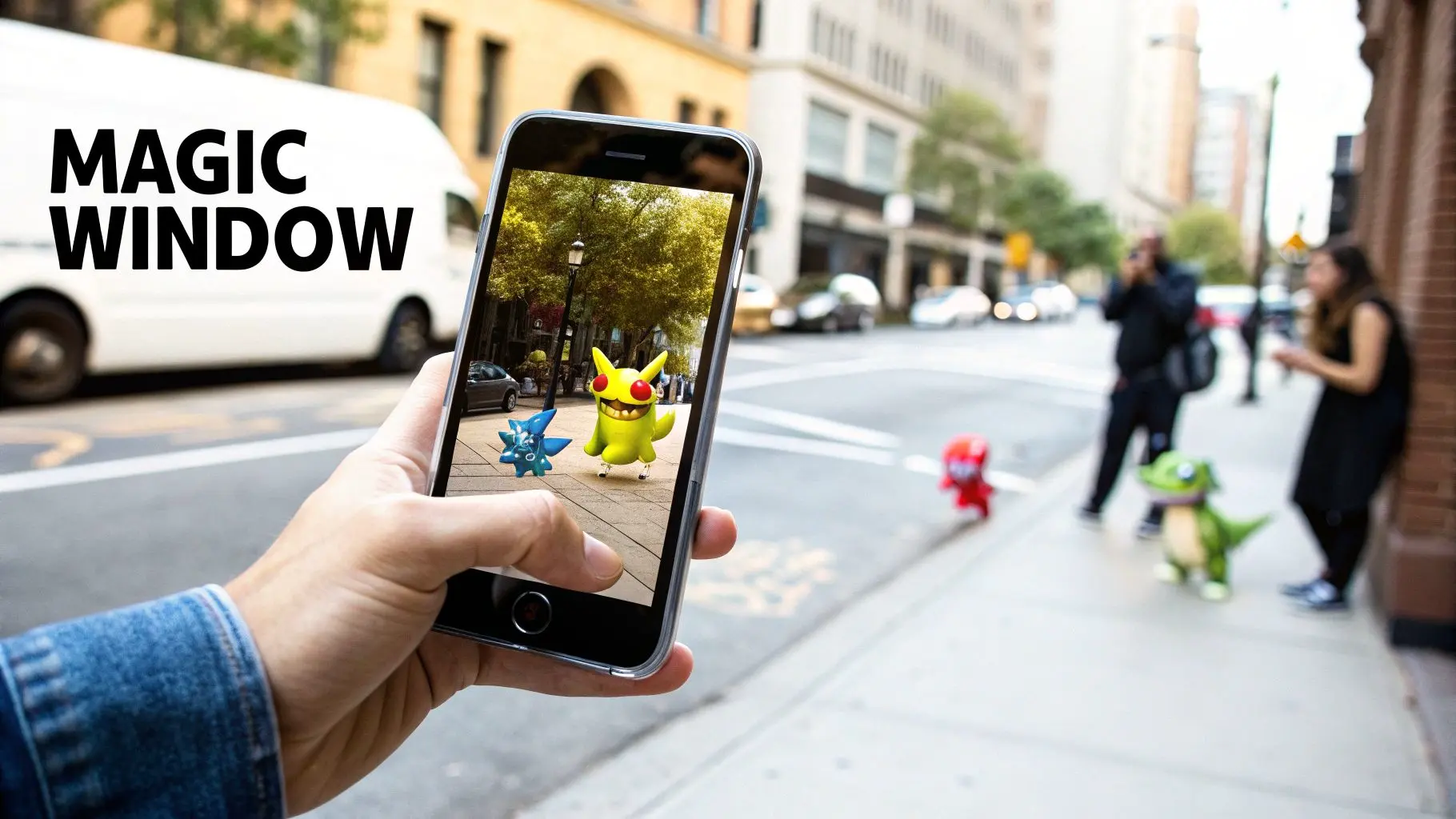
The easiest way to get your head around how AR games work is to picture your smartphone as a kind of magic window. When you hold it up, it doesn’t just show you what's there; it shows you what could be there. This "magic" is really just a clever team effort, with several technologies inside your phone working together seamlessly to blend the digital and the physical. At its heart, an AR game uses your device's camera to see and interpret the world in real-time. But the camera isn't working alone. It gets a lot of help from a team of sensors that provide crucial context about where you are and how you’re moving.
Key Technologies Powering AR Games
This table breaks down the essential hardware and software components that make augmented reality gaming possible on your mobile device.
| Technology Component | Function in AR Games | Real-World Example |
|---|---|---|
| Camera | Acts as the primary 'eye', capturing the real-world view that digital elements are overlaid onto. | Capturing the pavement so a virtual character can appear to stand on it. |
| GPS | Pinpoints your device's location on the globe, enabling location-based gameplay. | Guiding you to a specific park to find a rare in-game creature. |
| Accelerometer | Measures the phone's linear acceleration and tilt, detecting movement along different axes. | Registering when you quickly lift your phone, perhaps triggering a jump action. |
| Gyroscope | Tracks the phone's rotation and orientation, understanding how it's being turned and angled. | Allowing you to physically walk around a digital object while it stays "anchored" in place. |
| Plane Detection | Software that analyses the camera feed to identify flat surfaces like floors, walls, and tables. | Letting you place a virtual board game on your actual coffee table. |
| Spatial Audio | Delivers 3D sound that makes audio seem to come from a specific point in your physical space. | Hearing an enemy's footsteps coming from behind you and to your left. |
Each piece of tech plays a vital role, working in concert to create a convincing and interactive augmented world.
Creating an Immersive Experience
To make the illusion truly believable, the software does some heavy lifting. Plane detection, for instance, is what allows a virtual character to stand realistically on your floor instead of just floating awkwardly in mid-air. It finds the flat surfaces in the camera's view. Add in immersive sound like spatial audio, and you can make players feel like sounds are coming from specific points in the room around them.
AR is all about context. The technology doesn’t just place a 3D model on your screen; it understands where that model should be in relation to your floor, your table, or the street, making the illusion feel believable.
This blend of technologies is fuelling serious industry growth. The UK augmented reality market is booming, having already generated around USD 4.13 billion in revenue. While hardware currently holds the largest slice of the pie, AR gaming software is the segment picking up speed the fastest. Projections show the overall market rocketing to USD 25.76 billion by 2030. That tells you just how much appetite there is for the very experiences this technology creates.
Exploring the Types of AR Gaming
The world of augmented reality games is far broader than just one runaway hit. Think of it as a creative sandbox where developers are constantly mixing digital gameplay with our physical reality, leading to a huge variety of experiences. This means there’s an AR game out there for almost any setting, from a sprawling city park to the four walls of your living room. Getting your head around these different categories reveals just how flexible AR technology really is. The game's design, its core mechanics, and how you interact with it can change completely depending on whether it’s built to be played on the move or in one spot. This adaptability is a huge part of its growing appeal.
Location-Based AR Adventures
When most people think of AR games, this is usually what springs to mind. Popularised by trailblazers like Pokémon GO and Ingress, location-based AR turns the entire world into a giant, interactive game board. These games lean on your phone's GPS to pinpoint your position, scattering virtual characters, items, and objectives across real-world parks, landmarks, and streets. The whole point is to get you out and exploring. Players are nudged to walk, discover new places in their own community, and sometimes even team up with others they meet along the way. It’s a powerful formula, more than one billion people have downloaded Pokémon GO since it launched, proving just how much we love games that reward real-world movement.
- •Gameplay Mechanics: Built around exploring, collecting, and controlling territory tied to physical places.
- •Player Interaction: Usually involves walking or cycling to hit in-game goals, which gets people active.
- •Key Example: Pokémon GO, where you wander your neighbourhood to find and catch virtual creatures that look like they're right there in front of you.
Tabletop and Surface-Based AR Games
But not all AR games need you to lace up your walking shoes. A really interesting and growing category simply uses a flat surface, like your coffee table or the floor, as its stage. By using your device's camera and some clever plane-detection tech, these games can project a 3D game board, characters, or even entire miniature worlds right onto the surface. This approach brilliantly captures the social fun of board games and strategy games but gives them a dynamic, digital twist. Players can physically walk around the table to see the action from different angles, moving virtual pieces around as if they were actually there. It’s a fantastic way to create a shared, social gaming session in a single room. For a closer look, check out these 10 powerful examples of augmented reality in action.
Tabletop AR turns passive surfaces into active playgrounds. Your floor can become a puzzle, your desk a racetrack, and your coffee table a battlefield, all viewed through the lens of your device.
Immersive Shooters and Room-Scale AR
This is where things get really intense. This type of game pushes the boundaries by turning your immediate environment into a full-blown action arena. Using advanced environmental mapping, these games can actually understand the layout of your room. This allows virtual enemies to realistically duck behind your actual sofa or burst through a digital portal that appears on your real wall. These experiences are incredibly immersive and physical. You have to physically move, duck, and dodge within your space to stay in the game, making it a far more active and heart-pumping experience than just sitting with a controller. It’s a perfect showcase of how AR can tailor gameplay to the unique shape of a player's own space, making every single session feel completely unique. This variety just goes to show that AR gaming isn't one single thing. It’s a whole collection of different experiences. Whether it’s getting people to explore the globe, creating intimate tabletop adventures, or turning your living room into a laser-filled battleground, the technology offers an incredibly rich canvas for fun.
The Production Pipeline for AR Games
Bringing an augmented reality game to life is a journey from a spark of an idea to an interactive experience that spills out into the real world. This isn't your standard development process. It's a unique blend of creative vision and complex technical work, all funnelled through a structured production pipeline to keep things on track. From scribbling ideas on a whiteboard to launching on the app stores, every single stage is crucial for building a polished and genuinely fun product. This process is a real team effort. It’s not just coders in a dark room; you need storytellers, artists, animators, and engineers all pulling in the same direction. The big challenge? Designing for an environment you can't control, the player's own living room, park, or city street. This throws in a whole new set of considerations you just don't get with traditional games. This visual breaks down the high-level flow, showing how we get from that initial lightbulb moment to a fully developed, launch-ready game.
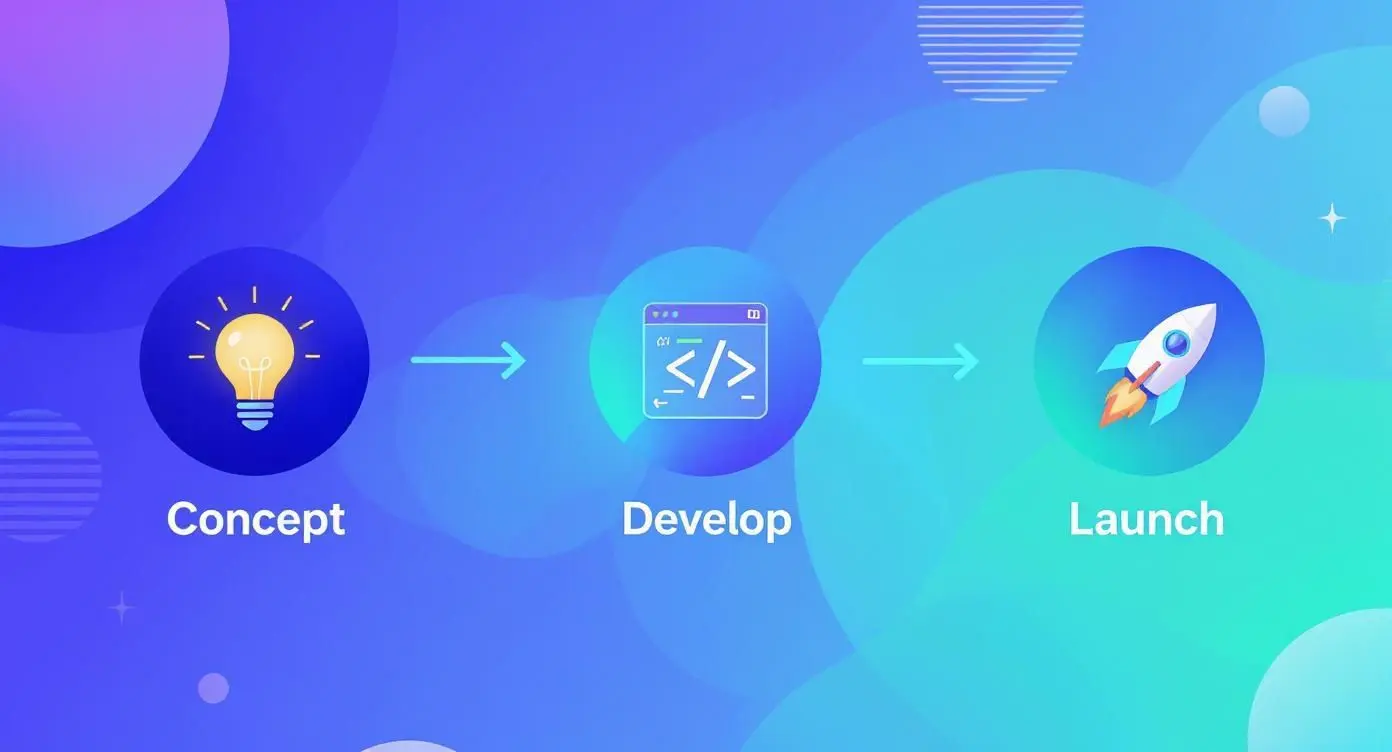
It’s all about turning those abstract ideas into a tangible, playable experience that people will love.
From Concept to Pre-Production
Every great AR game starts with a killer concept. This is where you nail down the fundamentals: What's the game really about? Who are we making this for? And most importantly, what’s the core fun factor? All of this gets poured into a game design document (GDD), which becomes the bible for the project, detailing everything from gameplay mechanics and story to the art style and tech requirements. With a solid concept in hand, we move into pre-production. This is the experimental phase. We build rough prototypes to test the core gameplay loop and see how the AR interactions feel. Does it feel natural when a digital dragon lands on your real-world coffee table? Pre-production is where we answer these questions, ironing out design kinks and spotting technical hurdles before we sink serious time and money into the full build. If you want to dig deeper into these early stages, check out our comprehensive guide to augmented reality application development.
Choosing the Right Game Engine
The game engine is the technical heart of any AR game. It’s the framework that handles all the heavy lifting, rendering graphics, managing physics, and executing game logic. For AR development, two names dominate the landscape: Unity and Unreal Engine.
- •Unity: Hugely popular for its flexibility and amazing support for mobile devices, making it a go-to for many AR games. Its massive Asset Store and passionate developer community mean you’re never short on resources.
- •Unreal Engine: If you want jaw-dropping visuals, Unreal is your engine. It's famous for high-fidelity graphics that can create incredibly realistic and stunning AR experiences.
Choosing an engine is a massive decision that echoes through the entire project. It affects everything from the skills you need on your team to the final performance on a player's phone.
Picking an engine isn't just a technical checkbox. It's a strategic move that defines the project's visual style, how fast you can build it, and ultimately, how many people can play it.
To help you see how they stack up for AR projects, here’s a quick comparison of their key strengths. #### Comparing AR Game Development Engines
| Feature | Unity | Unreal Engine |
|---|---|---|
| AR Foundation | Excellent cross-platform support (ARKit, ARCore) via AR Foundation, simplifying development for both iOS and Android. | Strong built-in support for ARKit and ARCore, with robust tools for handling real-world tracking and rendering. |
| Visual Quality | Capable of high-quality visuals, but often seen as more accessible and optimised for a wider range of mobile hardware. | Renowned for photorealistic rendering and advanced lighting, ideal for creating visually stunning, high-fidelity AR. |
| Learning Curve | Generally considered easier for beginners to pick up, thanks to a more intuitive interface and C# scripting. | Has a steeper learning curve, particularly with its C++ and Blueprint visual scripting system, but offers immense power. |
| Community & Assets | A massive, active community and an extensive Asset Store with countless pre-made assets, tools, and plugins for AR. | A strong community with a growing marketplace, but the asset selection is generally more focused on high-end PC/console games. |
While both are fantastic options, the "right" choice really depends on your project's specific needs, whether that's broad mobile compatibility or pushing the boundaries of visual realism.
Full Production and Asset Creation
Once the blueprint is approved and the engine is chosen, we dive into full production. This is the longest and most resource-heavy part of the process, where the game is truly built from the ground up. Developers write the code, 3D artists model the characters and props, and animators breathe life into everything. This is where the real magic happens. A 3D artist might sculpt a mischievous goblin, which an animator then rigs to scurry across a player’s floor. At the same time, a developer is writing the code that makes the goblin react to real-world objects. It's a deeply collaborative dance that continues until every feature is in place. It's this kind of compelling, layered world that is fuelling massive growth in the mobile gaming market. In the UK alone, the sector is valued at £3.4 billion and is projected to skyrocket to over £6 billion by 2033, largely thanks to the exciting new experiences that AR technology makes possible.
Designing a Great AR User Experience
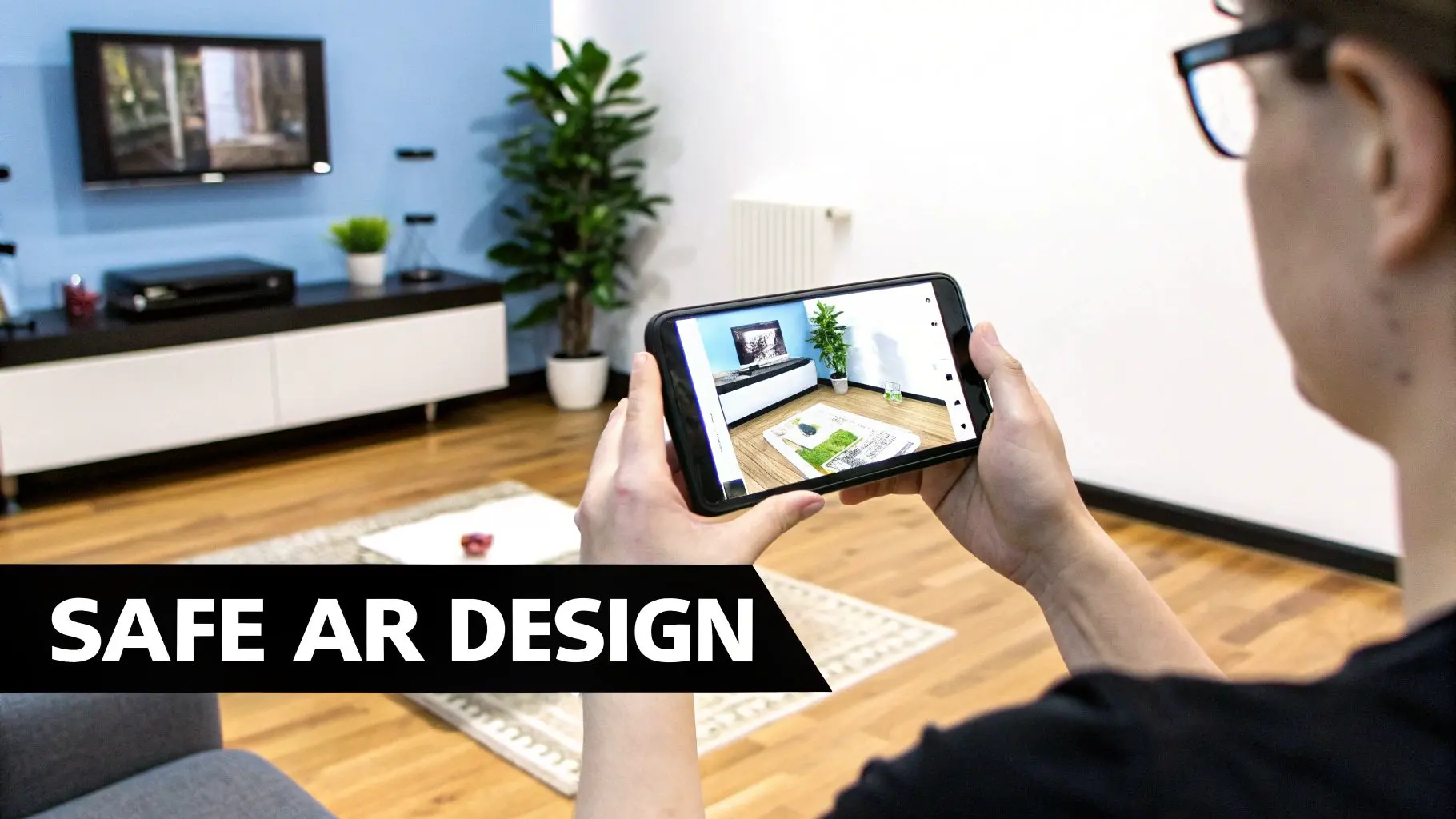
A killer AR game isn't just about cool tech. Its real magic comes from thoughtful, intuitive user experience (UX) design. When you’re creating an experience that blends digital fun with an unpredictable real world, you have to think very carefully about how the two will mix. The biggest hurdle for any designer is closing that gap between what’s on the screen and what’s in the player’s actual, physical space. Great AR UX is almost invisible. It guides people without them even realising it, making every interaction feel natural rather than clunky. When you get it right, the technology just melts away, letting players get completely lost in the blended reality you’ve built. The goal is always to enhance their world, not clutter it up with confusing menus or frustrating controls.
Prioritising Player Safety and Awareness
When the real world is your game board, player safety has to be your number one design concern. Location-based games like Pokémon GO literally get people up and moving through public spaces, which puts the responsibility squarely on the designer’s shoulders to build in features that keep them aware of their surroundings. A few simple but critical techniques can make all the difference:
- •Prominent On-Screen Warnings: Loading screens and pop-ups that remind players to "Be aware of your surroundings" are a vital first line of defence.
- •Intelligent Object Placement: The game’s logic must be smart enough to avoid dropping interactive items in dangerous places, like the middle of a road or on someone’s private property.
- •Audio and Haptic Cues: Using sounds or vibrations to signal a nearby objective is a game-changer. It means players can look up from their screen and actually see where they’re going.
This isn't just about avoiding accidents. It’s fundamental to creating a positive and sustainable game that respects both the player and the community they're playing in.
Crafting Intuitive Onboarding and Interfaces
AR introduces ways of interacting that are completely new to most people. Waving your phone around to find something or tapping on a character that seems to be standing in your living room isn't exactly second nature. That’s why a crystal-clear onboarding process is non-negotiable.
The best AR onboarding teaches by doing. Forget long blocks of text; guide users through their first few interactions with a simple, step-by-step approach. This builds confidence and makes the "magic" of AR feel genuinely accessible.
The user interface (UI) also needs to be designed with the real world as its backdrop. It has to provide all the essential info without blocking the camera view and obscuring what’s in front of the player. Think big, easy-to-tap buttons and high-contrast text that stays readable whether you’re in a dimly lit room or a bright, sunny park.
Managing Physical Comfort and Immersion
One aspect of AR UX that often gets missed is the player's physical comfort. Holding a phone up for ages can make your arm ache, and choppy AR tracking can even lead to a kind of motion sickness. Designers can tackle these issues head-on by:
- •Creating 'Rest States': Build moments into the game where people can lower their device without feeling like they’re missing out or being penalised.
- •Optimising Performance: Make sure the AR tracking is as smooth and stable as possible. This reduces that jarring jitter and makes the whole illusion far more believable.
- •Keeping Sessions Short: Design the core gameplay loop so it can be enjoyed in shorter, more manageable bursts.
Ultimately, designing a fantastic UX for an AR game is an exercise in empathy. It’s all about putting yourself in the player’s shoes as they navigate this blended world, making sure the experience isn’t just fun, but also safe, comfortable, and seamlessly woven into their reality.
How AR Gaming Technology Is Used in Business
It turns out the fun and games are serious business. The very principles that make augmented reality games so addictive are proving incredibly valuable far beyond pure entertainment. Businesses are now raiding the AR gaming playbook, using its core technologies to solve real-world problems, create unforgettable customer experiences, and build powerful training tools. This isn't about novelty anymore. We're seeing a major shift where gamified AR becomes a legitimate instrument for driving sales and making sure knowledge actually sticks. Instead of chasing virtual creatures, customers can now chase a better deal, and employees can master complex jobs in a safe, interactive space. It’s all about overlaying useful, dynamic information onto the real world, turning someone from a passive bystander into an active participant.
Revolutionising Retail and Exhibitions
In the noisy worlds of retail and live events, grabbing someone's attention is only half the battle; holding it is everything. AR gives brands a way to create interactive product demos that are genuinely fun and informative, which is a total game-changer for keeping people at an exhibition stand or engaging them in a shop. Imagine pointing your phone at a new car in a showroom and instantly cycling through different colours or swapping out the alloy wheels in real time. This isn't science fiction; it's already happening. Retail apps now let you drop a true-to-scale 3D model of a sofa right into your living room to see how it fits, slashing that 'will it work?' uncertainty that kills so many sales. These tools use the exact same tech as augmented reality games, plane detection to understand the space and 3D object rendering to place the virtual item, but point it towards a commercial goal. They gamify the shopping experience, turning a simple product viewing into a discovery session that keeps potential customers hooked for longer.
"AR in retail and at events is about removing friction. It answers the customer's biggest question, 'How will this look and feel in my world?', instantly and visually, creating a direct path from curiosity to purchase."
Immersive Training and Education
Beyond the shop floor, AR is completely changing how companies handle training and development. For complex, hands-on jobs where a mistake could be costly or even dangerous, AR provides a safe and endlessly repeatable learning environment. It allows trainees to run through intricate procedures with digital instructions overlaid directly onto physical equipment. Here are just a few ways this is already making a huge impact:
- •Medical Simulations: Medical students can explore an interactive, 3D model of the human anatomy, peering at organs and systems from any angle without needing a physical specimen.
- •Technical Assembly: A factory worker can look at a piece of machinery through an AR headset and see animated instructions showing exactly which bolts to tighten and in what order.
- •Safety Drills: Employees can walk through simulated emergency scenarios, learning evacuation routes and fire safety procedures in a controlled, stress-free setting.
This approach rips learning out of the textbook and puts it directly into the user's hands. By gamifying the training, perhaps by awarding points for correct actions or setting up timed challenges, businesses can dramatically boost information retention and skill mastery. The result is a more competent and confident workforce. The principles are straight out of gaming; the prize is just real-world expertise.
Understanding AR Game Monetization and Success
Beneath all the creative magic and technical wizardry, an augmented reality game is still a business. To succeed, it needs a solid commercial strategy. The unique way AR blends digital content with our physical world opens up some really interesting ways to generate revenue, moving far beyond the models we're used to seeing in console or PC gaming. The most common approach is still in-app purchases (IAPs). This is where players buy virtual items , anything from cool new skins for their avatar to special tools or power-ups that give them a gameplay edge. It’s a powerful model because it keeps the game free-to-play, which helps build a massive user base, while letting the most dedicated players spend money to enhance their experience.
Core Monetization Strategies
But IAPs are just one piece of the puzzle. Building a sustainable financial model means picking the right approach for your specific game and, crucially, for your audience.
- •Premium Model: The simplest route. You charge a one-off, upfront fee to download the game. It’s straightforward, but it can be a tough sell in a mobile market where players expect games to be free. It definitely creates a high barrier for new players to jump in.
- •Subscription Services: This model offers exclusive content, a regular drop of in-game currency, or access to special events for a recurring monthly fee. It’s a fantastic way to create a predictable revenue stream, especially for games that have a dedicated, long-term player base.
- •Location-Based Advertising: This is where AR’s real-world connection truly shines. Brands can sponsor specific in-game locations, effectively turning their real-world shops into digital hotspots that attract players. Imagine a local coffee shop becoming a key objective in a game, driving real footfall straight through their doors.
To get a much deeper look at these financial frameworks, check out our detailed guide on mobile application monetization strategies.
Defining and Measuring Success in AR
Success in AR gaming isn’t just about download numbers. The very nature of the platform means we need to look at a whole new set of metrics that paint a much richer picture of how players are actually engaging with the experience.
In augmented reality, success is measured by how effectively a game enhances a player's real world, not just how long it keeps them staring at a screen. Metrics that track physical movement and interaction with real places are just as important as traditional in-game analytics.
Some of the key AR-specific KPIs to watch are:
- •AR Session Length: How long are players actually using the AR features? This is different from the time they spend on 2D maps or in menus.
- •Real-World Footfall: For games with sponsored locations, this is the big one. How many players physically visited a specific point of interest because of the game?
- •Conversion at Sponsored Locations: Of the players who visited a sponsored location, what percentage actually made a purchase or used a special offer?
The commercial power here is undeniable. Globally, AR gaming revenue was valued at USD 14.32 billion and is on track to hit USD 18.43 billion. In the UK, player engagement is especially high, with users interacting with AR games at twice the rate of non-AR titles. This is what’s fuelling the sector's continued growth and commercial strength. You can explore more about these UK gaming industry trends and key insights on kasunsameera.com. By focusing on this blend of digital and real-world metrics, developers can get a true sense of the success and financial potential of their augmented reality games.
Frequently Asked Questions About AR Games
Jumping into augmented reality gaming for the first time often brings up a few questions, especially about how it differs from other tech you might have heard of. We get it. So, let’s clear the air and tackle some of the most common queries we hear from both players and developers. Our aim here is to cut through the jargon and give you the straight answers you need to really get what makes this corner of interactive entertainment so special.
What Is the Difference Between AR and VR Games?
The biggest distinction boils down to one simple thing: your relationship with the world around you. Augmented reality (AR) games don’t try to hide the real world; they build on top of it. Digital characters, puzzles, and effects are layered over your view of reality, usually through your smartphone’s screen. You’re still completely present in your own space, your living room or the local park just became the game board. Virtual reality (VR) games, on the other hand, are all about total immersion. They swap your real-world surroundings for a completely digital one. This means popping on a headset that blocks out everything else, plunging you headfirst into a computer-generated universe. So, in short: AR adds to your reality, while VR replaces it entirely.
Do I Need Special Equipment to Play AR Games?
For almost all of the AR games you’ll find on the app stores, the answer is no. You've likely already got everything you need. A modern smartphone or tablet is more than capable, packed with the cameras, gyroscopes, and processing power needed to run a great AR experience right out of the box. Sure, dedicated AR glasses and more advanced headsets are starting to pop up, but the market today is all about accessibility. That’s why developers are focused on creating games that work flawlessly on the devices you carry in your pocket, making it easy for millions of people to get in on the action without buying extra kit.
Are Augmented Reality Games Safe to Play?
On the whole, yes, AR games are safe. But they come with a unique twist: they ask you to be aware of your physical surroundings while you play. Because these games are designed to get you up and moving in the real world, developers usually build in safety reminders and features to help keep you out of trouble.
It's absolutely crucial for players to stay switched on and aware of what's happening around them, especially when playing out in public. Keep an eye out for real-world obstacles, traffic, and other potential hazards while you're deep in the game.
A little bit of mindfulness is all it takes to safely enjoy the incredible, immersive fun these games have to offer. Ready to turn your own AR game idea into a reality? Studio Liddell has been crafting award-winning digital experiences since 2019, mixing creative storytelling with deep technical know-how in Unity and Unreal Engine. From spellbinding brand activations to full-blown game development, our team can help you build an AR experience that truly connects with your audience. Book a production scoping call to discuss your project