Augmented Reality Advertising: A Guide for UK Businesses
So, what exactly is augmented reality advertising? In simple terms, it’s the magic of placing interactive digital content, think 3D models, slick animations, or useful data, right into a user's view of the real world, usually through their smartphone camera. It's the tech that lets you virtually try on a new pair of trainers or see exactly how that stylish sofa will fit in your living room before you even think about buying it.
A Digital Layer Over the Physical World
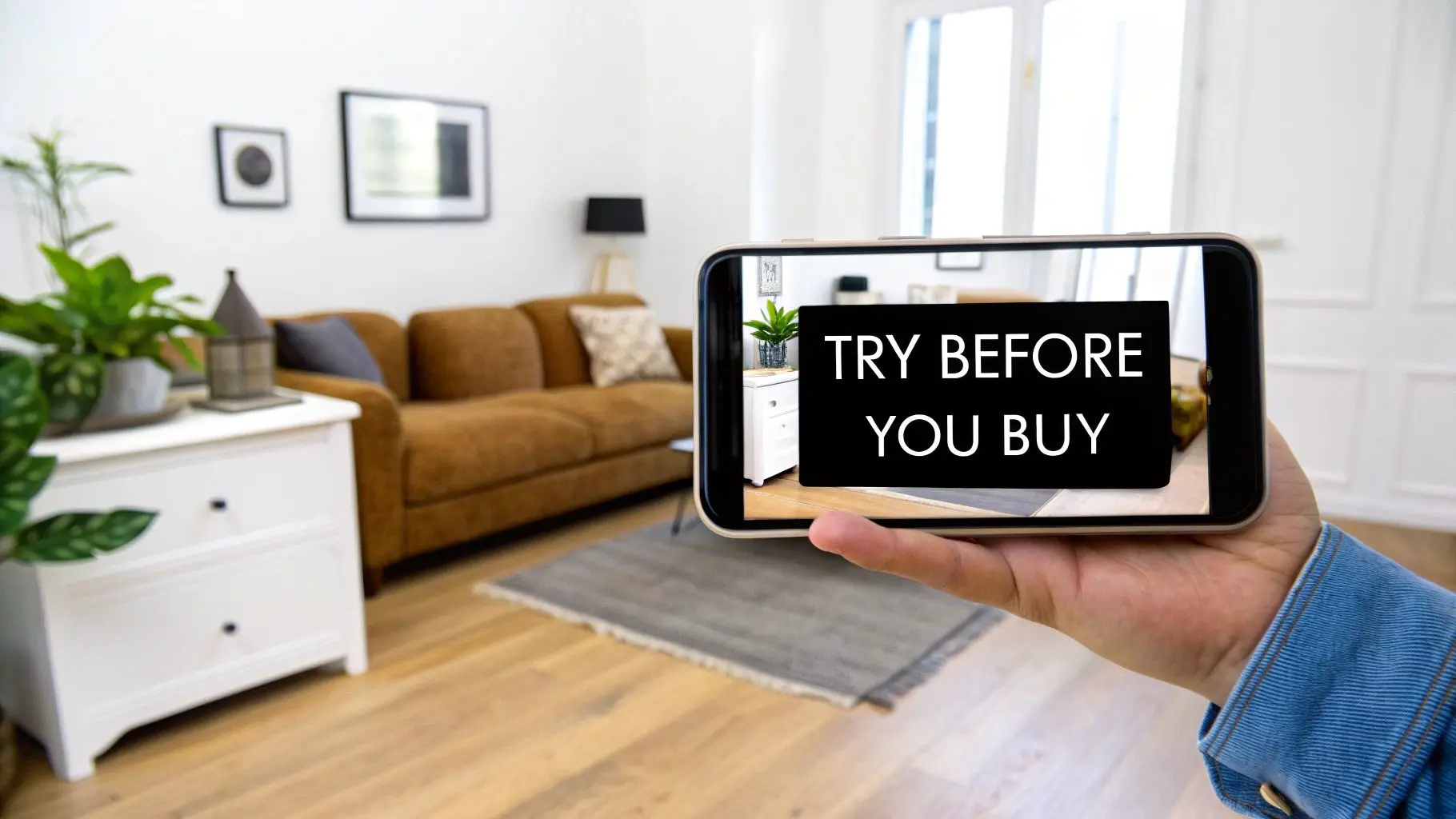
At its heart, augmented reality advertising builds a bridge between the digital stuff on our screens and the physical world around us. Unlike Virtual Reality (VR), which whisks you away to a completely new, artificial world, AR simply adds to the reality you’re already in. Think of it as adding a dynamic, interactive layer to what you see. This clever approach does something remarkable: it turns someone who was just passively watching into an active participant, completely changing the dynamic between a brand and its audience. And this isn't some far-off, futuristic concept. It's a genuinely practical tool that works on the one device nearly everyone has in their pocket: their smartphone. By using the cameras and powerful processors already built-in, brands can deliver deeply immersive experiences without anyone needing special goggles or expensive kit.
Why Is AR So Effective?
The real power of augmented reality advertising comes from its ability to create personal, memorable interactions. Instead of just telling a customer about a product, you can let them experience it in their own home, on their own terms. This hands-on approach builds confidence and gives people a real reason to act. Here’s a look at why it works so well:
- •Sky-High Engagement: AR adverts grab and hold attention for far longer than traditional static or video ads. We’re not talking seconds here; some studies show engagement times soaring past the one-minute mark.
- •Unforgettable Brand Recall: The novelty and pure interactivity of AR experiences make them stick in the mind. In fact, UK agencies have reported up to 20% better recall rates for AR campaigns compared to standard formats.
- •Removing Purchase Doubts: "Try before you buy" experiences, like virtual try-ons for clothes or furniture placement tools, tackle customer uncertainty head-on. This has been shown to slash product returns by a massive 25-40%.
The UK market is already all-in. In 2024 alone, the UK's augmented reality market pulled in an impressive USD 4,131.2 million in revenue, with projections showing it could rocket to USD 25,763.2 million by 2030. If you want to get a better handle on its strategic value, it's worth exploring how you can transform your marketing strategy with Augmented Reality Marketing. To provide a quick overview, this table breaks down the core benefits for any marketing team considering AR.
AR Advertising at a Glance: Key Benefits for Marketers
| Benefit | Description | Example Metric |
|---|---|---|
| Deeper Engagement | Interactive experiences hold user attention far longer than passive ads. | Average dwell times exceeding 60-75 seconds. |
| Increased Conversions | "Try before you buy" features build purchase confidence and reduce doubt. | Conversion rate lifts of 90% or more for AR-enabled products. |
| Better Brand Recall | Novel, fun, and memorable interactions make your brand unforgettable. | Up to 20% higher brand recall than traditional advertising. |
| Lower Return Rates | Visualising products in a real-world context ensures a better fit for customers. | 25-40% reduction in product returns. |
| Rich Data Insights | Track how users interact with 3D models to inform product and marketing decisions. | Analysis of user interaction hotspots on a 3D product model. |
By moving beyond simple viewing and inviting people to actively participate, augmented reality advertising gives brands a genuinely powerful way to connect with their audience, deliver real value, and smash their business goals.
Exploring the Main Types of AR Ads
Augmented reality advertising isn’t a one-size-fits-all solution. Far from it. The real power of the technology comes from its flexibility, with different formats built to suit specific campaign goals, user situations, and of course, budgets. Getting to grips with these types is the first step toward picking the right tool for the job. Each format offers a completely unique way to connect with an audience, from simple, snappy interactions to deeply immersive product visualisations. The choice really boils down to what you want your audience to do and where you want them to do it.
Marker-Based AR
Marker-based AR is probably the format you’ve seen the most. It works by using a specific physical image as a trigger, think of a QR code on a coffee cup, a brand logo, or a picture in a magazine. When a user points their phone’s camera at this ‘marker’, the AR experience springs to life on their screen. This approach is fantastic for bridging the gap between physical products or print media and a rich digital experience. Imagine a customer scanning your product packaging to see a 3D character pop up and explain the benefits. Or a magazine reader scanning an ad to watch a car drive right off the page. It's a direct, effective way to add a layer of digital magic to everyday objects.
Markerless AR
As the name suggests, markerless AR doesn't need a specific trigger image to get going. Instead, it uses the clever sensors and cameras already in a smartphone to understand the physical environment around it, detecting flat surfaces like floors, walls, and tabletops. This is what allows users to place virtual 3D objects right into their own space. This is the tech behind all those brilliant "try before you buy" experiences. Some of the biggest use cases include:
- •Furniture Retail: Letting customers drop a virtual sofa into their living room to see how it fits the space and matches the decor.
- •Automotive: Allowing a potential buyer to place a full-scale 3D model of a new car on their own driveway.
- •Fashion: Enabling virtual try-ons for everything from trainers to sunglasses, where the digital item is anchored perfectly to the user.
Markerless AR is a game-changer for e-commerce because it helps close the "imagination gap." In fact, research shows that a massive 40% of users are more likely to buy a product after experiencing it in AR.
Location-Based AR
Location-based AR, sometimes called geo-based AR, uses a phone's GPS and compass to overlay digital content onto specific real-world places. The experience is tied to a particular geographical coordinate, which means users have to physically be in that spot to unlock it. This format is perfect for creating interactive city tours, massive scavenger hunts, or one-of-a-kind experiences at events and landmarks. A local history group could create an AR tour where pointing your phone at a building shows you what it looked like 100 years ago. Brands can also create gamified treasure hunts that guide customers right to their front door.
WebAR and Social Lenses
Perhaps the most accessible format of all is WebAR. This technology allows AR experiences to run directly within a standard mobile web browser, no app download necessary. This is huge. By removing the friction of visiting an app store, you can get your campaign in front of the widest possible audience, fast. In a similar vein, social AR Lenses and filters on platforms like Snapchat and Instagram offer absolutely incredible reach. These are fun, shareable experiences that can turn your audience into genuine brand ambassadors. But crafting social AR that people actually want to share is a real skill. Our guide on designing Snapchat filters for UK brands dives into what it takes to create content that clicks and drives that all-important organic reach.
How AR Advertising Drives Business Growth and ROI
Sure, the "wow" factor of augmented reality gets a lot of attention, but savvy businesses know that novelty doesn't pay the bills. The real reason augmented reality advertising is taking off is its proven power to deliver tangible, measurable results. It shifts marketing from a one-way broadcast into a two-way conversation, making a direct impact on everything from customer engagement to your bottom line. For UK businesses, AR isn't a futuristic gamble anymore; it's a strategic investment that pays dividends. It offers a direct line to solving common headaches, like soaring return rates in e-commerce or the challenge of showing off a complex product. By letting customers truly experience products in their own space, AR builds a level of confidence and connection that a static ad could never hope to achieve.
Slashing Return Rates with Virtual Try-Ons
One of the most immediate and powerful uses of AR for retailers is the "try before you buy" model. For anyone in fashion, beauty, or furniture, this is a genuine game-changer. Customers can simply use their smartphone camera to see how a pair of trainers looks on their feet, test a new shade of lipstick, or check if that armchair really fits in their living room. This simple act of visualisation has a massive impact on profitability. It removes the guesswork and buyer's remorse that leads to product returns, a huge and costly problem for any e-commerce business. When customers know exactly what they’re getting, satisfaction goes up, and the operational nightmare of managing returns goes down.
Boosting Conversions and Engagement
Traditional digital ads are in a constant battle for a split-second of attention. AR experiences, on the other hand, are built to be explored. Their interactive nature means people spend far more time engaging with a brand’s content.
Research consistently shows that AR ads can hold a user's attention for up to 75 seconds, a lifetime compared to the fleeting glance a typical banner ad gets. This extended dwell time forges a much stronger, more memorable connection with your brand.
This deeper engagement translates directly into higher conversion rates. Once a customer has virtually placed a sofa in their home or tried on a watch, their intent to purchase skyrockets. In fact, studies have found that AR can lift conversion rates by an incredible 94% compared to standard advertising. The market growth tells the same story. The UK Mobile Augmented Reality Market is projected to climb from USD 788.41 million in 2025 to an astounding USD 29,335.5 million by 2035. This isn't just hype; it's driven by solid results. Personalised AR ads are already seeing 45% higher click-through rates and delivering a 70% lift in brand awareness. You can read the complete research on the UK mobile AR market to get the full picture.
Qualifying Leads with Immersive Previews
The benefits of augmented reality advertising reach far beyond retail. Think about high-value industries like property and automotive, where the sales process hinges on finding properly qualified leads.
- •Estate Agents: Instead of just flat photos, agents can offer immersive AR property tours. A potential buyer can walk through a home’s layout or even see how their own furniture would fit, all from their current sofa. This weeds out casual browsers, ensuring only genuinely interested people book a physical viewing.
- •Car Dealerships: Automotive brands are using AR to let customers drop a full-scale model of a new car right onto their driveway. People can walk around it, peek inside, and play with different colours and features. It’s a powerful pre-showroom experience that drives high-quality footfall to the dealership.
Gaining Deeper Customer Insights
Perhaps one of the most underrated perks of AR is the wealth of user data it generates. A static ad can only really tell you about clicks and impressions. An interactive AR experience, however, can track so much more. Analytics can reveal which virtual products people engage with most, what colours they prefer, or how long they interact with certain features. This data offers priceless insights into consumer behaviour, which can inform everything from your next product design to your broader marketing strategy. It turns a simple advert into a powerful market research tool, closing the loop between a campaign and your business intelligence.
The AR Advertising Production Journey
Ever wondered how a captivating augmented reality advertising campaign gets from a rough sketch to a seamless experience on your phone? It's a journey that blends sharp creative vision with deep technical know-how. When you pull back the curtain, you find a structured process designed to turn ambitious ideas into polished, high-performing digital realities. This isn't just about building a flashy effect; it's about crafting an experience that feels completely natural to the user while hitting specific business goals. The real work begins long before a single line of code is written, starting with a clear strategy and a shared vision for what we want to achieve.
From Concept to Interactive Prototype
The first leg of the journey is all about discovery and design. We kick things off with a strategy session to nail down the brand’s objectives. Are we trying to drive sales for a new product, boost brand awareness, or show customers how a new feature works? This core goal shapes every single decision that follows. Next up, the creative team gets to work. Ideas are fleshed out into storyboards and concept art, mapping out the user's journey from start to finish. This is a vital step; it ensures everyone is on the same page with the look, feel, and flow of the AR experience before we dive into production. It’s where we answer the big questions:
- •What will the user see first? Grabbing attention from the get-go is everything.
- •How will they interact with 3D objects? Actions like tapping, swiping, or moving their phone need to feel instinctive.
- •What's the final call-to-action? We have to gently guide the user toward the goal, whether that’s visiting a website or making a purchase right there and then.
Once the concept is locked in, we build a prototype. Think of it as a basic, functional version of the experience that lets us do some early user testing. It's the perfect way to iron out any usability kinks and refine the core mechanics before committing to full-scale development.
Building the Experience with Powerful Tools
With a tested prototype in hand, full production can begin. This is where our artists meticulously create stunning 3D assets, from lifelike product models to animated characters, and optimise them to run smoothly on mobile devices. At the same time, the development team gets cracking in powerful real-time engines like Unity or Unreal Engine. These platforms are the bedrock of the entire experience, handling the heavy lifting of rendering graphics, managing user input, and making the AR feel responsive and real. The magic that connects these engines to the phone's hardware comes from Software Development Kits (SDKs) provided by Apple and Google:
- •ARKit (iOS): Apple's framework lets developers build AR experiences for iPhones and iPads, tapping into their advanced cameras and sensors for world tracking.
- •ARCore (Android): This is Google's equivalent, enabling AR on a massive range of Android devices by understanding and mapping the environment.
These SDKs are the essential bridge that allows virtual objects to appear convincingly anchored in the real world. For a deeper look at the technical side, our guide to AR mobile app development covers the whole process in more detail. This production journey isn’t a one-off task; it feeds into a continuous cycle of business growth, as the diagram below shows.

A well-produced AR campaign drives engagement, which in turn leads to conversions and generates valuable user insights that fuel future strategies.
Choosing Your AR Development Platform: Unity vs Unreal
Picking the right engine is a crucial decision that influences the entire project. While both Unity and Unreal Engine are incredibly capable, they have different strengths that make them better suited for certain types of AR advertising campaigns.
| Feature | Unity | Unreal Engine |
|---|---|---|
| Learning Curve | Generally considered more beginner-friendly with extensive community support. | Steeper learning curve, but powerful visual scripting (Blueprints). |
| Asset Store | Massive marketplace with a huge variety of pre-made assets and tools. | Growing marketplace, known for high-fidelity, AAA-quality assets. |
| Target Platforms | Excellent cross-platform support, especially for mobile and web-based AR. | Traditionally stronger for high-end console/PC, but rapidly improving mobile. |
| Visual Fidelity | Capable of stunning visuals, though often requires more optimisation. | Renowned for photorealistic, out-of-the-box graphics and lighting. |
| Best For | Interactive brand experiences, mobile games, WebAR, and rapid prototyping. | High-end product visualisations, automotive configurators, cinematic AR. |
Ultimately, the choice often comes down to the specific project goals. For campaigns prioritising broad mobile reach and interactivity, Unity is often the go-to. For those demanding breathtaking visual realism for a premium product, Unreal Engine might be the better fit.
Testing, Launch, and Iteration
The final stage is all about polish. The experience goes through rigorous Quality Assurance (QA) testing across a wide range of devices to make sure it works flawlessly for everyone. We hunt down performance bugs, visual glitches, and any frustrating usability issues. But the journey doesn't end at launch. We monitor analytics closely to see how people are actually interacting with the experience. This data provides invaluable feedback, showing us what’s working well and uncovering opportunities for future improvements. It ensures the campaign doesn't just launch well, it continues to deliver exceptional results over time.
Best Practices for High-Impact AR Experiences
A brilliant idea is only half the battle in augmented reality advertising. Flawless execution is what separates a forgettable gimmick from a campaign that genuinely connects with people and gets results. To craft an AR experience that doesn't just look stunning but also performs brilliantly, you need a solid playbook. This isn't just about building something that works on a technical level. It’s about creating an interaction that feels intuitive, adds real value, and is completely seamless from the moment someone engages. Nailing these details is how you turn curious users into loyal customers.
Design an Intuitive User Interface
The best AR user interface (UI) is one people barely notice. It should feel so natural that even a first-timer understands what to do without needing a complicated tutorial. The aim is to remove any friction that might make them give up and close the window. Keep on-screen instructions to a minimum. Instead, lean on simple, universally understood gestures like tapping to place an object or pinching to resize it. Remember, the focus should always be on the magic of the augmented reality experience itself, not on figuring out the controls.
Optimise 3D Models for Performance
High-quality 3D models are the heart and soul of any AR experience, but it’s a delicate balancing act. An asset that looks photorealistic but causes the user's phone to lag or overheat will shatter the illusion in an instant. This is where expert optimisation comes in. It’s a technical craft that involves:
- •Reducing Polygon Count: Simplifying the geometry of 3D models without losing visual quality.
- •Compressing Textures: Using efficient file formats so that textures look sharp but load quickly.
- •Implementing Levels of Detail (LODs): Swapping in simpler models when an object is far away and loading more detailed ones as it gets closer.
A well-optimised experience runs smoothly across a huge range of devices, from the latest flagship phone to older models. This technical discipline is absolutely crucial for reaching a wide audience and avoiding user frustration.
Craft a Clear Call-to-Action
Every great AR ad needs a purpose. Once the initial "wow" moment fades, what do you want the user to do next? A vague or missing call-to-action (CTA) is a massive missed opportunity. The CTA should feel like a natural end to the experience, guiding them to the next step. Whether it's "Shop Now," "Learn More," or "Share with Friends," the instruction has to be prominent, clear, and make sense in the context of what they just did. This is how you convert genuine engagement into a measurable business outcome.
Ensure Contextual Relevance
Finally, the most successful AR advertising just makes sense in the user's environment. The experience should feel like a natural part of their physical world, not just a random digital object plopped into it. For a furniture brand, this means making sure a virtual sofa is realistically scaled to fit a living room. For a game promotion, it might mean having a character interact with real-world surfaces like tables and chairs. This kind of contextual awareness makes the whole thing more believable, immersive, and memorable, leaving a lasting positive impression of your brand.
How to Choose the Right AR Production Partner
So, you’re ready to bring an augmented reality advertising campaign to life? Fantastic. The next decision you make is easily the most critical one: choosing the right production partner. The ideal studio is a rare hybrid , part creative storyteller, part technical powerhouse. You need a team that can take your brand's goals and spin them into an immersive experience that actually works, flawlessly, in the real world. Finding that partner means looking past a polished showreel. You're looking for a team with a proven track record, deep technical know-how, and a genuinely collaborative spirit. Here at Studio Liddell, we've been in the digital production trenches since 2019, starting with broadcast animation and evolving right alongside the tech to pioneer AR and VR experiences. That history gives us a unique perspective, blending years of storytelling craft with razor-sharp technical execution.
Key Questions to Ask Potential Partners
When you start talking to studios, asking the right questions will quickly separate the experts from the enthusiasts. A solid partner won’t just tolerate a deep dive into their process and portfolio; they’ll welcome it. Start by digging into their technical foundations:
- •Engine Expertise: Do they have serious, hands-on experience with both Unity and Unreal Engine? Ask for specific projects they’ve built in each and, more importantly, why they chose one engine over the other for that particular job.
- •Development Pipeline: Get them to walk you through their entire project management process. How do they get from that initial brief to final delivery and analytics reporting? What does that journey look like for you as the client?
- •Platform Experience: Have they developed across the board? You want to see experience with app-based AR (using ARKit/ARCore) as well as the lighter, faster browser-based WebAR.
Next, you need to gauge their creative and strategic thinking. Remember, you aren't just hiring coders; you're bringing on creative problem-solvers. In a way, it's a lot like vetting top digital marketing agencies , you’re looking for a partner who gets the bigger picture and understands your business objectives. The core principles of finding a great fit are the same: look for proven results and a strategic mindset.
Evaluating Their Portfolio and Process
A strong portfolio is more than a highlight reel of cool projects. It's hard evidence that they can deliver for clients like you. Look for case studies that are relevant to your industry and campaign goals. Don't just look at the final product; pay close attention to the results it generated. Did it actually increase sales, boost engagement, or bring in qualified leads?
A studio’s process is every bit as important as its portfolio. You need a transparent, collaborative workflow with clear milestones for feedback and approvals. That’s what keeps a project on track and ensures the final result is perfectly aligned with your vision.
Finding the right team can feel like a huge undertaking, but getting this step right is the foundation for success. To help you navigate the process, our guide on how to find and choose the right mobile app development agency offers a ton of valuable insights that apply just as well to picking an AR partner. Ultimately, the right partner becomes an extension of your own team, guiding you confidently into this exciting new advertising frontier. They’re the ones who bring the technical muscle and creative flair needed to make your big ideas a reality.
Common Questions About AR Advertising
As augmented reality moves from being a niche novelty to a mainstream marketing tool, a lot of practical questions naturally come up. To help clear the air, we’ve pulled together answers to some of the most common queries we hear from brands who are starting to explore this exciting space. Think of this as your quick-start guide to the practicalities of launching an AR campaign, from what it might cost to how you’ll measure the results.
How Much Does an AR Advertising Campaign Cost?
There's really no single price tag for an AR campaign; the cost can swing wildly depending on how ambitious you want to be. A simple social media filter or a straightforward marker-based experience might start from just a few thousand pounds. On the other hand, a complex, custom-built application with super-detailed 3D assets and advanced interactivity is going to require a more significant investment. The main things that drive the cost are the detail of the 3D models, the level of user interaction you want, your choice of platform (a dedicated app versus WebAR), and how long the campaign will run. The best way forward is always to chat with a studio to get a detailed quote based on your specific brief.
Do Users Need to Download an App for AR Ads?
Not always, which is fantastic news for getting people involved. While a dedicated app can offer richer, more complex experiences, WebAR technology lets people jump into augmented reality content straight from their phone's web browser. All it takes is clicking a link or scanning a QR code, no trip to the app store needed. This removes a huge barrier for users, making WebAR a brilliant choice for campaigns aiming for wide reach and instant engagement. The choice between an app and WebAR really just boils down to your specific campaign goals.
How Do You Measure the Success of an AR Campaign?
Measuring an AR campaign’s success goes deeper than just looking at standard digital metrics. The key performance indicators (KPIs) you’ll want to track are much more focused on how users actually behave and interact with the experience. A few essential metrics include:
- •User Engagement Time: How long are people actively playing with the AR experience?
- •Interaction Rate: What percentage of users engage with the interactive bits and pieces?
- •Share Rate: How often is the experience shared on social media? This is a massive indicator of organic reach.
- •Conversion Rate: How many users go on to complete a desired action, like making a purchase?
Analytics can also show you which virtual items are the most popular or even where your users are physically located. This gives you priceless consumer insights that can shape future product designs and marketing strategies.
Which Industries Benefit Most From AR Advertising?
While AR is incredibly versatile, some industries are seeing exceptional returns right now. Retail and eCommerce are leading the charge, using virtual try-ons for everything from trainers to furniture, which has been proven to significantly cut down on product returns. Other sectors getting huge benefits include:
- •Automotive brands that are building virtual showrooms.
- •Entertainment companies creating immersive promotional games.
- •Education and Healthcare using AR for interactive learning and training simulations.
At the end of the day, any industry with a product that gets a boost from being visualised in the user's own space is a perfect candidate for augmented reality advertising. Ready to explore how augmented reality can bring your brand's story to life? The team at Studio Liddell has been crafting high-quality digital content since 2019, blending creative storytelling with deep technical expertise. Book a production scoping call today to discuss your vision.