Application Development London: Your Expert Guide
You're probably in one of two positions right now. Either you've got a solid product idea and need a London team to build it properly, or you've already spoken to a few agencies and realised most of the sales conversations sound the same. That's the problem with buying application development in London. There's plenty of supply, plenty of jargon, and far too many proposals that make complex delivery sound easy. It isn't easy. It can be done well, but only if you treat procurement as risk management, not as a beauty parade. The London market is large and competitive. The UK's app development market is projected to reach £32.3 billion in 2026, after expanding at a 10.9% CAGR between 2021 and 2026, with 15,282 businesses in the industry, according to IBISWorld's UK app development industry data. That same source says London accounts for 46% of all developer vacancies nationwide, which tells you two things. There's deep capability here, and there's serious competition for talent. If you want a good outcome, don't buy on charm, day rates, or a polished homepage. Buy on fit, process, clarity, and the studio's ability to reduce delivery risk before a line of code is written.
First Steps Before You Search for a Studio
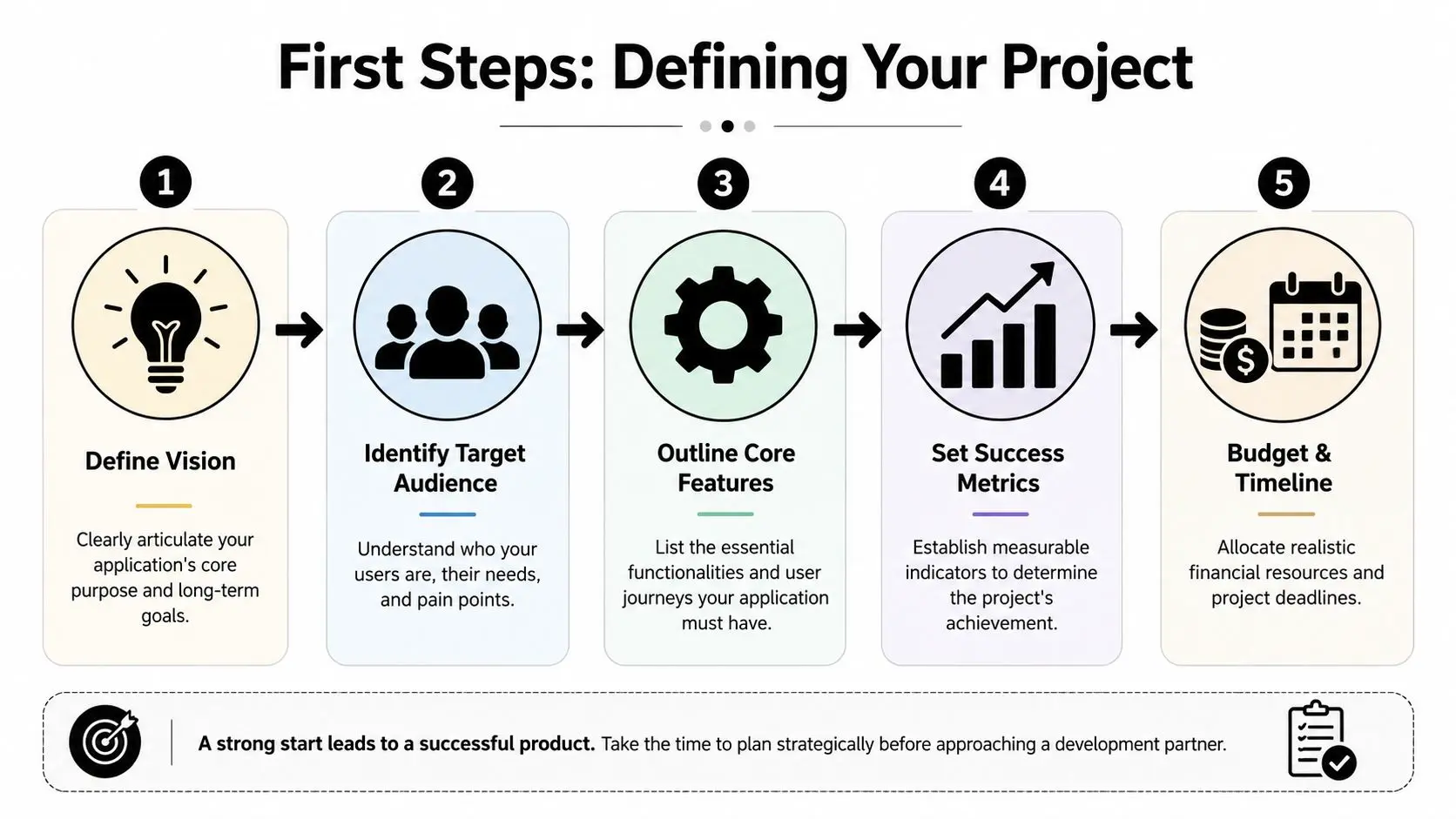
Most bad projects start before the supplier is even chosen. The brief is vague, internal stakeholders disagree, the budget is detached from reality, and nobody has decided what success looks like. That's why I push clients to slow down before they contact any London studio. A disciplined discovery-first approach is one of the few parts of software procurement that consistently protects budget. Discovery usually accounts for 10% to 15% of total app spend, with UK-reported brackets from £5k to £40k+, and underfunding it is a common way to push expensive changes into build. The same market research also notes that one study found projects with poor requirements engineering had a 65% chance of missing time, budget, or quality targets, based on a study of 600 UK and US engineers cited by Business of Apps' app development cost research.
Start with the commercial problem
An app isn't a strategy. It's a delivery mechanism. If you can't explain the business problem in plain English, you're not ready to buy development. “We need an app” is not a brief. “We need to reduce booking friction for returning customers” is a brief. “We need a field tool that works offline for engineers” is a brief. “We need an XR activation for an event audience” is a brief. Write down these five points before speaking to anyone:
- Commercial objective. What business result should the product support?
- Primary user. Who is the app for, and what job are they trying to do?
- Core action. What is the single most important thing the user must be able to do?
- Constraints. Budget, deadlines, internal systems, compliance, approval chains.
- Success criteria. What has to be true for the project to count as a success?
Decide what must exist on day one
Clients often mix MVP thinking with wishlist thinking. That creates chaos. Use three buckets instead:- •Must-have functionality. The app fails without these capabilities.
- •Should-have functionality. Valuable, but can wait if needed.
- •Future roadmap. Useful ideas that shouldn't distort the first release.
Good discovery proves its worth. Teams can prototype user journeys, test assumptions, and settle architecture choices before build. If you want a grounded starting point, Studio Liddell's guide to turning an app idea into a launch-ready product is worth reading before you brief vendors.
Practical rule: If a feature can't be tied to a user need, operational requirement, or business goal, it probably doesn't belong in phase one.
Pick the right platform, not the fashionable one
Not every problem needs native iOS and Android. Not every workflow belongs in a browser. Not every brand experience should be a conventional app. Sometimes a mobile web product is the smarter first release. Sometimes a tablet tool is enough. Sometimes the right answer is a real-time 3D application or immersive experience built in Unity or Unreal because the product goal is training, simulation, or engagement rather than transactional utility. Buyers who do this work early have better supplier conversations. They don't ask, “What would this cost?” They ask, “Given this user, this workflow, and this constraint set, what should we build first?” That's a much stronger procurement position.
Finding and Vetting London Development Partners
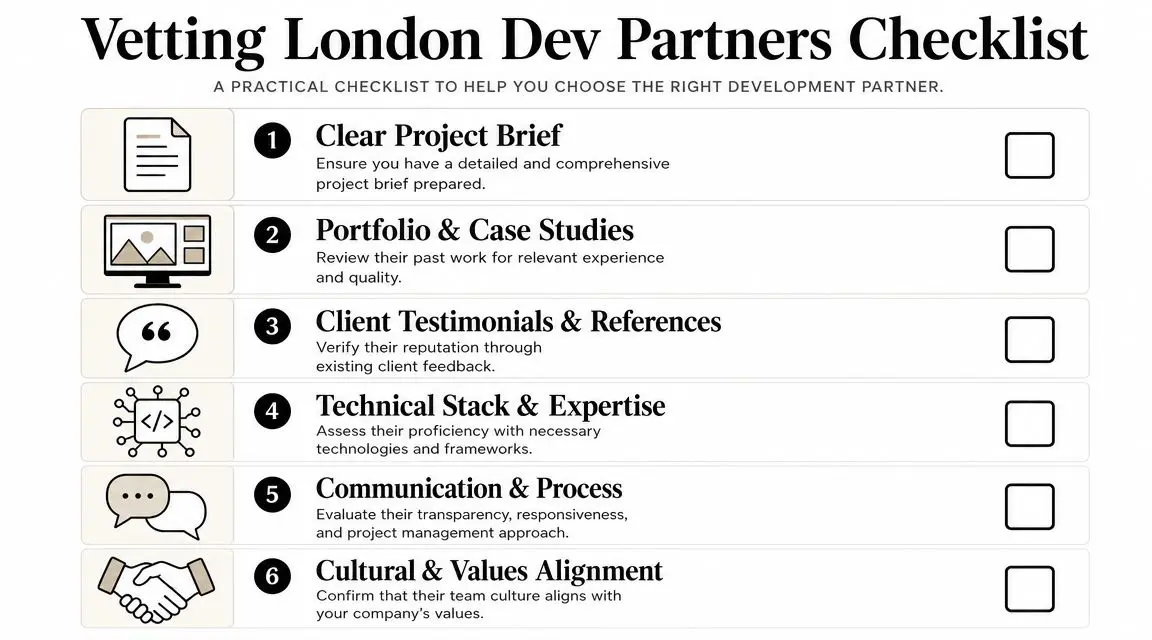
London gives you range. Boutique mobile specialists. Enterprise software consultancies. XR teams. Product studios. Full-service digital production companies. The difficulty isn't finding options. It's filtering them properly. A studio's site will tell you what it wants to sell. Its work will tell you what it can deliver.
Read portfolios like a producer, not a shopper
Ignore generic claims about innovation, smooth delivery, and user-centric design. Look for evidence of relevant complexity. If you need a consumer mobile product, find shipped mobile work with clear UX thinking. If you need a training app, look for simulation or enterprise workflows. If you need an experiential build, look for game engine work, optimisation discipline, and production craft. Breadth can matter when your project sits across categories. For example, a studio with both immersive and technical communication work often has stronger cross-functional thinking. Studio Liddell's portfolio includes projects like the mixed-reality game “Dance! Dance! Dance!” and the technical visual communication work for “GeoEnergy NI”, which is the sort of spread that can be useful when a brief combines product logic, visual storytelling, and interactive delivery.
Pressure-test the stack decision
One of the most important buying decisions is whether your project should be built with low-code, traditional engineering, or a hybrid approach. The pressure to choose low-code is real. The UK low-code application development platform market generated USD 1,129.9 million in 2023 and is projected to reach USD 4,037.1 million by 2030, with 20.1% CAGR from 2024 to 2030, according to Grand View Research's UK low-code market outlook. That growth doesn't make low-code universally right. It just means more buyers are being sold speed. Use this filter:
- •Choose low-code when the workflow is structured, the integrations are manageable, and internal teams need to iterate business logic quickly.
- •Choose traditional engineering when performance, custom UX, scalability, or complex integrations sit at the heart of the product.
- •Choose hybrid when a conventional codebase should handle the core product, but low-code can support admin tooling, internal workflows, or peripheral operations.
A fast build with weak governance is still a risky build.
If an agency pushes one answer for every brief, that's a red flag.
Ask questions that expose delivery maturity
You don't need a long RFP. You need a sharp one. Ask every potential partner the same questions and compare the quality of the answers.
- •Team composition. Who will work on the project, and who will own delivery day to day?
- •Relevant experience. Which past projects resemble this brief in complexity, not just in sector?
- •Technical recommendation. Why this stack, this architecture, and this hosting approach?
- •Discovery method. What happens before build starts, and what outputs do you produce?
- •Change control. How are scope changes documented, priced, and approved?
- •Communication cadence. How often will we review progress, risks, blockers, and decisions?
- •QA responsibility. Who writes test plans, who signs off acceptance criteria, and how is UAT managed?
- •Post-launch support. What happens after release if issues appear or priorities shift?
If you want a practical shortlist process, Studio Liddell's article on how to find and choose the right mobile app development agency is a useful reference point. The best London partners won't just answer your questions. They'll improve the brief while answering them.
Decoding Pricing Models and Contracts
Pricing confusion causes more friction than most technical issues. Clients think they're buying certainty. Studios think they're protecting flexibility. The contract ends up sitting in the middle, doing neither well. There are three common commercial models in application development London procurement. None is automatically right. Each suits a different risk profile.
Application development pricing models compared
| Model | Best For | Pros | Cons |
|---|---|---|---|
| Fixed Price | Small projects with stable scope and clear acceptance criteria | Budget visibility, straightforward approvals, easier procurement | Weak fit for changing requirements, change requests become contentious, padding often gets baked into estimates |
| Time and Materials | Complex or evolving products where learning continues during delivery | Flexible, transparent, better for iterative decision-making, supports discovery-led development | Final cost can move, requires active client engagement, weak governance can inflate spend |
| Retainer | Ongoing product development, support, optimisation, and roadmap work | Team continuity, easier prioritisation, good for long-term partnership | Less suitable for one-off builds, requires trust and active backlog ownership |
Match the model to the brief
Fixed price works when the scope is genuinely settled. That's rarer than most buyers think. If the product is small, the workflows are known, and the acceptance criteria are explicit, fixed price can work well. Time and materials is often the honest model for serious software. It accepts that decisions will evolve. It also forces everyone to handle prioritisation properly. If the studio is good, you'll get clearer visibility into trade-offs instead of artificial certainty. Retainers make sense after launch, or when a product is becoming a long-term operational asset. They're especially useful when you know iteration won't stop after the first release.
The wrong pricing model doesn't save money. It just moves the argument to a later date.
The SOW matters more than the day rate
A weak Statement of Work is where projects start drifting. A strong one should define deliverables, assumptions, exclusions, dependencies, review stages, acceptance criteria, commercial triggers for change, and who signs off what. I'd also push clients to think beyond build. Support, maintenance, and service obligations need the same scrutiny as initial development. If you want a clear non-software example of how support terms, responsibilities, and service expectations should be framed, Networking2000's IT support guide is a sensible reference. For budgeting conversations on app work specifically, Studio Liddell's UK app development pricing guide helps frame what should and shouldn't be included in a commercial proposal. Don't sign a contract that leaves key definitions open to interpretation. Ambiguity is not flexibility. It's deferred conflict.
Managing the Application Development Lifecycle
Once a project is signed, buyers often disappear until demo day. That's a mistake. The healthiest projects have active client involvement, but structured involvement, not random interference. What you want is a delivery rhythm with clear decisions at clear moments.

Use gates before sprints
Methodology matters more than most agencies admit. One UK-cited study reported that Agile projects were 268% more likely to fail than non-Agile counterparts, and broader software data in the same reporting said only 31% of projects are completed on time, within budget, and to requirements, according to DRJ's report on software project failure benchmarks. That doesn't mean sprints are bad. It means uncontrolled Agile is bad. A safer structure for many app projects looks like this:
- Kick-off and alignment. Confirm goals, roles, communication routes, and approval responsibilities.
- Architecture and risk review. Resolve integrations, security assumptions, performance needs, and environment strategy.
- UX and prototype validation. Test the journeys before detailed coding.
- Sprint delivery. Build in short increments once the foundation is stable.
- Release hardening. Fix defects, verify acceptance criteria, and prepare deployment.
Expect disciplined communication
You should know what's happening without chasing people. Good studios usually establish a simple operating cadence:- •Weekly delivery review for progress, blockers, and near-term decisions
- •Regular demo sessions tied to real increments, not slides
- •Shared backlog visibility so priorities don't vanish into email chains
- •Clear decision logs when scope, design, or architecture changes
If a team can't explain how it escalates risks, manages dependencies, or handles delayed client feedback, expect pain later.
Broad Agile adoption fails when teams sprint on features before they've stabilised performance, security, and integration requirements.
Know your role as the client
You don't need to manage developers. You do need to make timely decisions, consolidate stakeholder feedback, and avoid introducing late surprises through side conversations. The client who says “just get on with it” often creates more delay than the client who gives fast, organised feedback. Good delivery is collaborative. The studio owns execution. You own clarity and decision-making.
From Quality Assurance to a Successful Launch
A final build is not a finished product. It's a candidate for release. Clients who treat QA as a mop-up exercise usually pay for it later in support costs, reputation damage, and internal frustration. Testing is where you confirm that the product behaves the way the brief said it should behave.
QA is a delivery function, not a checkbox
Strong QA covers far more than obvious bugs. It checks usability, edge cases, device behaviour, environment consistency, regression risk, and release readiness. That matters because software rarely fails in the happy path. It fails in awkward states. Weak connectivity. partial form completion. stale sessions. unexpected input. inconsistent permissions. Those are the problems users remember. During this phase, your team should run User Acceptance Testing against agreed acceptance criteria, not vague impressions. “It looks fine” is not UAT. “This workflow passes the agreed scenarios” is UAT.
Launch in a controlled way
A smart launch plan reduces operational stress. For some products, that means staged rollout, internal release, limited user groups, or market-specific release sequencing before full promotion. If you want a practical overview of that approach, the soft launch explainer from Marketing For Apps By @designerants is useful background reading. Soft launching isn't necessary for every application, but the logic is sound. Expose the product to reality in a controlled environment before you expose it to everyone.
Plan support before the release date
Post-launch support shouldn't be negotiated after the app is live. Decide it during procurement. Cover these points in advance:
- •Incident ownership. Who triages and fixes production issues?
- •Response expectations. What gets treated as urgent, and what doesn't?
- •Maintenance scope. Are OS updates, dependency updates, and minor fixes included?
- •Roadmap process. How are enhancements requested, estimated, and prioritised?
Launch day is the start of operational responsibility, not the end of production responsibility.
If the product matters to your business, arrange support like it matters. That may be a retainer, a support contract, or a defined maintenance agreement. What matters is clarity.
Building a Long-Term Strategic Partnership
The strongest application development London relationships don't behave like one-off transactions. They behave like product partnerships. That matters because London sits inside the UK's most concentrated digital-economy corridor. Government data says data-driven companies generated £343 billion in annual turnover in 2023, equal to 6% of total UK turnover, and over 80% of that turnover came from large data-driven companies in London, the South East, and the East of England, according to the UK government's data-driven market publication. In plain terms, your application isn't just a digital asset. In this region, it often sits close to the core commercial engine of the business. That's why I'd choose a partner using four tests.
The four tests that matter
- •Transparency. They tell you what they know, what they don't know, and where the risks are.
- •Operational discipline. They can show how decisions move from brief to build to release.
- •Technical fit. Their stack and team match your product, not their sales preference.
- •Commercial maturity. They handle scope, IP, support, and change properly in writing.
The last one is non-negotiable. Clarify intellectual property ownership at the start. Who owns the final codebase? What third-party tools or licensed components sit inside it? What can be transferred, and what remains under separate licence? Professional studios answer those questions cleanly. A good partner doesn't just ship version one. They help you make better product decisions over time.
If you're buying application development and want a production-minded conversation rather than a sales pitch, Studio Liddell is one option to consider. They work across apps, XR, animation, and interactive production, which can be useful when a brief needs more than standard mobile delivery. Book a scoping conversation if you want help pressure-testing your brief, delivery approach, and procurement plan before you commit budget.