Advertising an App: The Creative-First Playbook
Your app is finished. The build is stable, the onboarding flow works, and the team has spent months polishing details users may never consciously notice. Then launch week arrives and a significant challenge emerges. Advertising an app isn't just about buying reach. It's about earning attention in a market where every screen is crowded, every platform is noisy, and every install that doesn't become an active user becomes wasted budget. That's the point many teams miss. They treat acquisition like a media problem and creative like packaging. In practice, creative is the delivery system for strategy. It's the thing that turns positioning into clicks, store visits into installs, and installs into retained users. A weak concept with broad targeting still struggles. A sharp concept, expressed through well-produced animation, clear motion design, and channel-fit assets, gives the media plan something worth scaling. In the UK, that opportunity is real and so is the competition. The UK Internet Advertising Bureau reported that UK internet advertising revenues reached £35.5 billion in 2023, with mobile devices accounting for a majority share of digital display consumption, while Ofcom's 2023 data found that 78% of adults used smartphones to browse the internet, which creates repeated exposure opportunities for app-install and retargeting campaigns, as noted in this UK mobile advertising summary.
Your App Is Built Now Comes the Hard Part
Launch doesn't reward the loudest app
Most app teams begin with the same assumption. If the product is good enough, distribution will follow. It rarely works like that. Users don't experience your roadmap, sprint velocity, or technical debt reduction. They experience a thumbnail, a video, a line of copy, a review snippet, and a few seconds of first impression. That means your growth plan has to start where the audience starts, with the assets they see. From a creative production perspective, the entire lifecycle matters:
- •Pre-click attention comes from the hook, framing, and visual distinctiveness.
- •Store conversion depends on whether the promise in the ad matches the store page.
- •Post-install quality depends on whether the campaign attracted the right user in the first place.
When those parts are disconnected, performance slips fast. A slick ad can drive poor-fit installs. A decent ad can send traffic to a weak store page and make the media look ineffective. A strong product can still stall because the creative system around it isn't built to persuade.
Why creative carries more weight now
Privacy changes have made app growth less dependent on neat, user-level attribution and more dependent on broader signals, testing discipline, and creative quality. That returns the advantage to what people control: the message, the craft, and the asset pipeline.
Practical rule: If a team can't explain its app in one clear promise and three visual proofs, it isn't ready to scale paid acquisition.
That's where animation and XR become useful, not ornamental. Good 2D motion clarifies utility fast. Good 3D gives products, worlds, and interfaces more presence. XR can create campaign experiences that help an app stand out in sectors where novelty and interaction support the proposition. None of those formats replaces strategy. They make strategy visible. The strongest app campaigns usually share one trait. Their creative isn't a batch of one-off ads. It's a system. Hooks, edits, cut-downs, store assets, social variants, explainer sequences, and retargeting messages all pull in the same direction.
Laying the Groundwork for Growth
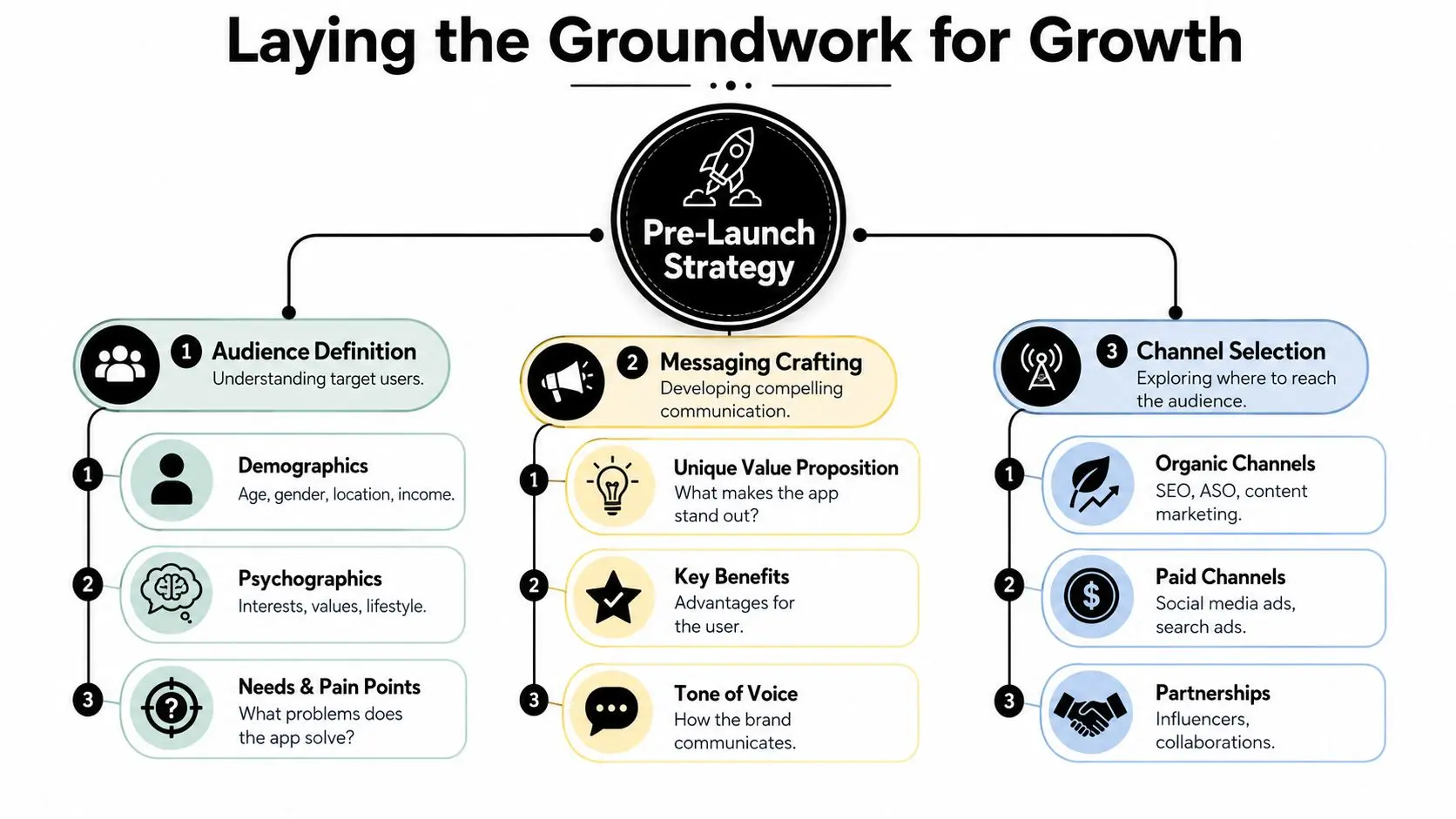
Before spending on acquisition, lock three things: who the app is for, what promise it makes, and how that promise appears in the store.
Start with a real audience, not a broad demographic
“Ages 18 to 44” isn't an audience. Neither is “busy professionals” or “mobile gamers”. Useful audience definition gets specific enough to influence creative choices. Ask practical questions:
- •Context of use
When does the user open the app? During a commute, in a queue, between meetings, at home, in a classroom?
- •Pain point intensity
Is the app solving an urgent problem, a repeated inconvenience, or a leisure need?
- •Motivation to install
Does the user want speed, status, entertainment, productivity, reassurance, or savings?
- •Barrier to action
What would make them hesitate? Complexity, trust, subscription anxiety, low perceived need, or unclear benefit? That work shapes everything downstream. A finance app aimed at anxious first-time budgeters needs reassuring clarity. A competitive game needs energy, spectacle, and social proof. A utility app needs immediate demonstration, not vague brand language. This planning discipline also mirrors broader content strategy work. Studio teams often use the same audience-first approach across acquisition assets, landing pages, and social campaigns, as discussed in this strategic content planning guide.
Build a messaging hierarchy
A good app ad doesn't try to say everything. It ranks ideas. A simple hierarchy looks like this:
- Core promise
- Proof points
- Objection handling
- Call to action
The ad should answer “why should I care?” before it answers “how does it work?”
Treat the store page as part of the campaign
The App Store or Google Play listing isn't a library entry. It's a conversion environment. If the ad sets one expectation and the store page presents another, users hesitate. Review these elements together, not separately:| Store element | What it needs to do |
|---|---|
| App icon | Signal category and character at thumbnail size |
| Title and subtitle | Clarify function and brand quickly |
| Screenshots | Show the app in use, not just interface fragments |
| Preview video | Demonstrate payoff in seconds |
| Description copy | Support intent and remove uncertainty |
Developing a Winning Creative Strategy
Creative usually gets blamed late. The media underperforms, install quality looks mixed, and the team starts asking whether the audience targeting is wrong. Sometimes it is. Often the issue is simpler. The ad didn't make the value visible fast enough, or it made a promise the product experience didn't sustain. In-app environments matter here. In-app ads have been shown to achieve a 0.56% click-through rate compared with 0.23% for mobile web ads, and 88% of mobile usage time is now spent in-app, which is why channel-fit creative matters so much in mobile acquisition, according to Business of Apps on in-app advertising.
Creative is the controllable variable
Bidding tools, campaign automation, and platform optimisation are useful, but they don't remove the need for strong assets. Platforms can distribute a weak ad efficiently. They can't make it persuasive. That's why app campaigns need a creative production workflow, not a one-off design sprint. The workflow should account for concept development, scripting, visual direction, motion language, edit variations, localisation, and cut-downs for different placements. If that sounds like film thinking, it should. Good app advertising behaves more like production than templated performance marketing. For teams producing lots of variants quickly, tools such as the ShortGenius AI ad creative tool can help with early versioning and concept iteration. The key is using those outputs as inputs to a creative system, not as a substitute for strategy, craft, or brand judgement.Build assets by role in the funnel
Not every ad has the same job. Treating all creatives as install ads usually leads to flat results. #### Top of funnel assets These create curiosity and recognisability.- •Short motion-led videos that dramatise the problem or show the app's world.
- •2D animated explainers for concepts that need clarity more than spectacle.
- •3D spots when the app has a product, environment, or character system that benefits from depth and tactile presence.
- •XR-led activations when the campaign needs participation, event tie-ins, or immersive demos.
#### Mid-funnel assets These reduce friction and sharpen understanding.
- •Interface demos
- •Side-by-side comparison edits
- •Feature-specific cut-downs
- •Creator or testimonial-style scripts
- •Store preview video variants
#### Lower-funnel and retargeting assets These close hesitancy.
- •Benefit reminders
- •Update-led messaging
- •Time-sensitive prompts
- •Content or feature access
- •Win-back creatives for dormant users
A useful reference point for creative teams producing motion-led campaigns is this look at adverts with animation that drive real engagement. It shows how animation isn't decoration. It structures attention, pacing, and memory.
Think modular, not bespoke every time
The most efficient campaign systems are modular. That means planning reusable parts from the start. A modular package often includes:
- •Master visual language for typography, transitions, framing, and colour
- •Message matrix that maps hooks to audience segments
- •Shot library of UI captures, lifestyle footage, product renders, and animated moments
- •Format variants for portrait, square, horizontal, and silent-first viewing
- •Editable end cards for platform-specific CTAs
Producer's note: Creative velocity comes from pre-deciding what can change and what must stay fixed.
That matters for testing. If everything changes at once, no one knows what caused the performance shift. If you isolate the hook, opening frame, CTA, or proof sequence, you can learn faster.
Where animation and XR add real value
Animation is often the cleanest way to advertise an app because apps themselves are made of interfaces, interactions, and invisible logic. Motion design can show causality. Tap this, get that. Start here, end there. It can also stylise utility and make dry features more human. 3D helps when realism, productisation, or world-building matters. Health apps, sports apps, educational products, and branded entertainment often benefit from that extra dimensionality. XR belongs in a narrower but still useful lane. It's effective when the app connects to live events, retail, exhibitions, product try-ons, or immersive storytelling. In those cases, the campaign itself can become a branded experience rather than just an interruption. Studio Liddell is one example of a production partner that works across animation, games, apps, and XR, which is relevant when an app campaign needs consistent creative across multiple interactive and video formats.
Activating Paid User Acquisition Channels
Once the foundation and creative system are in place, paid media becomes much easier to evaluate. The question isn't “which platform is best?” It's “which platform fits the app, the audience, and the current stage of growth?” Some apps need a launch burst with broad reach and fast learning. Others need steadier acquisition with tighter feedback loops. The right answer often involves more than one channel, but each one should have a defined role.
How to think about channel fit
Meta is useful when you need broad reach, interest-based discovery, and a wide range of creative angles. Google App Campaigns are often useful when search intent and platform automation can help match users to the app. TikTok tends to reward stronger native-feeling creative and clearer entertainment value. Programmatic and specialist app networks can support scale, retargeting, and more controlled inventory mixes. If you're reviewing competitors before launch, it helps to analyze Facebook ad campaigns in a structured way so you can study offer framing, edit patterns, and creative repetition without guessing what the market is doing.
Paid App Advertising Channel Comparison
| Channel | Primary audience | Best for... | Key creative formats |
|---|---|---|---|
| Meta | Broad consumer audiences across interests and behaviours | Launch testing, scaling multiple hooks, retargeting | Short video, motion graphics, UGC-style edits, carousels |
| Google App Campaigns | Users showing active search or platform-level intent | Utility apps, broad app-install automation, always-on acquisition | Video, image sets, app store assets, text variants |
| TikTok | Audiences who respond to native-feeling short-form content | Entertainment, lifestyle, gaming, trend-responsive campaigns | Vertical video, creator-style demos, fast-cut motion |
| Programmatic and app networks | Segment-specific or inventory-specific mobile audiences | Reach extension, retargeting, in-app placements | Rich media, rewarded video, playable-style units, native formats |
Two practical launch models
#### Launch burst This works when the app is new, the market needs educating, or the team needs signal fast.
- •Use broader reach channels first.
- •Run several creative angles at once.
- •Keep store assets tightly aligned with the ad message.
- •Watch install quality quickly, not just volume.
#### Sustained growth This works when the app already has a working offer and wants stable acquisition.
- •Reduce duplication across channels.
- •Refresh creatives before fatigue becomes obvious.
- •Segment by audience intent, not just demographic labels.
- •Retarget users with different messages than prospecting audiences.
A common mistake is pushing the same hero asset everywhere. Platforms behave differently. So do users. A polished cinematic edit may work well in one context and feel too slow in another. A creator-style phone capture may convert well on one platform and weaken brand perception elsewhere. Channel planning should shape creative packaging, not just media budgets.
Driving Sustainable Organic Reach
A user sees your paid ad on Tuesday, ignores it, hears a creator mention the app on Thursday, searches the name on Friday, and installs after the App Store page confirms the promise. Organic reach often closes the gap between first exposure and install. It also gives paid media more to work with, because people arrive with some recognition instead of cold skepticism. That is why organic growth should be planned as part of the creative system, not treated as whatever the team can post between paid campaigns. The best-performing app brands build assets once, then package them for search, social, creator outreach, press, product pages, and community distribution. High-quality animation helps here. XR can too, especially when the product needs demonstration rather than description. The point is not polish for its own sake. The point is making the app easier to understand, easier to trust, and easier to remember across every unpaid touchpoint.
One strong asset can keep working long after launch
A productivity app does not need a stream of generic updates about new features. It needs useful material that matches how real people solve the problem. A clear explainer on recurring tasks, handoffs, or admin bottlenecks can rank in search, circulate in newsletters, show up in community discussions, and give the sales team something credible to share. The same production logic applies to visual assets. One well-crafted animation can support a launch post, website hero, creator brief, PR kit, event loop, and cut-down social edit. Good creative travels because the message survives the format change. Cheap creative usually breaks under adaptation. Text gets rewritten, visuals lose clarity, and every channel starts telling a slightly different story. That inconsistency hurts organic performance more than many teams expect.
PR, creators, and store visibility should reinforce each other
Organic reach tends to grow when a few channels point to the same core message with different levels of depth.
- •Press and reviews give the app outside validation.
- •Niche creators translate the product into language their audience already trusts.
- •App store optimisation turns existing interest into installs by matching intent with the right screenshots, copy, and preview assets.
For store visibility work, this guide to app store optimization is a useful companion to broader campaign planning. From a production studio perspective, creative quality has a direct commercial effect. Creator content performs better when the product is easy to show. Press coverage gets cleaner screenshots, sharper motion assets, and stronger launch materials. Store pages convert better when the visual system feels deliberate rather than assembled from leftovers. Organic growth is not separate from craft. It depends on it.
Measure organic by user quality
Surface engagement can still be useful, but it is a weak proxy for business value. The better question is which organic sources bring in users who activate, retain, refer, or spend. A creator mention that sends fewer visitors can outperform a broad feature if those users are the right fit for the app. A tutorial article can keep bringing in relevant installs for months while a viral post fades in a weekend. Organic teams should review traffic source quality, activation behaviour, retention patterns, branded search lift, and assisted conversions into paid retargeting pools. ROAS also matters once organic and paid start supporting each other. If your team needs a plain-English primer, you can learn ROAS from UFO Performance Marketing. Organic reach works best when it is built like infrastructure. Strong assets, clear positioning, and disciplined repurposing give the app more chances to be found, understood, and chosen without paying for every touch.
Measuring What Matters for Profitability
A campaign can look healthy for two weeks and still lose money for six months. That usually happens when teams celebrate install volume before they examine what those users do. Cheap acquisition feels efficient in a dashboard. It becomes expensive once low-intent users fail to activate, ignore the product, or churn before they generate any value. Profitability comes from the full chain: who the ad attracts, whether the creative sets the right expectation, how well the product delivers on that promise, and whether revenue eventually covers acquisition cost.
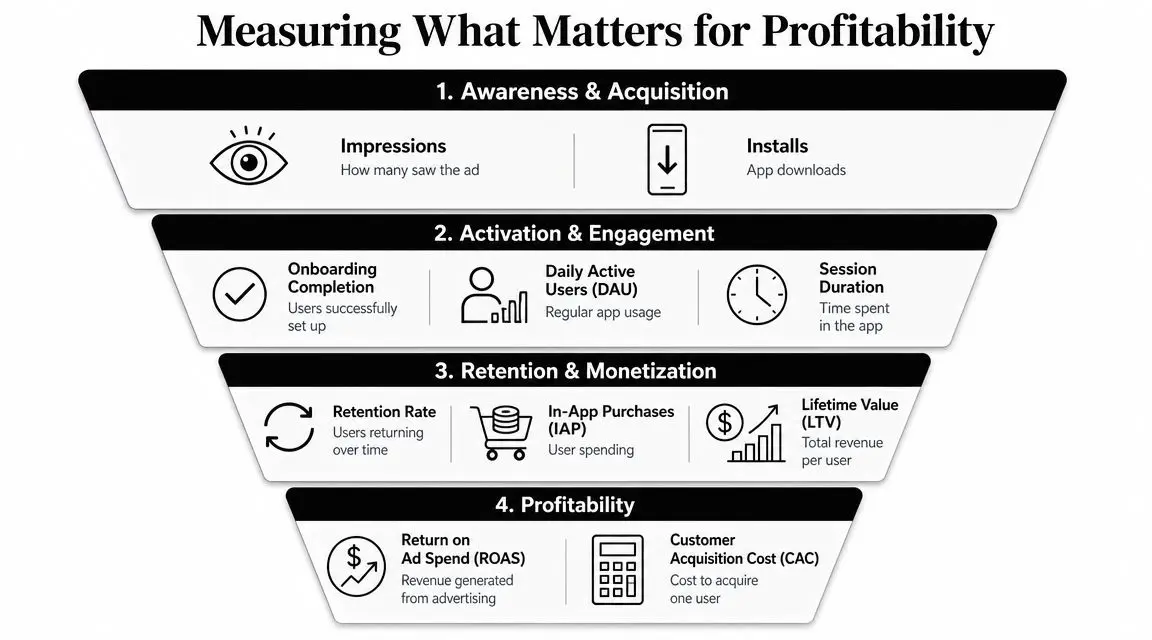
From a production studio perspective, measurement gets sharper when creative is treated as a business input rather than campaign decoration. A strong animation, product demo, or XR asset does more than lift click-through. It pre-qualifies the audience. It shows the interaction model clearly, sets the emotional tone, and filters out users who were never likely to stick. That makes downstream metrics cleaner and budget decisions easier.
The KPI stack that actually helps
Useful measurement works in layers, because no single metric explains profitability on its own. #### Acquisition signals These show whether the ad and audience pairing is generating response.
- •CTR
- •Conversion rate
- •CPI
These are early indicators, not final answers. #### Activation signals These show whether new users are reaching the first meaningful moment inside the app.
- •Onboarding completion
- •Account setup
- •First key action
- •Session depth
#### Engagement and retention These show whether the product is building repeat behaviour instead of one-time curiosity.
- •Retention
- •Churn
- •DAU/MAU
#### Commercial outcomes These show whether growth is economically sound.
- •Revenue by cohort
- •LTV
- •ROI or ROAS
- •CAC
If your team needs a plain-English refresher on return on ad spend, this explainer on learn ROAS from UFO Performance Marketing is a useful starting point. The primary work is reading these layers together. A video can produce a strong CTR and still hurt profitability if it overpromises. A cleaner, slower, more precise piece of creative can lower top-of-funnel volume while improving activation and retention enough to make the campaign more profitable. I have seen polished assets underperform because they looked impressive but failed to explain the product in the first few seconds. Craft matters, but clarity matters more.
Post-ATT measurement changed the job
Privacy changes forced app marketers to stop relying on perfect user-level attribution. The practical question now is broader: which channels, audiences, and creative systems produce incremental growth when visibility is partial? AppsFlyer covers that shift in its discussion of in-app advertising measurement difficulties. That changes how teams should evaluate performance. Instead of chasing certainty from one dashboard, stronger teams combine several approaches:
- •Cohort analysis to compare users by source, time period, or creative route
- •Modelled conversions to estimate performance where direct attribution is limited
- •Incrementality testing to check whether a channel is creating new demand or capturing demand that already existed
- •Channel-level judgement to compare portfolio value across paid, owned, and earned activity
This also raises the importance of creative asset design. In a privacy-first setup, creative has to do more of the qualification work upfront. The ad needs to communicate product value, usage context, and credibility clearly enough that the right users self-select before attribution systems fill in the gaps.
Testing discipline decides whether measurement is useful
Measurement breaks down when testing is sloppy. If a team changes audience, hook, edit pace, message, CTA, and store page at the same time, the result is confusion. No one can tell what improved performance or what damaged it. A better approach is to isolate one meaningful variable, define the expected business effect, and review the result against downstream behaviour, not just install cost. For creative teams, that often means testing questions like these:
- •Does a product-first opening improve activation quality over a lifestyle-first opening?
- •Does showing real UI earlier reduce wasted clicks?
- •Does a clearer motion sequence improve onboarding completion after install?
- •Does an XR demo attract better-fit users or just more curious ones?
If a creative variant lowers CPI but also lowers retention, it has not improved the campaign. It has shifted the loss further down the funnel.
App advertising is no longer solely a media-buying exercise. The teams that protect profitability usually have better creative systems, not just better bids. They build assets that can be versioned, localised, retimed, and tested across channels without losing strategic consistency. That gives media teams more useful inputs, and it gives analysts cleaner signals to interpret. Profitability measurement should help the team make harder, better choices. Cut channels that bring cheap but weak users. Keep creatives that attract fewer installs if those users activate and spend. Invest more in asset quality when stronger demos, clearer animation, and better interactive storytelling improve the match between promise and product.
Frequently Asked Questions on App Advertising
How much budget should an app launch start with
Start with a budget you can use to learn, not just to announce yourself. That means enough room to test several creative approaches, a few audience directions, and store page alignment without forcing a decision after one weak result. If the budget only covers one message and one channel, you're more likely to misdiagnose the problem. The important part is what you optimise for. Don't judge an early campaign only by installs. Judge it by whether those installs activate, retain, and show signs of future value.
Should we hire an agency, a studio, or build in-house
It depends on where the bottleneck is. If your team understands paid media but struggles to produce strong assets consistently, a creative studio can help build the system: concepting, animation, motion toolkits, edit variants, and store visuals. If your team has strong internal brand and product people but lacks campaign operations, a specialist media partner may be the right addition. If the app ships constant updates and needs daily content turnover, building some in-house capability usually makes sense. The best setup is often hybrid. Internal teams hold product truth and speed. External partners bring specialised craft, outside perspective, and production capacity.
Are XR and immersive formats actually useful for app advertising
Sometimes yes, but only when they support the proposition. XR isn't a default acquisition tactic. It's most useful when the app has a spatial, experiential, educational, retail, or event-based angle that benefits from immersion. In those cases, XR can make the campaign itself memorable and newsworthy. The caution is economic. Not every emerging format deserves budget. A study of app outcomes found that the share of new iOS apps reaching $100K in in-app revenue within 12 months fell to about 0.4% by 2022, with the decline accelerating after iOS 14.5, which is why campaigns need to be judged by cohort revenue, retention, and LTV rather than CPI alone, according to GoPractice's study on new app success rates. That's the test for any format, XR included. It has to contribute to profitable user behaviour, not just novelty.
If you're planning the creative side of advertising an app and need assets that can work across motion, animation, interactive formats, and XR, Studio Liddell is a production company working across those disciplines for brands, broadcasters, and digital products. A practical first step is to map the app's core promise, audience segments, and required asset types, then scope the production workflow around the channels you plan to use.