7 Virtual Reality Experience UK Providers
A search for a virtual reality experience UK provider can take you in very different directions. You might need a public venue, a touring exhibition, a museum installation, a factual headset title, a high-throughput attraction, or a commissioned training and brand project. Those formats share immersive technology, but they don't share the same creative process, hardware plan, staffing model or success criteria. This roundup compares seven UK providers by commissioning need rather than by reputation alone. The focus is practical: who suits cultural touring, who understands visitor throughput, who can build a room-scale attraction, who brings documentary authority, and who can own animation, apps, games and XR within one production relationship. If you're organising an event, PSW Events' VR hire guide is useful for understanding the equipment and event-side questions that sit alongside studio commissioning. Availability, pricing, technical specifications and deployment arrangements must be confirmed directly with each provider. A strong portfolio demonstrates capability, but it doesn't guarantee that a team has capacity for your dates or that a previous format will transfer neatly to your venue.
1. Studio Liddell
Studio Liddell is the strongest all-round option for a brief that moves between animation, games, apps and immersive XR. Established in 2019, the full-service creative digital production company has delivered digital content watched and played by audiences globally, combining 2D and 3D animation, IP development, native app production, Unity and Unreal expertise, and AI-enhanced production pipelines. That breadth matters when a project starts as a film concept but becomes an interactive installation, or when a broadcaster wants a character property extended into a game. Studio Liddell's work includes the multi-award-winning VR short Aurora, described as Ireland's first VR short, BooSnoo for Sky Kids, Dance! Dance! Dance! Quest VR, interactive museum and AR installations, and the room-scale Late Cretaceous experience opened by Sir David Attenborough. Clients and partners include BBC, Sky Kids, Nelvana, Nat Geo from Disney, Manchester United and Merck.
Best fit for hybrid commissions
The practical advantage is fewer handoffs. A single studio can shape the story, build the world, animate characters, develop the interactive layer and prepare the application or installation. Its VR and AR production service is relevant to brands, broadcasters, educational institutions, cultural organisations and agencies that need more than a headset demonstration. The studio's Innovation Lab also supports technology-led experimentation, while client endorsements from Nelvana, Spree and Visionality Media reinforce the value of a collaborative production partner. That combination makes Studio Liddell particularly suitable for:
- •Cross-platform IP: Extend a TV or animation property into apps, games and immersive content.
- •Immersive learning: Translate technical or educational material into interactive scenarios.
- •Public installations: Build room-scale or museum experiences that need both visual polish and operational thinking.
- •Branded entertainment: Connect a campaign film with a playable or spatial experience.
Practical rule: Ask one lead studio to map the complete audience journey before separate teams begin producing assets. It prevents a beautiful film, app and VR build from feeling like unrelated campaign parts.
The trade-off is commercial rather than creative. Studio Liddell doesn't publish packaged pricing, so you'll need an initial discovery conversation to establish scope, resources and delivery expectations. International clients should also confirm time-zone coordination, travel and on-site requirements. For a brief requiring one accountable partner across animation, XR, games and IP development, that early conversation is usually more useful than comparing isolated day rates.
2. Nexus Studios
Nexus Studios is a strong candidate for public-facing projects that bring culture, education, brands and spatial computing into one experience. Its London team works across interactive experiences, AR, VR, real-time technology and location-based formats, supported by operations in Los Angeles and Sydney. The portfolio points to a studio used to complex commissioning environments. Work connected with Marvel and Disney, Google Arts & Culture and CERN, BBC's Civilisations XR, Superblue x JR and Headspace XR spans entertainment, cultural interpretation, education and wellbeing. For a museum or cultural organisation, that experience matters because delivery extends beyond the headset. Rights, interpretation, accessibility, technical testing, installation and staff handover all need to be resolved with institutional stakeholders.
A practical fit for major activations
Nexus works best when the brief requires strategy, experience design, real-time development, deployment and operational support through one coordinated production process. Its cultural and education projects also suggest a useful understanding of visitors who may be new to VR, rather than experienced gamers seeking complex interaction. The studio's international structure can support work that travels between regions or appears in several venues. That reach brings coordination and process, so a small local activation with a short turnaround may be better matched to a specialist team. Ask how decisions will be managed across locations, who owns venue readiness and which partner remains accountable after launch. Studio Liddell's guide to top virtual reality development companies in the UK offers further context on UK studio specialisms. For commissioners comparing providers, Nexus stands out in three areas:
- •Institutional confidence: Recognised partners can reassure boards, funders and other stakeholders during approval.
- •Format range: AR, VR, apps, real-time work and location-based experiences can support one wider programme.
- •Research-led experimentation: Spatial computing and emerging interaction models suit briefs with a meaningful R&D requirement.
The main decision is whether the project needs that scale. A major museum installation, global brand activation or education-led experience with complex approvals may justify Nexus's structure and reach. A rapid prototype or tightly scoped local build may benefit from fewer layers, simpler communication and a smaller delivery team. Ask for a proposed team structure, approval workflow and post-launch support model before commissioning.
3. Marshmallow Laser Feast
A museum brief about climate, ecology or the human body needs more than a headset demonstration. Marshmallow Laser Feast builds immersive work around that kind of subject, combining VR and XR with science, data visualisation, spatial sound and directed storytelling. Its approach suits commissioners seeking a cultural encounter with a clear editorial or social purpose. We Live in an Ocean of Air, In the Eyes of the Animal and Water Body demonstrate how the collective turns scientific material, captured environments and designed sound into embodied experiences. These works give visitors something to interpret and discuss after removing the headset. They are a strong fit for museums, galleries, environmental organisations, cultural institutions and purpose-led brands.
Commissioning for cultural value
The commissioning question is less about spectacle than about fit. Scientific datasets, LiDAR, CT capture, spatial audio and visual composition can all serve the narrative, rather than remaining invisible production tools. That makes the work suitable for exhibitions, touring programmes and carefully curated public experiences. A touring commission also needs practical decisions early. Confirm how the installation will be adapted between venues, what technical package travels with it and which responsibilities sit with the producer, venue and local team. Check lighting, sound bleed, floor area, queueing space, headset supervision and any facilitator requirements before the creative direction is fixed. Studio Liddell's guide to immersive brand experiences, strategy, technology and production helps teams separate the artistic, technical and operational parts of an immersive brief. Use the first conversation to settle four points:
- •Exhibition life: Define the intended run and whether the production can support that timetable.
- •Audience framing: Decide if visitors need interpretation, facilitator support or a pre-show introduction.
- •Success measures: Choose between attendance, learning, critical response, brand association and repeat programming.
- •Partnership fit: Ask how creative decisions, venue adaptation and post-launch support will be handled.
If the brief is judged mainly by direct-response conversion, lead capture or rapid campaign iteration, another type of studio may fit better. Marshmallow Laser Feast is strongest when the subject merits sensory treatment, the venue can support a considered exhibition model and the commissioner values cultural or environmental impact alongside visitor engagement.
4. Figment Productions
A theme-park brief changes the production question. The virtual reality experience UK must run reliably through a queue, loading process and repeatable guest cycle. Figment Productions is suited to that setting, with location-based VR work including Derren Brown's Ghost Train at Thorpe Park and Galactica VR at Alton Towers. Both examples required coordination between virtual content, physical rides and venue operations. For high-throughput attractions, creative ambition has to share space with throughput. Entry instructions, headset fitting, hygiene, safety checks, ride synchronisation, reset time and staff intervention all affect the visitor experience and the operating model. Figment's experience with ride and venue integration, including motion-synchronised systems such as Vector VR, gives commissioners a relevant starting point. The studio works across content, hardware and physical presentation. VR can be combined with live action, physical set pieces and ride systems, so the story is shaped around the venue rather than delivered as a standalone film. That approach suits visitors expecting a substantial attraction, while operators need predictable timings, clear staff roles and dependable recovery when equipment or software fails.
A strong attraction brief describes the queue, loading process, operating team and reset procedure alongside the story and visual reference.
Commissioners should test the partnership against four practical requirements:
- •Operational design: Can the experience handle real visitor movement and venue constraints?
- •Ride timing: Do media cues and physical motion read as one authored experience?
- •Repeat use: Has the team worked with the safety, reliability and maintenance demands of a major attraction?
- •Physical integration: Can performers, sets and mechanical systems support the virtual layer without adding avoidable staffing or reset pressure?
The trade-off is commissioning fit. Figment is more relevant to location-based entertainment than to a small event demonstration, cultural short film or internal training prototype. Older coaster-style headset models may also require review against current expectations for cleaning, staffing and visitor comfort. A feasibility conversation should cover hardware, ride integration, maintenance, content replacement, staff training and failure recovery. Ask who owns each task on a busy operating day, how faults are isolated and how quickly the experience can return to service. The ride succeeds when the full operating system works, not only when the film is exciting.
5. Dream Reality Interactive
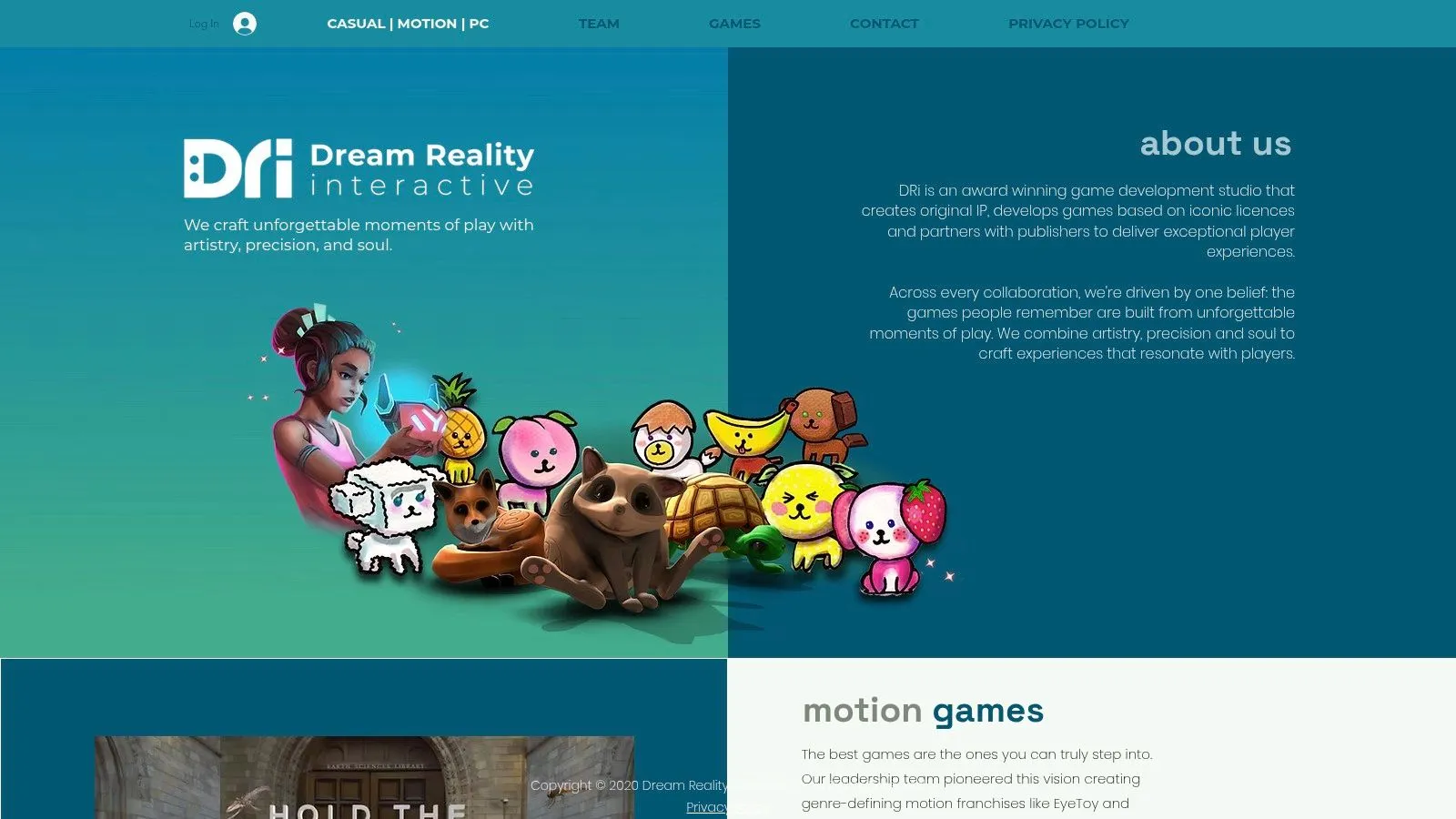
A museum commissioner may begin with a broad question: should visitors wear a headset, use an accessible display or interact through a mobile device? Dream Reality Interactive is a useful partner when that format is still open. Based in London and led by former Sony London leadership, the studio combines game design, human-computer interaction, motion-based interaction and narrative development. Its work includes Hold the World, created with Sir David Attenborough for Sky and the Natural History Museum, alongside original VR and AR games. Experience across mobile, PC and console VR and AR supports briefs that may need one experience adapted for different platforms, rather than a single headset build.
A strong fit for interactive museum work
Dream Reality Interactive's value lies in treating interaction as part of the creative concept. Motion-driven work can include volumetric humans, photogrammetry and responsive interfaces, but visitors still need to understand what to do, what feedback means and why the action matters. That design discipline matters in museums, where a visitor may have limited time, no prior VR experience or accessibility needs that a conventional game loop does not address. HCI expertise can help shape a technically ambitious demonstration into an experience people can enter, understand and complete. Ask the studio to respond to these points in the first brief:
- •Visitor action: Define whether people point, gesture, move, speak, select or observe.
- •Audience access: Account for first-time users, children where appropriate, older visitors and people unable to use standard controls.
- •Platform choice: Confirm whether the experience must run on mobile, PC, console VR, AR or more than one format.
- •Operational setting: Clarify throughput, supervision, session length and how staff introduce the experience.
- •Portfolio access: Ask which relevant projects can be discussed publicly and which remain confidential.
The public portfolio shows selected flagship work, so recent or confidential projects may not be visible online. A larger parallel programme may also require clear agreement on team availability and delivery ownership. Confirm milestone staffing, approval routes and platform responsibilities before the treatment is fixed. That conversation will show whether the studio suits a museum commission, a branded interactive or a cross-platform product with changing visitor and distribution requirements.
6. Alchemy Immersive
Alchemy Immersive suits commissioners seeking factual, educational and natural-history VR. As Atlantic Productions' immersive arm, it brings documentary experience to stereoscopic and computer-generated VR production, with a focus on accurate subjects and clear communication. Its David Attenborough XR titles include First Life VR, Kingdom of Plants, Micro Monsters and Museum Alive. Together, they show how broadcast discipline can support spatial storytelling. Viewers need a reason to look around, move through a scene or spend time with a digital reconstruction, while the underlying science or history remains understandable.
A fit for premium factual commissions
Alchemy's approach works well for museums, broadcasters and cultural organisations commissioning high-end factual content with spatial audio and distribution beyond one installation. Its work can support museum touring and consumer platforms such as Meta Quest and Oculus TV, subject to current platform and rights discussions. The creative fit is weaker for a gamified location-based attraction. Training simulations with scoring, competitive event games and high-throughput rides may require a studio built around repeatable gameplay, rapid sessions and active supervision. Alchemy's strengths are editorial authority, visual immersion and factual communication. A first conversation should settle four points:
- •Editorial framework: Name the scientific, historical or educational authority responsible for accuracy.
- •Audience outcome: Define what visitors should understand, remember or feel.
- •Capture requirements: Separate live-action, stereoscopic, CG, reconstruction and spatial-audio needs.
- •Distribution plan: Confirm whether the work is intended for a museum, headset platform, touring programme or several channels.
Also confirm where project information and updates sit within the wider Atlantic Productions structure, along with current availability. That clarity matters when a commission depends on approval routes, rights and platform delivery. For a natural-history organisation or broadcaster, the partnership offers strong documentary heritage alongside immersive production capability. It is a practical choice when the brief prioritises credible factual storytelling and premium visual treatment over competitive mechanics or maximum visitor throughput.
7. East City Films
A museum planning a touring VR programme needs more than a finished film. It needs a title that can travel, installation guidance that venue teams can follow and an operating model that keeps visitor flow manageable. East City Films specialises in VR documentaries and touring location-based experiences for museums, festivals and cultural venues. Its work includes In Pursuit of Repetitive Beats, Common Ground and Holocaust-museum commissions, with social-impact storytelling and public engagement at the centre.
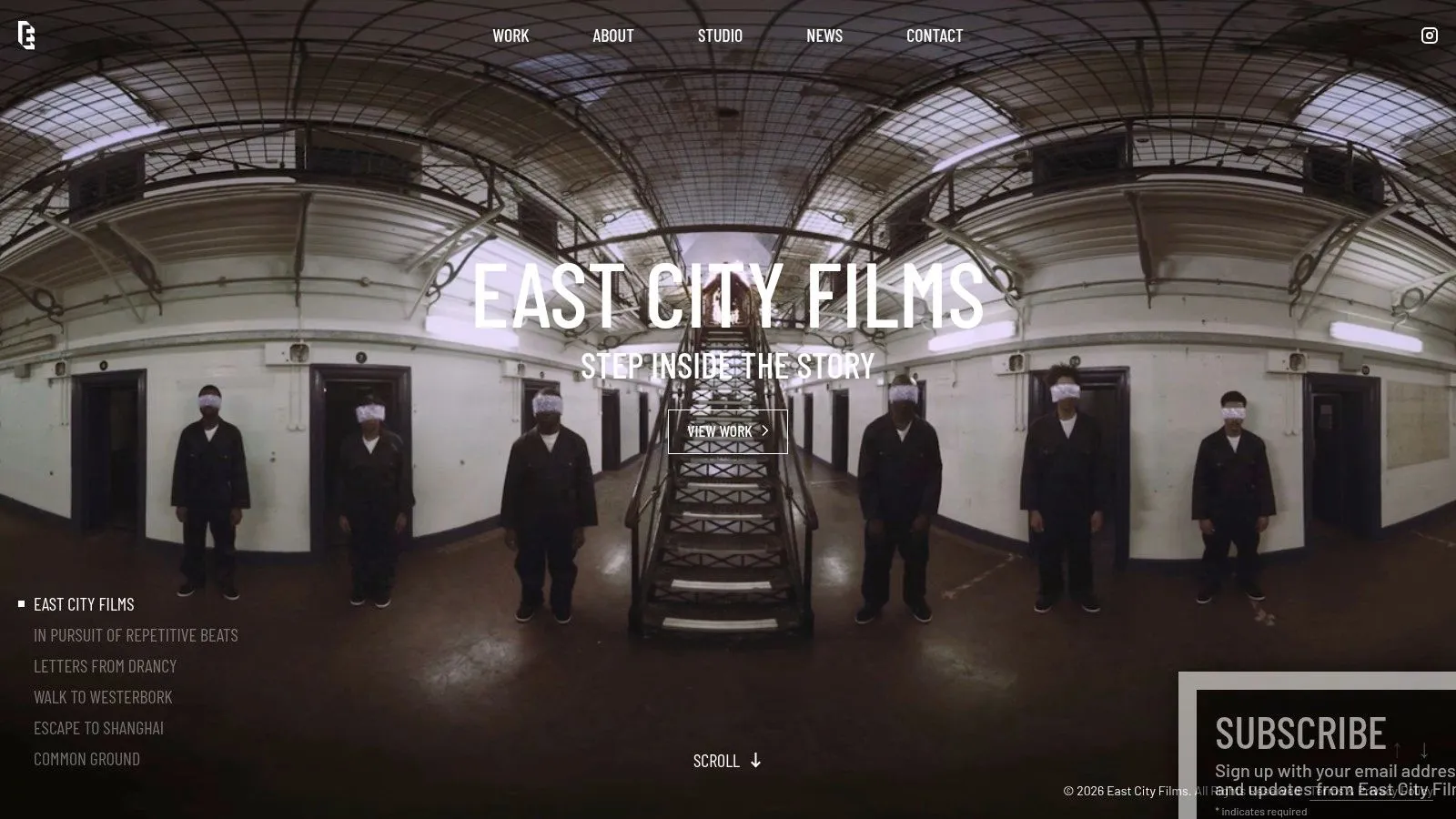
East City Films can support more than filmmaking. Its involvement may span financing and rights, production, technology build, installation, operations and touring. For a cultural organisation, that can reduce the gap between licensing a title and preparing it for real venues. The commissioning team should still confirm which services are included, who owns each delivery task and how technical support works during a run.
Where the partnership fits
The studio has worked with cultural institutions and festivals including Venice, Tribeca, SXSW and IDFA. Its touring kits are intended for repeat venue deployment, while its active slate of touring and currently showing titles gives programmers a route to presenting an existing work rather than waiting for a new commission. That creates two distinct buying routes. A museum or festival may need a ready-to-tour experience, installation documentation, venue support and a predictable visitor flow. A social-impact commissioner may need co-production, rights planning and a partner able to handle sensitive material with care. East City Films is a strong fit for:
- •Documentary storytelling: Place visitors inside personal, historical or social narratives.
- •Cultural touring: Plan repeat installation across museums, galleries and festivals.
- •Operational delivery: Confirm kits, staffing, technical support and venue requirements before booking.
- •Educational use: Build interpretation and facilitation around the experience, rather than treating them as separate materials.
The studio is less suited to ride-scale attractions and may need a co-production partner for a conventional commercial brand activation. Its typical installations are room-scale or gallery-based. For venues seeking a proven touring title or a socially purposeful VR commission, that focus supports a clearer brief and a more manageable delivery plan.
Top 7 UK VR Experience Studios Comparison
| Provider | 🔄 Implementation complexity | ⚡ Resource requirements | ⭐📊 Expected outcomes | 💡 Ideal use cases | ⭐ Key advantages |
|---|---|---|---|---|---|
| Studio Liddell | Medium, High: end-to-end animation + XR pipelines | High: Unity/Unreal, AI-enhanced production, multidisciplinary teams | High-quality, award‑winning cross‑platform IP and immersive experiences | Brands, broadcasters, cultural institutions seeking single‑partner delivery | End-to-end tech + craft; fast iteration via AI; proven broadcast & XR credits |
| Nexus Studios | High: strategy → real‑time tech → deployment & ops | High: global hubs, ops teams, real‑time engine expertise | Scalable, museum‑grade and brand activations with strong institutional impact | Large museum installs, brand activations, R&D‑led spatial projects | Blue‑chip track record; full experience design and global rollout capability |
| Marshmallow Laser Feast | High: multi‑sensory, data‑driven artistic production | High: scientific datasets, LiDAR/CT capture, spatial sound & touring logistics | Distinctive sensory, science‑led exhibitions with strong audience resonance | Museums, galleries, science and purpose‑led storytelling | Unique data+art narrative; critically acclaimed touring works |
| Figment Productions | High: ride/venue integration and motion‑sync complexity | High: motion‑sync systems, operations‑ready media, attraction-grade hardware | Reliable, high‑throughput LBVR media synchronized to rides and shows | Theme parks, attractions, entertainment venues needing ride integration | Proven theme‑park reliability; deep ops & motion‑sync expertise |
| Dream Reality Interactive | Medium: game/HCI‑led interactive design with volumetrics | Medium, High: volumetric capture, photogrammetry, cross‑platform dev | Engaging interactive museum/gaming experiences with accessible HCI | Branded cultural projects, museum interactives, VR/AR games | Strong game design + HCI skills; volumetric and narrative expertise |
| Alchemy Immersive | Medium, High: broadcast‑quality stereoscopic/CG VR pipelines | High: stereoscopic 6DoF/3DoF tools, spatial audio, distribution channels | Broadcast‑grade natural‑history VR for museums and consumer platforms | Factual, educational, natural‑history commissions and touring | Benchmark natural‑history storytelling; ties to broadcasters/platforms |
| East City Films | Medium: documentary production + touring installation logistics | Medium: touring kits, festival/cultural networks, installation ops | Social‑impact VR documentaries with reliable venue deployment | Museums, festivals, cultural venues needing touring VR titles | Focused on cultural impact; operational touring experience and festival reach |
Turn Your Shortlist Into a Stronger Brief
A shortlist becomes useful when it reflects the project you need to operate. Start by defining whether you're commissioning a venue visit, a touring programme, a public attraction, a consumer title or a bespoke brand, training or education experience. Those categories determine almost everything that follows, including the production model, approval process, hardware, staffing and support burden. Next, describe the audience and the physical environment. Include visitor age range, accessibility requirements, available floor area, ambient light, sound conditions, queue space, supervision and whether the experience needs to work for one person or several people at once. A museum installation, an event activation and a theme-park attraction may all use headsets, but they place very different demands on onboarding, hygiene, reset time and technical support. Your brief should also specify the intended hardware and tracking approach where you know it. If you don't know, ask shortlisted providers to recommend a route based on the venue rather than forcing the project into a preferred device. Mention whether you need standalone headsets, a PC-powered build, room-scale tracking, motion platforms, AR devices, a mobile companion or a platform release. Include deployment dates, touring requirements, content updates and who owns the hardware after launch. The UK market has a substantial production base for this kind of work. The UK immersive technology sector was estimated to include around 2,106 companies in 2022, with approximately 12,609 full-time employees and industry turnover of roughly £1.4 billion, according to the Immersive Economy 2022 report. Activity also extends beyond London into clusters including Brighton, Bristol, Newcastle, Liverpool and Belfast. That gives commissioners a meaningful range of creative, technical and regional production partners, but it also makes precise briefing more important. Adoption is growing, though many organisations are still moving from pilot to operational deployment. In the UK AEC sector, VR adoption was scored 2.5 out of 5, with 61.8% of surveyed companies reporting testing or pilot use and 2.9% reporting full implementation in the cited Vision Network report. For buyers, the implication is practical. Ask studios how they support testing, staff onboarding, measurement and the transition from a successful demonstration to a dependable live service.
Questions to put to every provider
- •Comparable delivery: Which previous project most closely matches your audience, venue and operational constraints?
- •Production ownership: Who owns creative direction, technical design, content production, testing and installation?
- •Testing process: How will first-time visitors, accessibility needs, tracking reliability and edge cases be tested?
- •Deployment support: Who trains venue staff, handles launch issues and maintains the build after installation?
- •Commercial assumptions: Which elements are included in the proposal, and which depend on hardware, travel, rights, licensing or third-party systems?
- •Post-launch plan: How will you monitor faults, update content, replace equipment and respond to visitor feedback?
Don't treat a published portfolio as proof of current availability or a fixed price. Ask for a discovery conversation, then request a proposal that separates creative development, technology, content production, hardware, installation, support and future updates. That structure makes competing bids easier to compare and exposes hidden operational costs before production starts. Studio Liddell is a relevant full-service option when the project combines animation, games, apps and XR rather than fitting one narrow category. Its experience across broadcast content, children's IP, immersive learning, room-scale experiences and interactive installations makes it worth including in a shortlist for a commission that may grow across platforms. The right partner isn't the provider with the most impressive headset footage. It's the team that can connect the audience promise to a build that visitors, staff and stakeholders can use confidently. --- Studio Liddell brings animation, games, native apps and Unity and Unreal XR production together for brands, broadcasters, educational organisations and cultural venues planning a virtual reality experience in the UK. Visit Studio Liddell to explore its work and start a conversation about your concept, audience, venue and delivery needs.