What Is Account Management: Guide to Success
A common studio scenario goes like this. The animation film ships, the XR demo lands well, the client is happy, and then the relationship stalls because no one owns what happens after delivery. Six months later, the client has a new brief and starts the search again, even though your team already understands their brand, stakeholders, and production constraints. That gap is where account management earns its keep. If you're asking what account management is, you're usually dealing with one of two problems. You want to stop a good project from becoming a one-off. Or you're building a client-facing team and need a role that does more than run meetings, send status notes, and chase approvals. In high-value creative production, account management turns delivered work into commercial continuity. It protects context between projects, keeps decision-makers engaged after the first win, and helps a client connect creative output to broader business goals. That matters more in animation and XR than many teams admit, because these projects are expensive, involve multiple stakeholders, and often sit inside longer transformation, marketing, or product roadmaps. Studios that treat account management as light-touch client servicing usually feel the cost later. The work gets approved, the files go out, and the relationship loses momentum because nobody is actively shaping the next conversation. A good account manager prevents that. They stay close enough to the client to spot timing, budget, and strategic shifts early, and close enough to the internal team to know what the studio can realistically deliver well. If you want a practical outside view on that discipline, these 10 actionable account management strategies are a useful reference. In practice, account management sits at the point where trust, commercial judgment, and delivery reality meet. Sales may open the door. Producers and project managers may get the work done. Account management keeps the relationship valuable after the first project, which is how a studio moves from isolated commissions to retained strategic partnership.
The Core Philosophy of Strategic Account Management
A client signs off an animation project, the film performs well, everyone says they should work together again, and then nothing happens for six months. No crisis. No fallout. Just lost momentum. That gap is where weak account handling shows up in creative studios. In animation and XR, the work is rarely standalone. A launch film can lead to versioning, sales enablement assets, event content, product visualisation, training, or an ongoing content system. Strategic account management keeps that chain intact. It carries context forward, turns one successful delivery into a wider commercial conversation, and helps the client buy with more confidence the second time than they did the first.
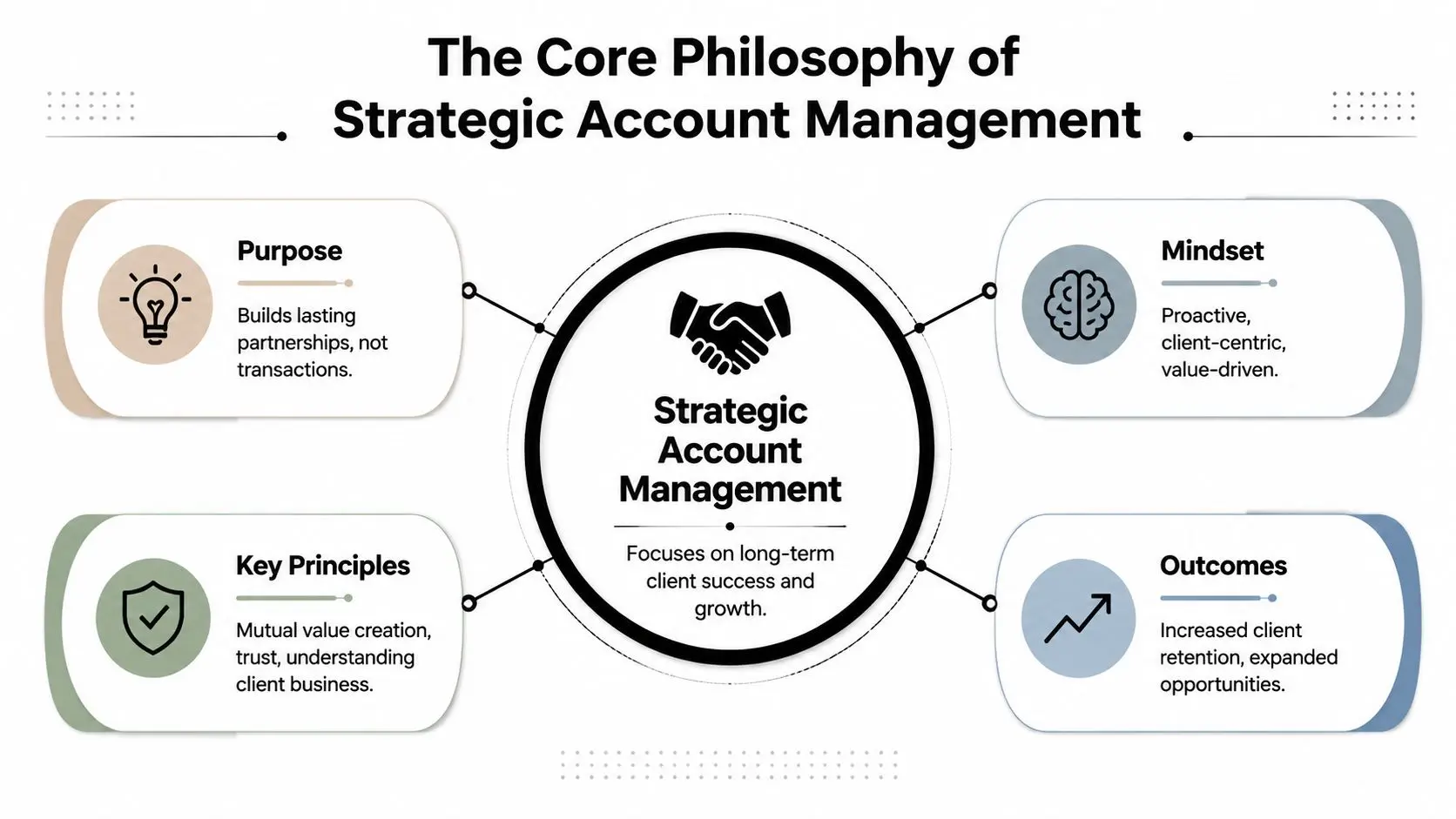
Strategic partnership over polite responsiveness
In a studio environment, account management means owning the relationship beyond the active brief. The role exists to help the client make better decisions over time, with a clear view of commercial goals, production reality, and future opportunities. That changes how the work is approached.
- •Problems are addressed early: strong account managers spot approval risk, stakeholder drift, budget pressure, and delivery dependencies before they become client frustration.
- •Each project is read in sequence: a campaign film may lead to cut-downs, localisation, paid social variants, stills, interactive assets, or a broader content rollout. Good account management keeps those routes visible.
- •Value is protected on both sides: clients need clarity and honest guidance. Studios need healthy margin, achievable timelines, and a brief that can survive production without constant churn.
Practical rule: If the role only activates when an email needs answering, the account is being serviced, not managed.
The mindset that makes the role work
Account management in high-value creative production depends on judgement. Clients do not keep a studio on retainer because the team is friendly. They stay because someone understands the political, commercial, and operational reality around the work and can act on it. In practice, that usually comes down to four habits:
- Commercial awareness. Know how the account creates revenue, where margin gets squeezed, and what type of work the studio can deliver profitably.
- Context gathering. Understand the client's wider roadmap, buying process, internal stakeholders, and pressure points beyond the current brief.
- Internal advocacy. Provide creative, production, and technical teams with the context behind client decisions so the work solves the right problem.
- Constructive challenge. Push back on choices that weaken the outcome, even when the easier option would be to nod and proceed.
Purpose in a creative production business
The purpose of account management in a creative studio is to make the client feel understood, guided, and safe to invest again. That matters more in animation and XR than in lower-commitment production categories. Budgets are larger. Stakeholder groups are broader. The work often sits inside a longer product, brand, or transformation programme. A client may start with a single immersive demo or hero animation, then need help deciding whether the next spend should go into platform adaptation, internal rollout, localisation, or a new content stream. The account manager helps shape that decision with timing, commercial sense, and a clear read on what the studio can deliver well. Organic growth often emerges at that stage. The best account managers know when to open a strategic conversation, when to let delivery build more trust first, and when to say a project is a poor fit. That restraint matters. Long-term partnerships are built on relevance and judgement, not constant upselling.Key Responsibilities and Daily Activities
The role looks less glamorous and more disciplined than many people expect. Strong account management is built on repeated actions, not charisma. On a live account, the work usually happens across three time horizons: daily control, weekly alignment, and quarterly planning. If any one of those is missing, the relationship gets shaky. Daily control without strategic planning turns into admin. Quarterly strategy without daily grip turns into theatre.What happens day to day
A practical account manager's daily work often includes:- •Client communication management: keeping replies clear, prioritised, and aligned with what the production team can deliver.
- •Internal briefing: making sure creatives, producers, developers, and leads know what matters to the client, not just what was written in the brief.
- •Scope awareness: spotting when “a small change” is a timeline, workflow, or budget issue.
- •Expectation setting: clarifying approval dates, review windows, deliverables, and dependencies before confusion hardens into frustration.
A lot of this work is invisible when it's done well. That's the point. Clients shouldn't feel the machinery grinding.
The best account managers make complexity feel organised without pretending it doesn't exist.
Weekly and monthly rhythms
Once a project is moving, the account manager becomes the consistent thread across teams and phases. In animation and XR work, that matters because the client often experiences the process in fragments. Briefing. Concepts. Boards. Styleframes. Previs. Asset development. Lighting. Comp. QA. Delivery. The account manager holds the full narrative together. Typical weekly or monthly responsibilities include:
- •Running status meetings: not as ritual, but as decision-making sessions with clear actions.
- •Maintaining account plans: documenting client priorities, risks, stakeholder map, and future opportunities.
- •Reviewing delivery health: checking whether the account is drifting into over-servicing, revision fatigue, or avoidable delays.
- •Acting as the voice of the client: bringing nuance back into internal conversations so the team solves the actual problem, not the last comment in an email thread.
Quarterly work that drives growth
The quarterly layer is where account management becomes strategic. At this point, you stop asking “how is the project going?” and start asking “what is the account becoming?” That usually means:
| Cadence | Focus | Output |
|---|---|---|
| Daily | Clarity and momentum | Decisions, responses, issue handling |
| Weekly | Alignment | Status reports, action lists, risk visibility |
| Quarterly | Growth and retention | Account review, roadmap, expansion ideas |
A good quarterly business review isn't a slideshow of tasks completed. It should answer a harder set of questions.
- •What changed in the client's business?
- •What worked in the recent delivery cycle?
- •Where did process friction appear?
- •Which adjacent services now make sense?
- •Who else on the client side needs to be involved next?
In creative studios, this is often where organic growth emerges. An explainer turns into a training series. A launch film opens the door to social cut-downs. A children's brand campaign becomes a conversation about games, XR, or broader IP development. None of that happens by accident.
Account Manager vs Project Manager vs Producer
Creative businesses blur these roles all the time, and that's usually where trouble starts. The account manager owns the relationship and commercial future. The project manager owns delivery structure. The producer owns the practical and creative execution of making the work happen. When one person tries to carry all three functions on a complex account, something gives. Usually it's foresight.
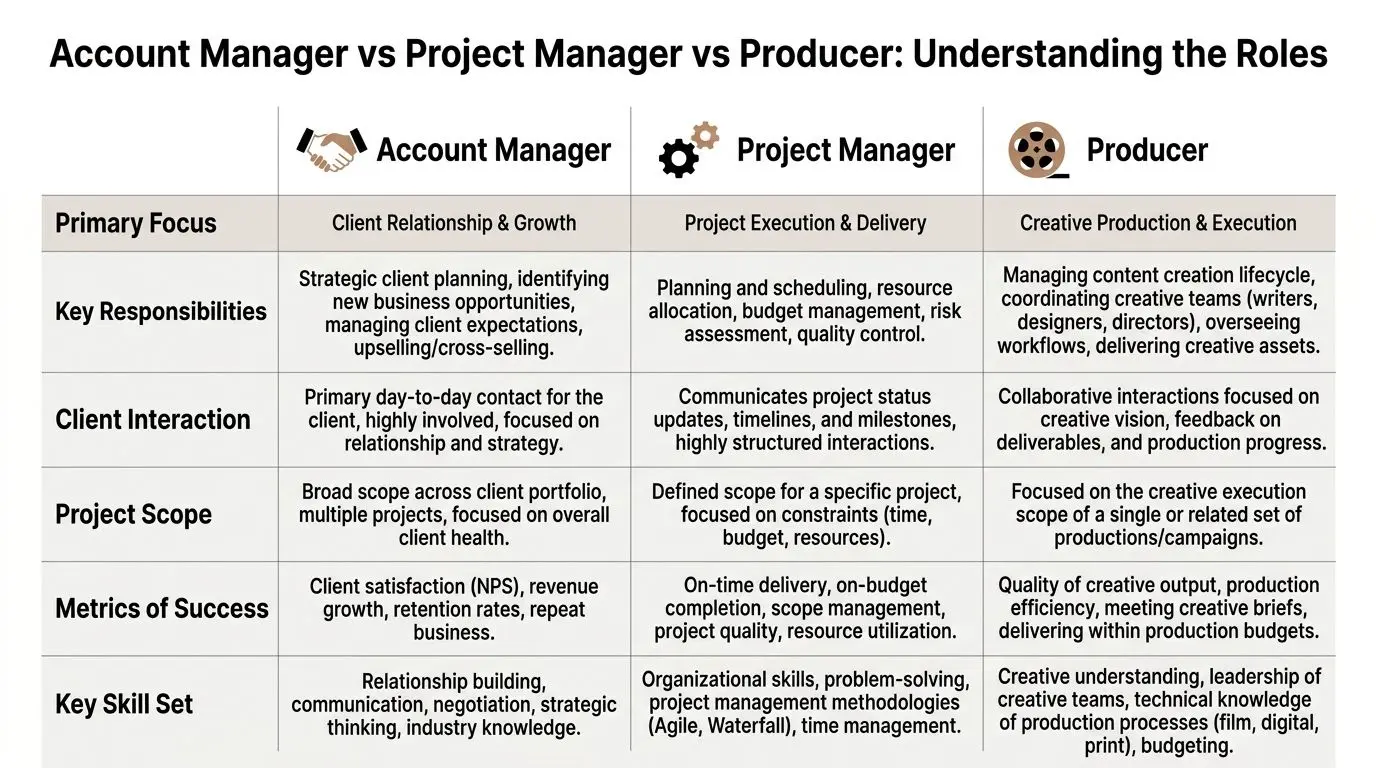
Where each role points its attention
Here's the practical split:
| Role | Primary concern | Main time horizon | Core question |
|---|---|---|---|
| Account Manager | Relationship and growth | Lifetime of the client | What should happen next? |
| Project Manager | Process and delivery control | Duration of the project | How do we deliver cleanly? |
| Producer | Making the work real | Phase by phase | What does this need to get made properly? |
The overlap is real, but the centre of gravity is different. A producer might talk to the client every week, but that doesn't make the role responsible for retention strategy. A project manager may manage milestones brilliantly, but that doesn't mean they should lead commercial expansion conversations.
Why the distinction matters in animation and XR
In production-heavy environments, clients often confuse the person they speak to most with the person who owns the relationship. That's understandable. It's also risky. A producer is often closest to craft decisions, resourcing trade-offs, and the practicalities of getting shots, builds, or experiences over the line. If you're working in real-time pipelines, this kind of production leadership becomes even more specialised, which is why practical resources like a producer's guide to real-time VFX are useful for understanding where production expertise sits. The account manager's job is different. They're looking beyond the current milestone. They're asking whether this client will need localisation, platform adaptation, post-launch support, technical animation, or a wider rollout once the current work lands.
If the producer owns “can we make this well?”, the account manager owns “how does this fit the client's wider agenda?”
Where a Technical Account Manager fits
There's another layer when the work becomes technically dense. A Technical Account Manager is structurally distinct from a standard account manager because the role requires a mandatory triad of competencies: technical engineering expertise, operational troubleshooting, and the ability to act as a trusted advisor, according to Amazon's UK Technical Account Manager role description. That matters in enterprise XR, platform integrations, and data-driven experiences. In those contexts, relationship skills alone won't carry the conversation. The client may need someone who can discuss APIs, workflow constraints, implementation risk, and operational implications without translating everything through support or engineering. A standard account manager keeps the partnership healthy. A technical account manager keeps the partnership healthy while also helping the client solve deeper technical friction.
How to Measure Account Management Success
A client can praise the final animation, pay the invoice on time, and still never come back. That is why account management success cannot be judged on responsiveness or general goodwill alone. In high-value creative production, the true measure is whether the relationship gets stronger after delivery, whether future work becomes easier to originate, and whether the studio earns a larger role in the client's decision-making. Studios that measure the role properly look at commercial performance, relationship depth, and operational quality together. If one of those is missing, the picture is incomplete. A likeable account lead who cannot grow or protect revenue is underperforming. So is someone who grows revenue while creating delivery friction and stakeholder distrust.
The numbers that matter
Recent salary data from RepVue's UK Account Manager salary data reflects the commercial value attached to strong account management. Businesses pay well for people who retain revenue, expand accounts, and reduce the odds of a costly client exit. The most useful scorecard usually includes:
- •Net Revenue Retention: whether existing accounts hold value, contract, or grow over time.
- •Customer Lifetime Value: whether the account becomes more commercially meaningful across multiple engagements.
- •Customer Health Score: a practical signal built from delivery satisfaction, stakeholder engagement, response patterns, forecast confidence, and project momentum.
- •Net Promoter Score: a useful advocacy measure if your business collects it consistently and compares it over time.
For teams focused on long-term commercial return, this perspective on sustainable growth via customer value is a useful companion.
What good measurement looks like in a creative studio
These metrics matter, but creative studios often need to translate them into signals they can observe account by account. In animation and XR, retention rarely starts with a formal renewal conversation. It starts earlier. The client brings your team into planning before the brief is written. They ask for input on rollout risk, localisation, content adaptation, or platform constraints. They introduce colleagues from adjacent departments because they already see the studio as more than a production supplier. That is usually the first sign that account management is doing its job. A stronger lifetime value profile often comes from adjacency, not aggressive selling. A client who first bought a hero film may later trust the studio with cutdowns, title design, technical animation, event visuals, immersive demos, or post-launch support. The account manager's contribution is not just spotting those opportunities. It is spotting them at the right moment, in a way that fits the client's priorities and the studio's delivery capacity. Health scores also need adult judgement. A healthy account is not just a happy one. Some accounts sound enthusiastic right up until procurement takes over, stakeholder access narrows, and approvals slow down. Those are early warnings. If the account manager sees them soon enough, there is still time to address the issue before revenue is lost.
Measure behaviour, not sentiment alone
Satisfaction scores help, but they are a lagging measure. By the time a client tells you they are unhappy, the damage is usually already operational or commercial. A better approach is to track what the client does:
| Indicator type | What to look for |
|---|---|
| Relationship | Candour, access to senior stakeholders, involvement before briefing |
| Commercial | Repeat briefs, broader scope, retained or increased budget |
| Operational | Faster approvals, fewer late surprises, more accurate forecasting |
Studios that want a sharper read on these patterns often borrow ideas from customer analysis work. Practical examples appear in this guide to utilizing analytics to understand customer behavior, especially when you need to spot account risk before it shows up in revenue. The strongest account managers are measured on outcomes that matter to the business. Revenue held. Revenue expanded. Better visibility into future work. Stronger client access. Lower friction across delivery. In a creative studio, that is the difference between finishing a project and building a partnership.
Mastering the Project-to-Partnership Transition
A client approves the final animation, thanks the team, and asks for the delivery files. Everyone leaves the project feeling good. Six months later, the next brief goes elsewhere. That usually is not a quality problem. It is an account management problem. In high-value creative production, especially animation and XR, studios often do the hardest part well. They solve a complex brief, manage production risk, and deliver work the client is proud to show internally. Then the relationship slips back to procurement, support, or silence. The studio is remembered as a capable supplier, but not kept close as a strategic partner.
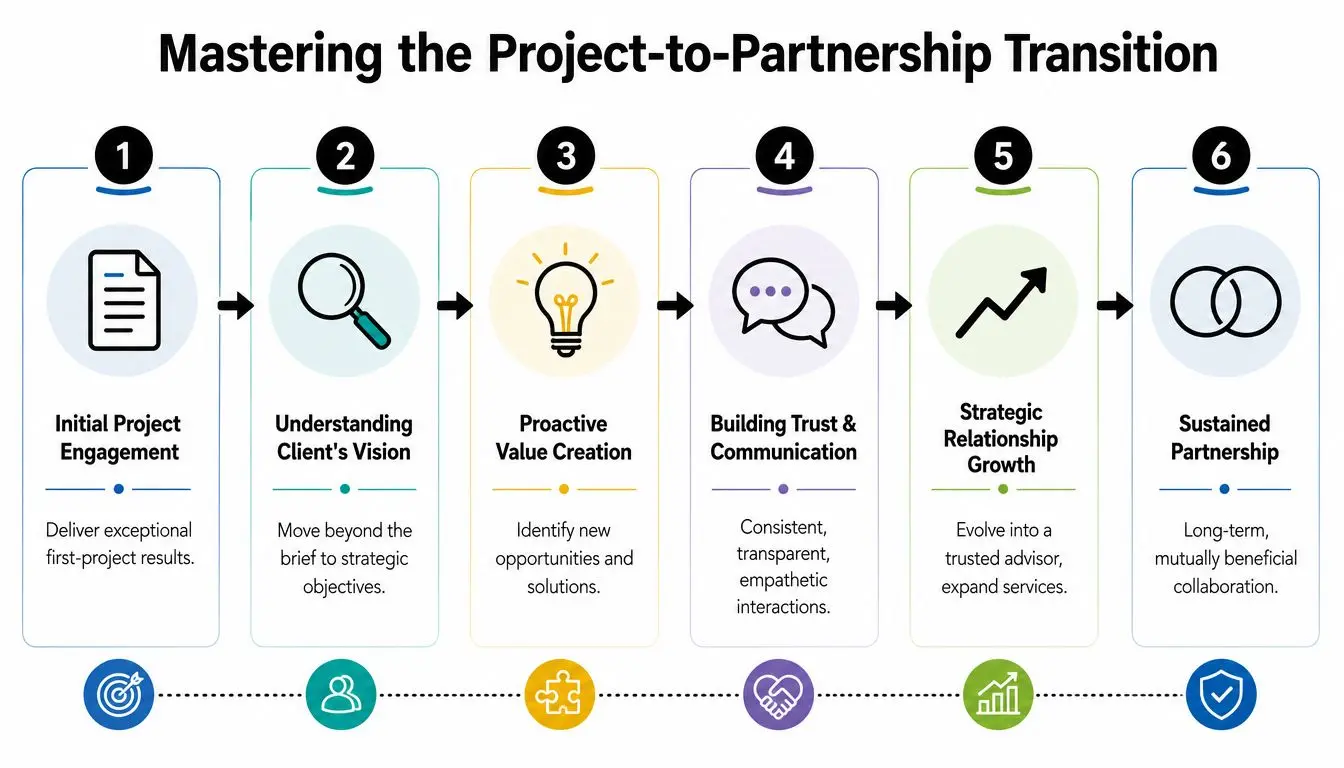
Why the transition breaks down
The failure rarely looks dramatic. It usually shows up in small gaps after delivery. The project closes cleanly, but nobody schedules a business review. The client hears from finance about the final invoice before they hear from the account lead about outcomes and next steps. The work gets praised as a successful project, yet nobody connects it to the client's next campaign, product launch, training need, or platform roadmap. That gap matters more in creative studios than it does in many service businesses. A finished asset often contains more value than the original brief captured. A film can become a content system. An animation toolkit can support regional versions, retail screens, paid social, and internal comms. An XR prototype can open a wider conversation about training, events, product education, or sales enablement. If nobody frames that opportunity, the value stays buried inside the delivered work.
What good account managers do after delivery
Strong account management treats the end of a project as the point where strategic relevance has to be earned again. That starts with a proper closeout. Delivery files need to be organised, usage rights need to be clear, loose ends need to be resolved, and the client needs confidence that the studio will still respond once the invoice is issued. Without that foundation, any growth conversation feels premature. Then comes the review. The debrief should be useful, not an exercise in self-congratulation. Look at what the work achieved, where the process got stuck, which stakeholders became influential, and what the project revealed about adjacent needs. In my experience, the best expansion opportunities appear here. They usually come from operational truth, not sales scripts. A practical sequence looks like this:
- Close the original project with care
- Run a focused outcome review
- Identify the next business need
- Make a specific recommendation
What that looks like in a creative studio
If a brand commissions a hero animation for a launch campaign, the next conversation should not start with “Do you need anything else?” A better discussion might be about how the existing visual system can support cut-downs, retail motion, event content, or localisation without rebuilding the whole asset base. If a children's property performs well on screen, the account lead should be asking what happens next for the IP. That might include short-form digital content, interactive story experiences, educational extensions, or XR activations. Studios offering AI-supported creative production services also need to explain where faster iteration helps and where senior craft and review still matter. The point is relevance. Clients stay when the next recommendation fits their priorities, budget cycle, and internal politics. They pull away when the follow-up feels detached from the work they just approved.The trade-off most studios get wrong
Many teams wait too long because they do not want to appear pushy. Others push too early and turn a good delivery moment into a sales meeting the client did not ask for. Good account management handles that tension. The right timing usually sits between immediate project closure and the point where the client has mentally filed the studio under completed supplier. In practice, that often means closing the work cleanly, giving the client space to absorb it, then returning with a considered recommendation tied to a live business need.A disciplined post-project rhythm
Studios that make this transition well usually have a simple rhythm:- •A short post-delivery check-in: confirm the work has landed properly and any issues are handled
- •A structured review: capture outcomes, friction points, and stakeholder dynamics
- •A partnership lens: identify where the delivered work can support a wider objective
- •A timed recommendation: reconnect when the client is planning, budgeting, or extending activity
This is how one-off delivery becomes an ongoing account. The relationship grows because the studio keeps proving commercial usefulness after the files are sent.
The Evolving Role in an AI-Powered Creative Studio
A lot of outdated guidance still treats account management as a soft-skills role with a commercial layer. In an AI-powered creative studio, that's no longer enough. Clients don't just need reassurance. They need someone who can explain how AI affects workflow, cost, quality, approvals, authorship, and risk. That doesn't mean every account manager needs to become an engineer. It does mean they can't stay vague while the production model changes underneath them.

Why the role is getting harder
The knowledge gap is already visible. In the UK, 71% of account managers in creative firms feel unprepared to manage client expectations around AI-driven timelines and IP, while only 28% of training programmes cover AI ethics, workflow transparency, or client education on AI outputs, according to Salesmotion's review of account management best practices. That gap creates very practical problems. Clients hear “AI-assisted production” and assume speed, lower cost, and unlimited revisions. Internal teams know it is more conditional. Some stages accelerate. Others still require senior craft judgement, revision discipline, and quality control. If the account lead can't explain that clearly, expectation drift starts early.
The new conversations clients expect
In AI-enhanced animation and XR pipelines, account managers increasingly need to handle questions like these:
- •Workflow transparency: Which parts of the process are AI-assisted, and which still depend on specialist artists, animators, or technical directors?
- •IP and usage clarity: What inputs are being used, how are outputs handled, and what does the client need to know before sign-off?
- •Timeline realism: Where does AI help with concepting, iteration, or production support, and where does it not remove review, craft, or technical integration work?
- •Ethical communication: How should the team explain AI use without overselling automation or hiding material process detail?
That's why the future version of the role looks closer to a strategic translator. The account manager must turn technical and ethical complexity into plain client language.
“AI” isn't a selling point by itself. Clients care about whether the process is reliable, transparent, and fit for purpose.
What good AI-aware account management looks like
The strongest practice I've seen has three traits. First, the account manager can describe the production pipeline in concrete terms. Not buzzwords. Actual process. They can explain where concept art, asset generation, previs support, cleanup, editing assistance, or workflow automation might appear. Second, they know when to bring specialists into the room. Some client questions should be answered by production leads, technical directors, or pipeline experts. Good account management doesn't fake expertise. It orchestrates it. Third, they frame AI as part of a capability mix, not a magic shortcut. In an advanced studio setup, AI-enhanced production sits alongside conventional craft, real-time workflows, and specialist design. A client exploring that environment needs a guide who can connect use case to method. For a clearer view of how that capability can be positioned, see AI services in creative production.
What doesn't work anymore
Three habits break trust quickly:
| Weak habit | Why it fails |
|---|---|
| Overpromising speed | It creates impossible expectations for review and finish quality |
| Hiding the process | It makes clients suspicious about authorship and control |
| Treating AI as purely technical | It ignores brand risk, ethics, and stakeholder confidence |
Account management used to be enough when it kept communication smooth. Now it has to make innovation legible. In creative production, that's becoming one of the role's most important jobs. --- If you're planning animation, XR, interactive learning, or AI-enhanced production and want a partner that understands both delivery and long-term relationship value, Studio Liddell can help shape the work from first brief to sustained partnership. If you're ready to move from one-off project thinking to a smarter client growth model, start the conversation with the team.