Progressive Web Apps Vs Native: An Unbiased Comparison
When you get down to it, the progressive web apps vs native debate boils down to a single question: do you want to be everywhere at once, or do you want to offer the most powerful experience possible on a specific device? PWAs are essentially supercharged websites, designed to look and feel just like a mobile app. You access them through a browser, but they offer an experience that’s a world away from a standard mobile site. Native apps, on the other hand, are built from the ground up for a specific operating system, like iOS or Android. They live on the device and have to be downloaded from an app store. Your choice hinges on whether you prioritise wide, instant reach (PWA) or the deepest possible integration with device hardware for a premium user experience (native).
Understanding The Core Technologies
Choosing between a Progressive Web App (PWA) and a native application isn't just a technical decision; it's a strategic one that will shape your budget, how you find users, and your long-term maintenance plans. Each path comes with its own set of very distinct advantages and trade-offs that go far beyond what the user sees on the screen.
A Progressive Web App is, at its heart, a highly refined website built with modern JavaScript frameworks. It runs inside a standard web browser but has been engineered to deliver a seamless, app-like experience. This includes clever features like being 'installed' on a user's home screen, working offline by caching data, and sending push notifications (on supported devices, of course). Think of it as pushing a website to its absolute limits. In contrast, a native app is purpose-built for a single platform. Our developers use platform-specific programming languages, Swift or Objective-C for Apple's iOS, and Kotlin or Java for Google's Android. This native approach gives the app unrestricted access to a device's hardware, from the camera and GPS to the accelerometer and biometric scanners. The result is almost always faster performance and a much more integrated, polished feel. This fundamental difference in architecture dictates everything that follows. For our clients, this decision isn’t just about technology; it's about aligning your digital strategy with your operational capacity and what you ultimately want to achieve.
Key Differences At A Glance: PWA vs Native
To really get to grips with the comparison, it helps to see the major distinctions side-by-side. This table cuts through the noise and gives a high-level summary of the critical factors you need to weigh up.
| Feature | Progressive Web App (PWA) | Native App |
|---|---|---|
| Development | Single codebase built with web technologies (HTML, CSS, JavaScript). | Separate codebases for iOS and Android using native languages. |
| Distribution | Accessed via a web browser and shareable with a URL; no app store needed. | Must be downloaded and installed from an app store (e.g., Apple App Store, Google Play). |
| Discoverability | Indexable by search engines like any website, benefiting from SEO. | Primarily discovered through App Store Optimisation (ASO) within the app stores. |
| Installation | Users can "add to home screen" directly from the browser; no download required. | Requires a deliberate download and installation process from a centralised store. |
| Device Access | Limited access to device hardware; relies on browser capabilities. | Full, direct access to all device hardware and OS features (camera, GPS, contacts). |
| Updates | Updates are instant; users always access the latest version on refresh. | Updates must be submitted to app stores for review and then downloaded by users. |
As you can see, the trade-offs become clear very quickly. PWAs offer speed and accessibility, while native apps provide depth and power. The right choice depends entirely on your project's specific needs, your audience, and your business goals.
Money And Minutes: Weighing Up The Investment
When you get down to brass tacks, the progressive web apps vs native debate often comes down to two things: money and time. The financial and time commitments are where these two paths really diverge, and it all stems from a single, fundamental difference in how they’re built. A PWA is born from one codebase. A native app demands two separate, parallel development projects for iOS and Android. Building a native app is a serious undertaking. You’re essentially funding two distinct software projects from the ground up, which means you need specialist developers for each platform , someone who speaks Swift for iOS, and someone else who speaks Kotlin for Android. This duplication of effort is precisely why development costs can spiral into the tens, or even hundreds, of thousands of pounds. Timelines naturally follow suit, often stretching out over several months. Now, let's look at the PWA. It’s built once, using the universal languages of the web: HTML, CSS, and JavaScript. This unified approach slashes development hours and complexity right from the start. A single team builds one application that just works across every device and browser, getting you to market much faster and with a significantly smaller hole in your budget.
Breaking Down The Development Costs
To put some real numbers on it, let's look at what UK businesses are actually paying. A property firm based in London was quoted around £120,000 to build separate native apps for iOS and Android. For comparison, they developed a PWA that delivered even more functionality, including offline property viewing and push notifications, for about £35,000. It's not an isolated case. A Manchester fashion retailer launched its new PWA for just £22,000, a tiny fraction of the £80,000 they were quoted for a native build. The results were staggering: mobile engagement tripled, and revenue from mobile shot up by 55% in the first four months. The pattern is pretty clear. Native development represents a major capital investment, whereas PWAs offer a much more pragmatic way to get powerful, app-like features into the hands of your users without breaking the bank.
Key Takeaway: The single codebase is the PWA's trump card. It doesn’t just cut initial development costs by 50-75% on average compared to a twin native app build; it streamlines the entire project from start to finish.
Factoring In Timelines And Long-Term Maintenance
Speed to market is another area where PWAs have a clear edge. You aren’t juggling two development cycles or navigating two different, often fussy, app store review processes. A PWA can realistically go from concept to launch in a matter of weeks, not the months it typically takes to get a native app live. If you're curious about what goes into these schedules, have a look at our guide on understanding the app development timeline. This efficiency isn't just a one-off benefit at launch; it pays dividends for the entire life of the app. Maintaining a native app means you're forever managing two separate codebases. Every bug fix, security patch, or new feature has to be developed, tested, and submitted twice, once to Apple's App Store and again to Google Play, followed by a wait for approval. With a PWA, updates are as simple as pushing new code to your web server. The changes go live for every user instantly, the next time they open it. There's no third-party gatekeeper, no approval queue. This agility is invaluable, allowing you to iterate on feedback and adapt to the market at a moment's notice, all while keeping your maintenance overheads low and predictable. Over the long run, those savings in time and money can be just as significant as the initial cost reduction.
Comparing Performance And User Experience Nuances
While budgets and timelines are crucial, the progressive web apps vs native decision really comes down to the quality of the user experience you want to deliver. Performance isn't just a technical box to tick; it directly shapes how users feel about your brand, how long they stick around, and whether they come back. The differences in speed, responsiveness, and hardware integration create two very distinct worlds, each with its own advantages depending on your goals.
Native apps have a home-turf advantage. Built from the ground up for either iOS or Android, they are compiled into the device's own machine code, which means they run as efficiently as possible. This direct line to the operating system results in silky-smooth animations, instant responsiveness, and the power to handle graphically intense tasks like 3D rendering or complex computations without breaking a sweat. PWAs, on the other hand, live inside a web browser and rely on JavaScript for their logic. Modern JavaScript engines are incredibly fast, but they still introduce an interpretation layer that can't quite match the raw horsepower of native code. For most e-commerce or content-led apps, this difference is practically unnoticeable, but for high-performance gaming or our interactive XR experiences, a native build is almost always the only way to go.
Unlocking Device Hardware Capabilities
This is where native apps truly shine. Their deep, unrestricted access to a device's hardware opens up a world of possibilities for rich, interactive experiences that PWAs can only partially imitate. Key integrations where native has a clear edge include:
- •Advanced Camera Controls: Native apps can tap directly into camera APIs for features like RAW image capture, manual exposure, and high-level video processing, all essential for professional-grade media applications.
- •Biometric Security: Seamlessly using Face ID or fingerprint scanners for secure logins and payments is a standard, expected feature in native apps.
- •Geofencing and Advanced GPS: Native apps can run processes in the background to trigger location-based notifications (geofencing) and access more precise GPS data, which is vital for navigation or logistics apps.
- •Bluetooth and NFC: Direct, low-level access to Bluetooth for connecting to external devices or NFC for contactless payments is far more reliable and feature-rich in a native environment.
While PWAs have gained access to some hardware through browser APIs, like basic camera functions and geolocation, they often need explicit, repeated user permissions and simply lack the depth and reliability of their native counterparts.
The Realities Of Offline Functionality
Both PWAs and native apps can work offline, but the depth of that functionality is worlds apart. PWAs use 'service workers', scripts that run in the background, to cache key assets and data. This allows users to browse pages they’ve already visited, read articles, or look at product catalogues without an internet connection. This caching is brilliant for static content. However, for anything dynamic, like submitting a form or finishing a purchase, a PWA has to sit and wait for the connection to come back. Native apps, by contrast, can be engineered to handle complex offline tasks. They can store data locally in a robust database, letting users create, edit, and save information that automatically syncs once a connection is re-established. This makes native the clear winner for field service tools, note-taking apps, or any application where productivity can't be at the mercy of a stable internet signal.
In the UK, PWAs have shown some serious advantages in user engagement. Businesses adopting them reported a 36% lower bounce rate compared to their traditional mobile websites. This makes sense, as faster load times are critical in a market where 53% of users will abandon a site that takes longer than three seconds to load. UK retailers using PWAs also saw a 68% increase in mobile traffic.
Ultimately, whether you choose a PWA or a native app, delivering a top-tier user experience and solid performance relies on a clear strategy for understanding quality assurance in software development. This process ensures that whichever path you take, the final product is stable, secure, and lives up to user expectations.
How Users Discover And Access Your App
One of the biggest deciders in the progressive web apps vs native debate is simply how people find and start using your application. This first touchpoint can either be a frustrating bottleneck or a massive booster for user growth, and the two technologies couldn't be more different. Native apps are found within the walled gardens of app stores, while PWAs live on the open web, ready for anyone with a browser.

This single difference has huge knock-on effects for your marketing, how much you spend to get a new user, and how quickly you can build an audience. Getting to grips with these channels is vital for picking the right path for your business goals.
The Frictionless World Of PWA Discovery
At their heart, Progressive Web Apps are websites. This gives them a massive advantage: they can be discovered through search engines like Google and Bing. Every single page, product, or piece of content in your PWA can be indexed and ranked, just like a normal webpage. This opens up the entire field of Search Engine Optimisation (SEO) as your main way to attract users. Someone searching for a solution can land directly inside your app from a search result, no extra steps needed.
A PWA can be shared with a simple URL. This makes it incredibly easy to distribute through email, social media, QR codes, and messaging apps, turning your existing users into a powerful engine for viral growth.
Once a user lands on the PWA, they can get started right away. There’s no download, no waiting around, and no need to visit an app store. Modern browsers will simply prompt the user to "Add to Home Screen," which saves an icon for them to tap later, giving you that native app feel without all the friction.
Navigating The App Store Ecosystem
Native apps, on the other hand, are almost exclusively found and installed through massive, centralised marketplaces like the Apple App Store and Google Play. This model comes with both opportunities and serious challenges. While these stores attract billions of visitors, the competition is fierce, with millions of apps all fighting for the same eyeballs. To get noticed, you have to invest heavily in App Store Optimisation (ASO). This is a very specific discipline focused on getting your app to show up higher in the store's search results and featured sections. It’s a completely different game to traditional SEO. If you want to get into the details, check out our guide on App Store Optimisation. The installation process alone creates a lot of friction. A user has to:
- Search for and find your app in the store.
- Tap to start the download.
- Wait for the download and installation, which can be painfully slow on a poor connection.
- Finally, find the app on their home screen and open it.
Distribution and User Acquisition Channels
The table below breaks down the primary channels and strategic thinking required to get your app in front of users.| Metric | Progressive Web App (PWA) | Native App |
|---|---|---|
| Primary Channel | Search Engines (Google, Bing) & Direct URLs | Apple App Store & Google Play Store |
| Key Strategy | Search Engine Optimisation (SEO) | App Store Optimisation (ASO) |
| User Access | Instant access via browser | Requires download and installation |
| Update Process | Instant, server-side deployment | Requires app store review and user update |
| Shareability | High (via simple link) | Moderate (via app store link) |
The Long-Term Realities of Maintenance and Updates
When you look past the initial development, the real test of your PWA vs. native app decision comes down to the day-to-day reality of keeping it running. This is where the long-term cost and effort really start to show. The daily grind of fixing bugs, adding features, and patching security holes is handled very differently between the two, and it can make or break your budget and agility. With a native app, you're essentially managing two completely separate products. If a bug pops up on iOS, you need a Swift developer to fix it. If something breaks on Android, you’ll need someone who knows Kotlin. Every new feature has to be designed, built, tested, and shipped twice. This duplication ripples through the entire lifecycle, inevitably driving up costs and slowing you down. A PWA, on the other hand, is a much simpler beast. It runs on a single, unified codebase. You make an update, push it to your web server, and it’s instantly available to every single user, no matter their device. There’s no waiting around for app store approvals or wrestling with different version rollouts. This streamlined approach slashes the complexity and the ongoing maintenance bill.Managing Updates And Platform Dependency
The update process for native apps is entirely at the mercy of Apple and Google. Every single change, whether it's a tiny bug fix or a major new feature, has to go through their review process. This can take days, and you're always subject to their shifting rules and guidelines. A sudden rejection can halt a critical update in its tracks, leaving your users stuck with a broken app.This reliance on the app stores is a serious business risk. Your app's very presence is governed by policies that can change overnight, potentially affecting your features, how you make money, or whether you're even allowed in the store at all.PWAs sidestep this whole system. Because they live on the open web, you are in complete control of your deployment schedule. Need to push an urgent security patch? You can have it live in minutes, not days. This kind of agility is a massive advantage, letting you adapt and respond to user feedback without any outside interference. Thinking about the long game from day one is critical, a topic well-covered in guides to software maintenance and support services.
Total Cost Of Ownership: A Clear Divide
When you start adding up the long-term expenses, the financial argument becomes incredibly compelling. For native apps, you're funding two parallel maintenance streams for the entire lifespan of your product. It’s a constant drain on resources. Think about the persistent costs that come with native apps:- •Dual Development Teams: You need specialised iOS and Android developers on retainer just to handle platform-specific problems as they arise.
- •Synchronised Release Schedules: Juggling updates across two platforms, each with its own review process, adds a thick layer of project management overhead.
- •Platform-Specific QA: Your testing efforts are doubled, as every feature needs to be independently verified on each operating system.
- •OS Update Compatibility: Every new version of iOS or Android can introduce breaking changes, forcing you into unplanned development cycles just to keep your app working.
A PWA, with its single codebase and direct deployment, consolidates all of these costs into one efficient, manageable workflow. This isn’t just about saving money; it’s about freeing up your team to focus on building better features and innovating, rather than just keeping the lights on across two different platforms.
Making The Right Choice For Your Business Needs
The whole progressive web apps vs native debate isn’t really about which technology is fundamentally better.It’s about picking the right tool for the job you need to do. A clear-eyed look at your business model, who you’re trying to reach, and your long-term goals is what’s needed here. It’s all about matching the technology’s strengths to your unique operational realities. For many businesses we talk to, a PWA is the most logical place to start. Its blend of easy access, quick development, and lower cost makes it a fantastic fit for a huge range of applications.
When A PWA Is The Smartest Move
Think of a PWA as your go-to option if your business fits into one of these buckets:
- •E-commerce and Retail: PWAs absolutely sing in this space. Their lightning-fast load times are proven to improve conversion rates, and because they’re SEO-friendly, they drive organic traffic straight to your product pages. Being able to send push notifications for sales or abandoned carts is just an incredibly powerful marketing lever to have.
- •Content and Media Publishers: For news outlets, blogs, or digital magazines, the instant access of a PWA is unbeatable. Users can jump straight to your content from a search result or a social media link without the friction of a download. Plus, the offline reading capabilities keep them hooked.
- •Service-Based Businesses: Any company offering bookings, quotes, or consultations benefits from the low-barrier entry of a PWA. All a client needs is a simple URL to access your services, which really streamlines the entire customer journey from discovery to conversion.
If you have an interactive project that needs a solid mobile presence but you have to balance the budget with functionality, exploring our comprehensive app development services can bring a lot of clarity to the path forward.
When Only A Native App Will Do
Despite how versatile PWAs are, some scenarios just demand the raw power and deep device integration that only a native app can provide. Going native becomes non-negotiable when your project involves:
- •High-Performance Gaming: We’re talking about graphically intense games that need every last drop of processing power, buttery-smooth frame rates, and direct access to the device's GPU. That can only be delivered through a native build.
- •Apps Needing Deep OS Integration: If your app's main function relies on advanced hardware features, like geofencing, complex camera controls, biometrics, or seamless Bluetooth connectivity, a native app is the only way to guarantee a reliable and polished user experience.
- •Complex Utility and Enterprise Tools: Applications that require significant offline data processing, heavy background tasks, or highly secure local data storage are much better served by a native architecture.
This decision tree helps to visualise how the need for frequent, seamless updates often points straight towards a PWA.
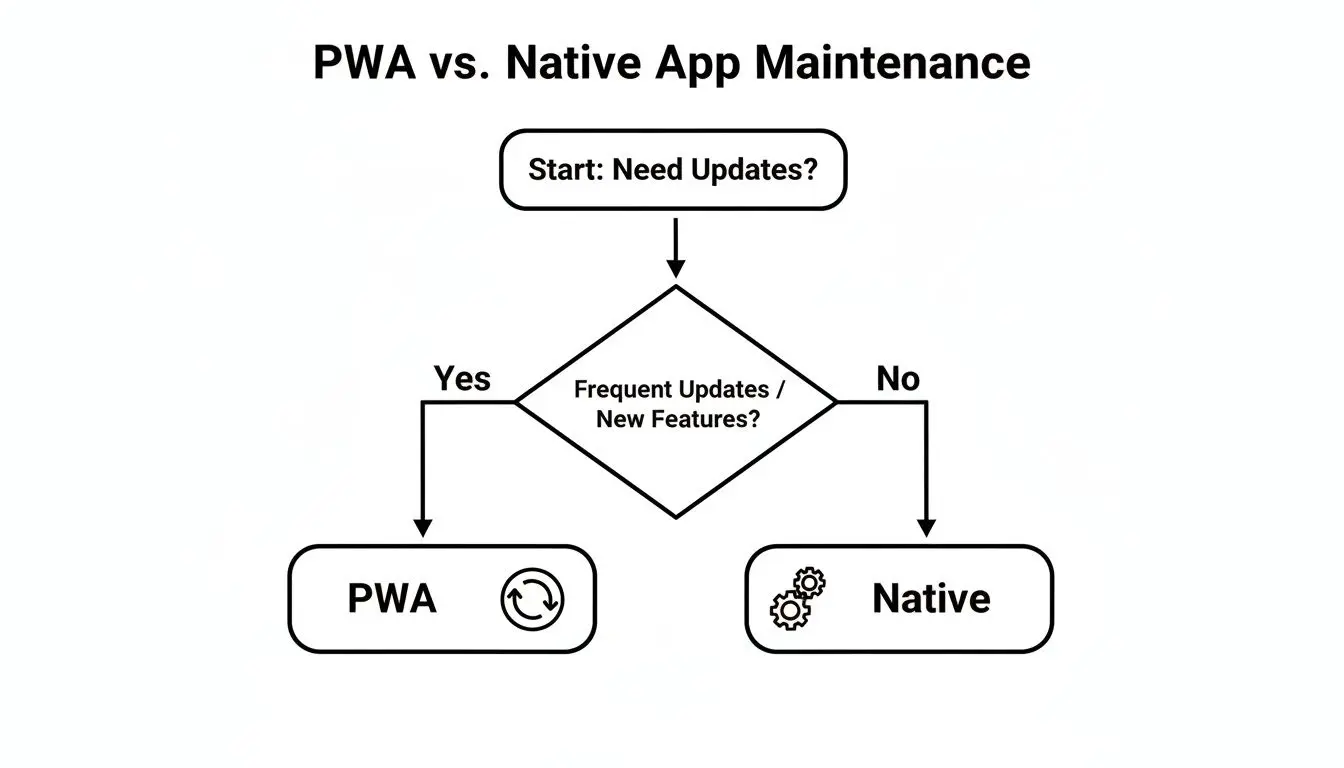
As the flowchart shows, a PWA's instant, server-side updates offer a huge operational advantage for businesses that need to iterate and push changes quickly. Ultimately, your decision should line up with your growth strategy. For UK businesses, particularly those serving regions with patchy mobile connectivity like rural Scotland or parts of Wales, a PWA’s offline capabilities can offer a distinct competitive edge. This advantage is driving some serious growth, with industry reports estimating the global PWA market will rocket from $3.53 billion to over $21 billion by 2033, and the UK is set to play a major part in that. This makes the PWA a powerful tool not just for engagement, but for genuine market penetration in underserved areas.
Frequently Asked Questions
After weighing up the finances, performance, and strategic angles of the progressive web apps vs native debate, a few specific questions always seem to pop up. Here are some straight answers to the queries we hear most often, helping you iron out the final details.
Are PWAs Secure Enough for E-commerce?
Yes, absolutely. PWAs run over HTTPS, which is the non-negotiable standard for encryption. It’s the same basic security layer that protects virtually every modern website you use, from your online banking portal to major retail platforms. When it comes to taking payments, PWAs don't handle that sensitive data themselves. Instead, they plug into trusted, secure payment gateways like Stripe or PayPal. This means all the card details are managed by PCI-compliant systems, making the entire process just as secure as it would be on a native app.
One of the standout security perks of a PWA is its natural defence against "man-in-the-middle" attacks, especially on public Wi-Fi, as long as HTTPS is properly set up. Their architecture also sidesteps the deep OS-level vulnerabilities that can sometimes plague native applications.
Can a PWA Truly Replace a Native App?
For a huge number of businesses, the answer is a resounding yes. If you’re running an e-commerce store, a content-led platform, a booking system, or most kinds of service-based apps, a PWA can do everything you need and more. It delivers the core app-like features people expect, an icon on the home screen, offline functionality, and push notifications. But there are limits. A PWA isn't the right tool for jobs that demand raw performance, like high-end gaming, complex background tasks, or unrestricted access to sophisticated device hardware. Think advanced camera controls, geofencing, or complex biometrics. For that kind of deep integration, a native app is still king.
What Is the Future Trend: PWA or Native?
The future isn't a battle where one wins and the other loses; it's about coexistence. We're moving towards a much more integrated digital ecosystem where businesses pick the right tool for the right job. Native apps will always be the go-to for specialised, high-performance experiences that need to get right down to the metal of the hardware. At the same time, PWAs are set to become the default for delivering fast, accessible, and easily discoverable experiences across the web. As browser technology continues to evolve, the feature gap between PWAs and native apps will keep shrinking. This will make PWAs an even more compelling option for a wider range of projects. Ultimately, the smart choice will always be about matching the tech to the specific user experience you want to create. At Studio Liddell, we live and breathe this stuff. Whether you need a lightning-fast PWA or a powerful, feature-rich native app, we specialise in creating digital experiences that make an impact. We can help you navigate the options and find the perfect solution for your project. Explore our bespoke app development services to get started.