Interactive Learning Platforms a Strategic Business Guide
Online learning has already crossed from optional to mainstream in the UK. Approximately 21% of the population has taken part in some form of online education, and that rises to 46% among 18 to 24-year-olds, according to MOL Learn's summary of UK online learning statistics. For leaders responsible for training, education, or public engagement, that changes the question. It's no longer whether people will learn through digital channels. It's whether the experience you provide is good enough to hold attention, build skill, and justify investment. That's where interactive learning platforms matter. A static portal full of PDFs, recordings, and next-button modules may still count as digital learning, but it rarely changes behaviour on its own. Strong interactive learning platforms do something else. They ask learners to respond, decide, practise, test, retry, collaborate, and apply. For businesses, institutions, and cultural organisations, that difference is strategic. Better interaction can improve onboarding, compliance, technical understanding, and learner confidence. It can also turn content from a one-off deliverable into a reusable digital product.
The Shift to Active Digital Engagement
70% of employees say they are more likely to stay with a company that invests in learning and development, according to LinkedIn Learning's workplace learning report. For leaders, that matters because learning is no longer a back-office function. It affects retention, speed to competence, operational consistency, and brand experience. The earlier phase of e-learning solved a distribution problem. Organisations could publish training at scale, standardise core material, and record completion. Useful, yes. Sufficient, no. Completion data does not show whether someone can perform a task correctly, make a sound decision under pressure, or apply guidance in context. That gap has pushed digital learning toward active engagement.
From publishing content to designing performance
The strongest programmes are built around what the learner needs to do, not just what the organisation needs to upload. That sounds obvious, but it changes budget decisions, platform choices, and production scope. A passive module can explain a process. An interactive platform can let someone rehearse it, get feedback, make an error safely, and try again. That is a different standard of delivery. It usually requires closer alignment between subject matter experts, instructional design, UX, analytics, and engineering. In practice, the shift looks like this:
- •Content still provides the foundation: videos, readings, and explainers introduce concepts and context.
- •Interaction tests application: branching paths, simulations, guided tasks, and timed decisions show whether learners can use the material.
- •Feedback supports improvement: the platform responds to choices while the reasoning is still fresh.
- •Tracking becomes more useful: leaders can measure attempts, errors, drop-off points, confidence gaps, and progression, not just completions.
Practical test: if a course can be completed while the learner is checking email, it is probably functioning as content delivery rather than skill development.
Why the business case has changed
Leaders across sectors are under pressure to prove that digital learning does more than reduce delivery cost. Employers want fewer avoidable mistakes in onboarding and compliance. Universities want online experiences that hold up academically, not just administratively. Public institutions and cultural organisations want audiences to participate, not just browse. Off-the-shelf tools can cover baseline needs quickly. They are often the right choice for standard compliance libraries or straightforward course delivery. The trade-off is that they tend to impose someone else's model of interaction, assessment, and reporting. Once an organisation needs training that reflects its own workflows, risk profile, audience behaviour, or service model, custom development becomes a strategic option rather than a technical preference. That is the shift. Interactive learning platforms are now product builds with educational goals attached. The organisations getting the best results treat pedagogy and technology as one design problem.
Defining Interactive Learning Beyond Buzzwords
A lot of platforms are labelled interactive because they contain buttons, hotspots, or quizzes. That isn't a useful definition. Clicking through content doesn't automatically create learning. A clearer test is this. Compare a lecture theatre with a workshop. In the lecture, the learner receives information. In the workshop, the learner uses information. They attempt a task, make choices, get feedback, and adjust. True interactivity starts there.
What meaningful interactivity looks like
The strongest interactive learning platforms are built around participation. They ask the learner to do work that resembles the actual cognitive or practical task. That might include:
- •Decision-based scenarios: the learner chooses a response and sees consequences.
- •Guided simulation: the learner practises a process in a safe environment.
- •Adaptive questioning: the next step depends on demonstrated understanding.
- •Peer interaction: discussion, review, or collaborative problem-solving adds perspective.
- •Immediate feedback: the platform responds while the learner still remembers the decision they made.
By contrast, superficial interactivity tends to rely on cosmetic motion. Progress bars, clickable cards, and occasional multiple-choice questions can support the experience, but they don't define it.
A useful way to evaluate a platform
Leaders often get pulled into feature lists too early. A vendor demo may look polished, but the better question is whether the interaction supports the learning task. Use this lens when reviewing options:
| Question | Weak answer | Strong answer |
|---|---|---|
| What does the learner do? | Watches and clicks next | Solves, decides, practises, reflects |
| How is feedback delivered? | End-of-module score | In-context correction and guidance |
| Does difficulty change? | Same path for everyone | Content adjusts by performance or role |
| Is it job-relevant? | Generic information dump | Task-based practice tied to real use |
| What is measured? | Completion only | Engagement, understanding, performance patterns |
Interactivity isn't the presence of motion on a screen. It's the presence of meaningful learner action.
Why this distinction matters commercially
If you're investing in a platform for customers, employees, students, or visitors, shallow interactivity creates a false sense of progress. The dashboard may show completions, while the organisation still deals with support issues, repeated errors, weak product understanding, or low confidence. That's why the best projects start with pedagogy before production. Technology matters, but it should serve a learning model. When organisations skip that step, they often end up with a well-designed interface wrapped around thin instructional thinking.
Anatomy of a Modern Interactive Platform
A modern platform works when two systems reinforce each other. One is pedagogical architecture, which shapes how learning happens. The other is technical infrastructure, which makes the experience stable, measurable, and scalable.
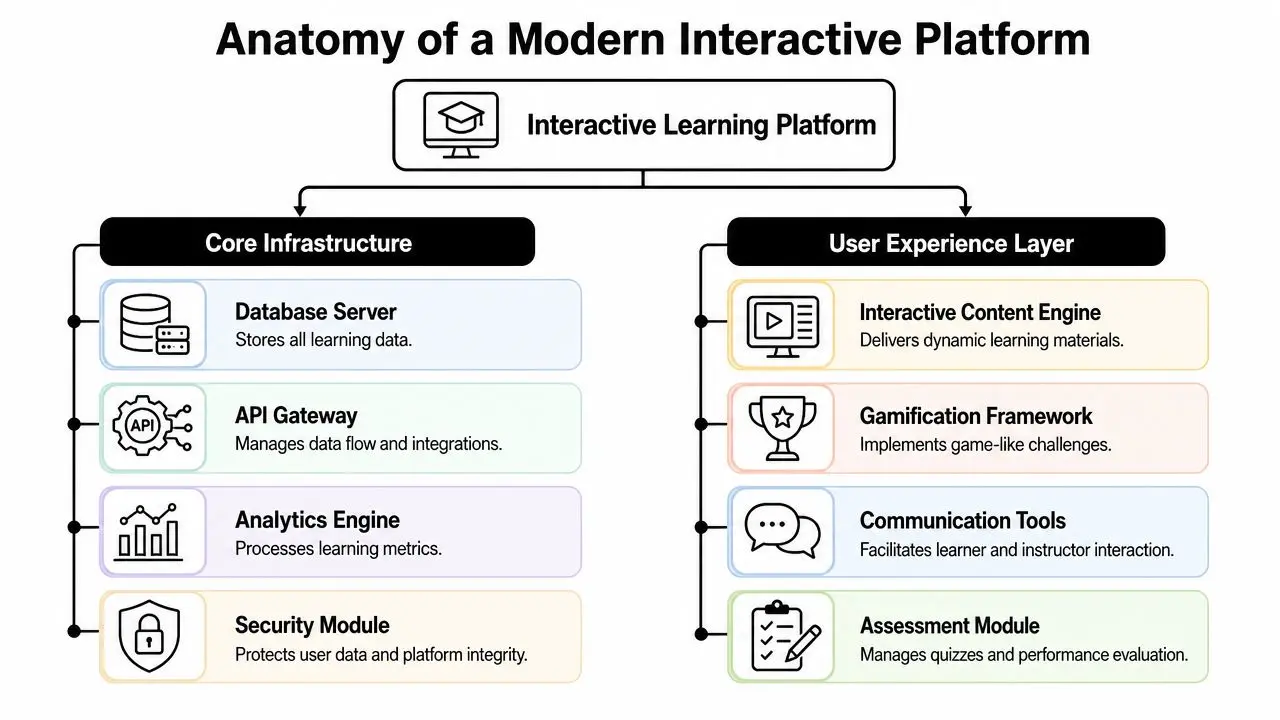
Pedagogical architecture
This is the part many teams under-specify. They commission content screens and workflows before they define how the platform should teach. A stronger model usually includes:
- •Clear learning progression: beginners need orientation, structured practice, and manageable challenge.
- •Assessment logic: checks should diagnose understanding, not just gate completion.
- •Feedback loops: learners need signals that help them correct mistakes early.
- •Motivation design: rewards, pacing, and visible progress must support effort without turning the whole experience into a gimmick.
- •Transfer planning: what happens on-platform should connect to real-world performance.
Adaptive design belongs here too. The best systems don't treat every learner as identical. They recognise prior knowledge, confidence, or repeated errors, then adjust the route accordingly.
Technical infrastructure
The platform also needs an engineering backbone that won't collapse once content gets richer, users increase, or integrations multiply. In practice, that usually means aligning several layers:
| Layer | What it does |
|---|---|
| LMS or portal layer | Handles access, permissions, course structure, and reporting |
| Content engine | Runs interactive modules, simulations, and multimedia |
| Data and analytics | Captures progress, behaviour, assessment results, and patterns |
| Integration layer | Connects CRM, HR, SIS, payment, or identity systems |
| Security and governance | Protects data, supports compliance, and controls access |
When teams ignore one of those layers, problems show up quickly. Rich content without robust analytics leaves you blind. A solid LMS with weak content design feels administrative. Beautiful modules that don't integrate with enrolment or reporting create manual workarounds.
User experience has to be tested, not guessed
Many otherwise capable builds lose value. Stakeholders approve a prototype because it looks modern, then real users struggle with navigation, interaction cues, or task flow. That's why interface testing matters. A practical reference is Uxia's practical guide on UI testing, which is useful for teams validating navigation, usability patterns, and interaction quality before launch. For learning products, this work isn't cosmetic. It affects whether the learner understands what to do next.
A platform can be technically complete and still fail if users hesitate at every step.
The system works only when both sides connect
Pedagogy without engineering stays theoretical. Engineering without pedagogy becomes a container. The strongest interactive learning platforms combine both. They know what the learner must do, how the system should respond, and how the organisation will measure whether the experience is working.
Must-Have Features for Driving Learner Engagement
The feature set that drives engagement isn't the longest one. It's the one that keeps attention connected to purposeful activity. Plenty of platforms overload the learner with dashboards, badges, pop-ups, and tabs, then wonder why completion drops. The better approach is to prioritise features that support momentum.

The features that usually earn their place
Some elements consistently prove useful when they're tied to a clear learning purpose:
- •Personalised pathways: learners should see content that matches their role, level, or recent performance.
- •Frequent low-stakes assessment: short checks reduce drift and reveal confusion early.
- •Scenario-based interaction: people stay engaged when they can act, not just observe.
- •Progress visibility: a clean sense of where the learner is, what's complete, and what remains helps sustain momentum.
- •Social mechanics: discussion, peer review, or instructor feedback can make digital learning feel less isolated.
Gamification can help, but only when it reinforces the task. A leaderboard may motivate one audience and alienate another. Badges can mark milestones, but they won't rescue weak content. A more grounded discussion of this balance appears in Studio Liddell's piece on gamification in education and learning engagement.
Rich media matters, but budget discipline matters too
Animation, motion design, and immersive assets can dramatically improve clarity. They're especially useful when you're explaining abstract systems, dangerous procedures, physical products, or historical reconstruction. But they should be commissioned with intent. In the UK, a professional-quality 60-second 2D animation typically costs £4,500 to £7,500, while adding 3D elements or traditional hand-drawn animation raises the budget to £12,000 to £28,000, according to Stormy Studio's animation cost guide. That cost spread is a useful reminder that not every lesson needs premium visual treatment. A practical content mix often works better than visual maximalism:
| Content need | Often best fit |
|---|---|
| Fast concept explanation | 2D motion graphics |
| Spatial process or physical product | 3D visualisation |
| Procedural rehearsal | Interactive simulation |
| Revision and confidence-building | Timed practice mode |
| Reflection or collaboration | Discussion and peer response tools |
For assessment-led environments, it helps to look at products that make practice feel purposeful rather than punitive. Exam Practice for GCSE is one example of a focused mode that shows how structured practice mechanics can support preparation without overcomplicating the user journey.
What usually doesn't work
Three patterns cause trouble repeatedly.
- •Feature stuffing: teams add every available tool, then create a cluttered experience.
- •Media without interaction: high production value can still produce passive learning.
- •Uniform pathways: advanced learners get bored, while beginners get lost.
If every learner sees the same content in the same order, the platform is easier to build but harder to justify.
The engagement question isn't “What can we add?” It's “What will help this audience keep going, understand faster, and perform better afterwards?”
Real-World Applications Across Key Sectors
The value of interactive learning platforms becomes clearer when you look at where they solve real operational problems. Different sectors use different mechanics, but the underlying pattern stays consistent. Learners do better when they can test decisions, receive guidance, and repeat complex tasks safely.
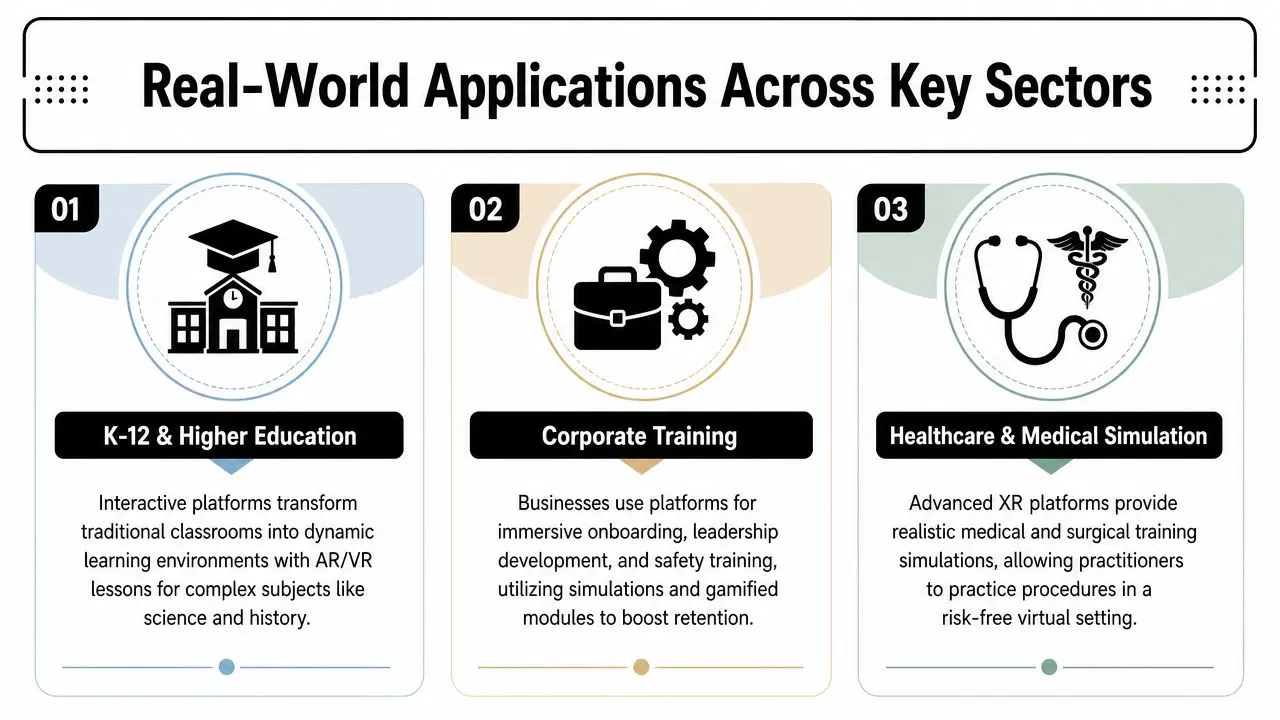
Corporate training
In corporate settings, interactive platforms are most valuable when the cost of confusion is high. Safety training, equipment handling, compliance workflows, and customer-facing processes all benefit from guided rehearsal. A manufacturing team, for example, may need more than a document set and a sign-off form. A simulation can walk staff through a sequence, let them choose actions, and surface mistakes before those mistakes happen on the job. In service businesses, scenario-led training can help teams practise difficult conversations, troubleshooting, or escalation paths. XR also has a place here, especially where the physical environment is difficult, expensive, or risky to reproduce. Studio Liddell's overview of VR, AR and MR applications across industries gives a useful cross-sector view of how immersive technologies support training and engagement.
Education and academic learning
In formal education, the strongest platforms don't just digitise worksheets. They adapt. They identify weak spots, change pacing, and provide targeted support while the learner is still engaged. One concrete example stands out. Century Tech's platform demonstrated a 27% improvement in student attainment when used across more than 450 UK schools, as reported in Educational Voice's review of UK interactive educational platforms. The key mechanism was adaptive delivery. The system adjusted content difficulty and pacing based on learner performance. That matters for institutions because the practical challenge isn't limited to giving everyone access to the same material. It's helping different learners move through that material productively. Some need reinforcement. Some need acceleration. Some need a different explanation altogether. For product teams building in this space, streamlined education app development for product teams is a useful reference point for thinking about delivery models, mobile readiness, and the practical shape of education-focused apps.
Museums, heritage, and public engagement
Cultural organisations use interactivity differently. Their problem is often attention, interpretation, and recall. A static exhibit label may communicate facts, but it can't always convey process, context, or lived experience. Interactive learning platforms let museums and heritage venues create layered experiences. A visitor can explore a reconstruction, trigger narrative branches, compare periods, or use AR to understand how an object functioned in context. That works especially well for subjects involving machinery, architecture, archaeology, or social history. The strongest public-facing experiences don't just entertain. They help visitors form a mental model. That's the common thread across education, business, and culture. The platform succeeds when interaction sharpens understanding.
Building a Custom Platform and Calculating ROI
Off-the-shelf tools are useful when your needs are standard. If you need basic course hosting, simple tracking, and limited customisation, buying a platform often makes sense. But once learning needs become tied to your own workflows, audience behaviours, data requirements, or brand experience, compromise starts to show. That's where custom development becomes a strategic option rather than a luxury.
When custom is the better decision
Custom interactive learning platforms are worth considering when you need one or more of the following:
- •A distinct learning model: branching logic, simulations, or role-specific pathways beyond standard templates.
- •Deep integration: connections to internal systems, enrolment data, HR tools, product databases, or customer portals.
- •Specialist content formats: immersive 3D, XR, advanced animation, or assessment models that generic authoring tools handle poorly.
- •Long-term product value: the platform itself becomes an institutional asset, not just a one-off campaign.
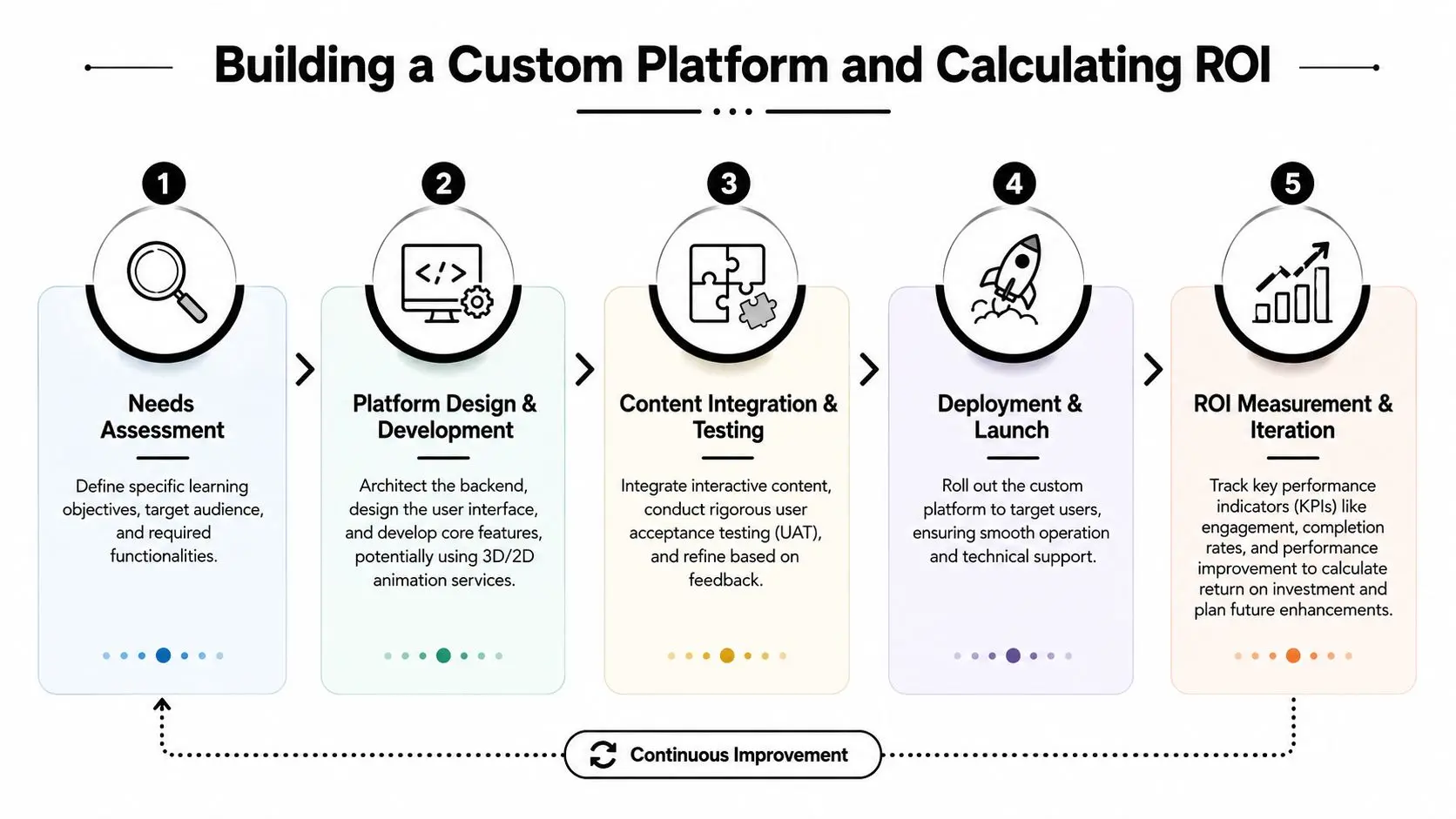
The process usually starts with scoping the learning problem, not the technology stack. Teams that jump straight to features often buy complexity they don't need. A better starting point is audience, job-to-be-done, measurable outcomes, and the operational constraints around launch and maintenance. For organisations exploring that route, Studio Liddell's page on online learning platform app development is a relevant example of how custom platform thinking can extend beyond generic LMS procurement.
How to frame ROI properly
Return on investment is often reduced to platform cost versus licence cost. That's too narrow. Instead, an ROI case should encompass performance and operational value. Use a broader lens:
| ROI dimension | What to assess |
|---|---|
| Learning performance | Are users understanding and applying knowledge better? |
| Operational efficiency | Has manual delivery, support, or retraining reduced? |
| Content reuse | Can assets be repurposed across teams, cohorts, or channels? |
| Experience quality | Does the platform reflect the organisation's standards and brand? |
| Data value | Can teams now see where learners struggle and improve the product accordingly? |
There's also a market argument. The UK e-learning market is projected to grow by USD 14.63 billion between 2026 and 2030 at a CAGR of 17.1%, according to Technavio's UK e-learning market analysis. The same source notes 80% of more than 27,000 UK university students rated their online learning quality as above average, 71% said it helped them progress academically, and the UK online education and training market includes 761 businesses, with sector growth at a CAGR of 2.9% between 2020 and 2025. Those figures don't prove that every custom build will pay off, but they do show a market with sustained demand, maturing supply, and rising expectations.
What good decision-making looks like
A sound custom platform investment usually follows five disciplines:
- Define the learning problem clearly
- Map user journeys before selecting technology
- Prototype the hardest interaction early
- Test with real users, not only stakeholders
- Plan iteration after launch, not just launch itself
Custom development pays off when the organisation treats the platform as a living product with measured improvements over time.The organisations that get the best return don't just buy software. They build a system that matches how their people learn, how their teams operate, and how their content needs to evolve. --- If you're weighing whether to commission a bespoke learning product, Studio Liddell can help shape the brief, define the right production approach, and build interactive learning platforms that combine strong pedagogy with animation, app, and XR expertise.