Augmented Reality in Retail: A Guide for UK Businesses
Augmented reality is closing the gap between browsing online and feeling confident enough to actually buy something. It’s a simple but powerful idea: letting customers see products in their own space, right through their phone, before they commit. The technology layers interactive, 3D digital models onto a live view of the world, turning what was once a gimmick into a must-have tool for boosting sales and slashing returns. For UK businesses, it’s a brilliant way to build certainty and create far more engaging experiences for shoppers.
How AR Is Reshaping the UK Retail Landscape
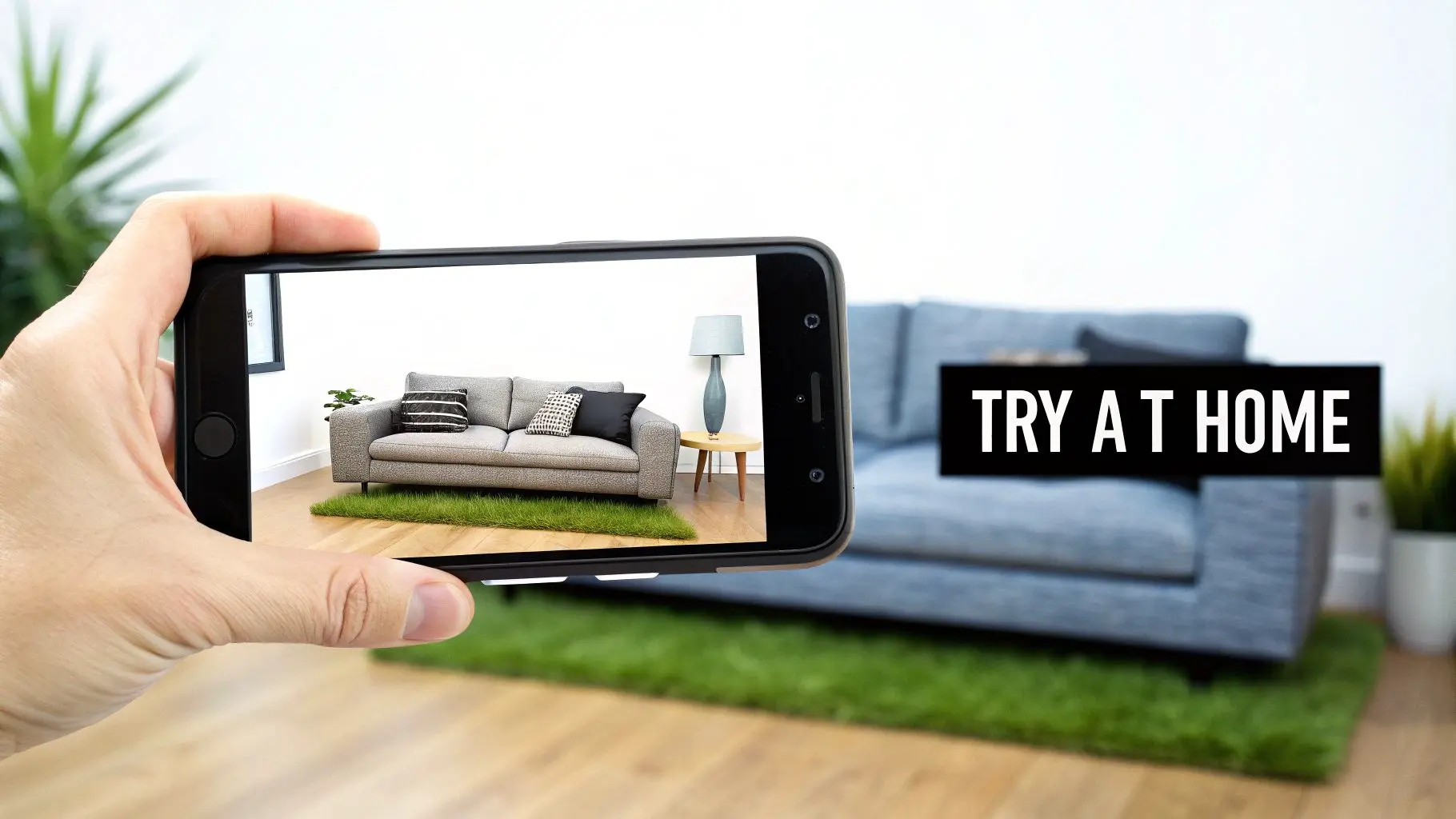
Picture this: a customer is eyeing a new armchair online. Instead of wondering if it will fit or match the curtains, they just point their phone at an empty corner of their living room. Instantly, the armchair appears, perfectly to scale and in the right colour. That’s the new reality of retail, an interactive layer that strips away the guesswork and gives people the confidence to click ‘buy’. This is a direct answer to one of the biggest headaches in e-commerce: returns. When a shopper can stop imagining how a product might look and start knowing how it will look, everything changes.
The Driving Force Behind AR Adoption
The reason augmented reality in retail is taking off so fast is because it solves real, practical problems. It’s graduated from being a fun marketing trick to a genuine utility that improves the entire shopping journey. You can see this shift clearly in the market growth.
The UK augmented reality market is booming, generating USD 4,131.2 million in 2024. Forecasts show that figure rocketing to USD 25,763.2 million by 2030, which is a massive compound annual growth rate of 34.7%.
This explosive growth comes down to a few core benefits that click with both businesses and their customers:
- •Boosts Buyer Confidence: Seeing a product in your own home or on your own body massively reduces that feeling of purchase anxiety.
- •Cuts Down Returns: When customers are sure about their choice, they’re far less likely to send it back. That saves retailers a fortune.
- •Drives Real Engagement: Interactive AR features create memorable, shareable moments that deepen a customer’s connection to a brand.
- •Blends Online and Offline: AR can bring a showroom into someone’s living room, or add a rich layer of digital information to the in-store experience.
As more businesses get creative with the tech, the applications are only getting smarter. We’ve written in more detail about the different VR, AR, and MR applications across industries if you want to explore further. It’s also worth looking into the wider world of innovation in retail stores to see how AR fits into the bigger picture of creating next-generation customer experiences.
Why AR Is a Game Changer for Customer Engagement
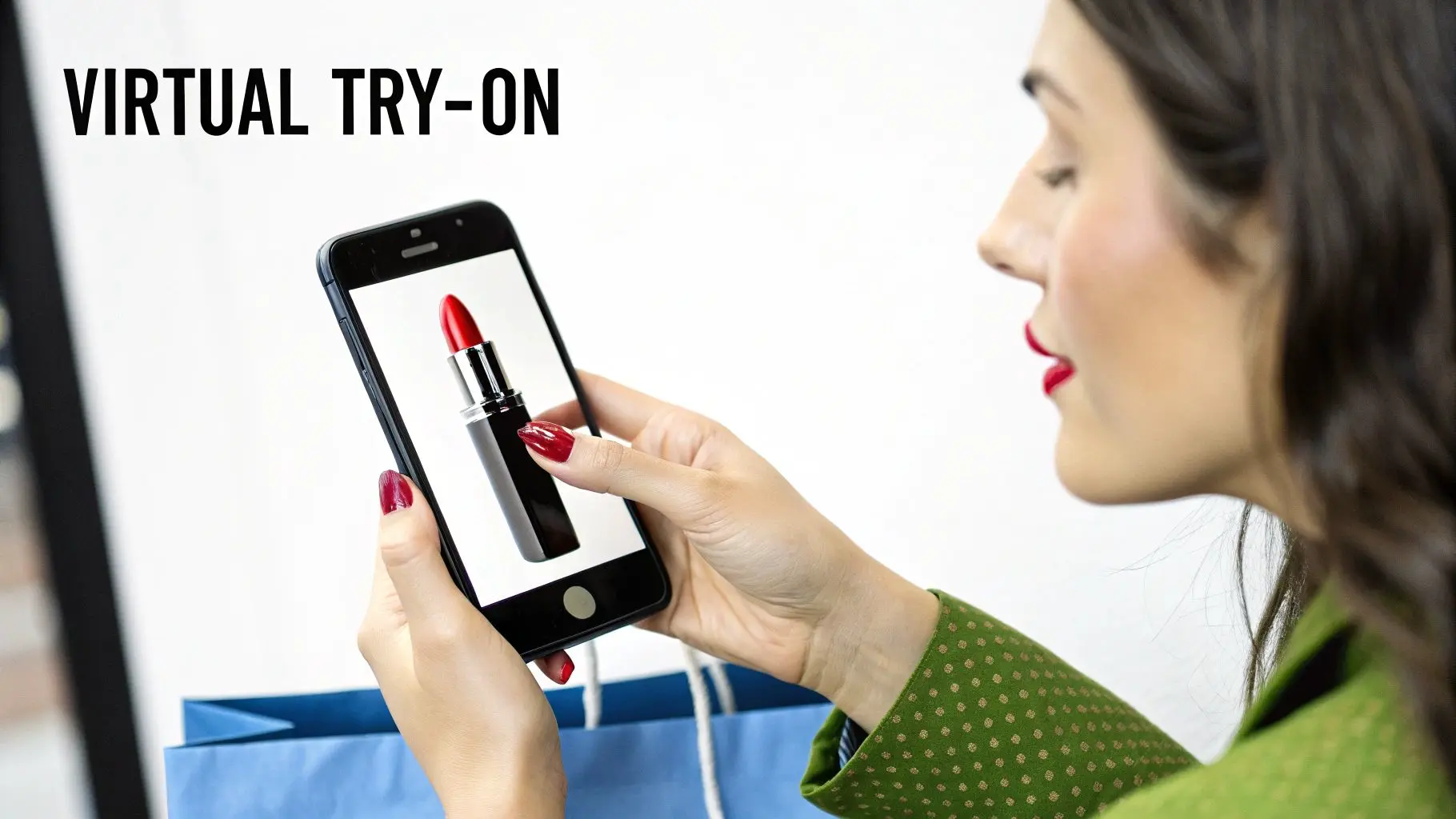
While the tech itself is impressive, the real magic of augmented reality in retail is how it solves genuine business problems. It's not just a flashy gimmick; it’s a strategic tool that gets real results by changing how customers behave and, ultimately, boosting the bottom line. At its heart, AR turns passive browsing into an active, hands-on experience. This is a massive deal because it tackles the biggest hurdle in online shopping: doubt. When a customer can virtually place a new sofa in their living room or see how a pair of sunglasses actually looks on their face, that hesitation disappears. It builds a bridge of confidence that makes them far more likely to click "buy".
Supercharging Conversions with Virtual Try-Ons
One of the most powerful uses of AR is the virtual try-on. Whether it's testing a new shade of lipstick or checking how a watch fits your wrist, this feature delivers the personalised preview that customers have always wanted. The results speak for themselves. Studies have shown that AR interactions can lift conversion rates by an incredible 94% compared to experiences without it. Why such a dramatic jump? It's simple. AR removes the guesswork. Customers don't have to imagine what something will look like, they can see it for themselves, right there and then. This instant visual feedback makes for a smoother, more satisfying journey that turns window shoppers into definite buyers.
Slashing Returns and Protecting Profits
Product returns are a multi-billion-pound headache for retailers, draining profits and causing logistical chaos. The main culprit is the gap between "what I thought I was getting" and "what actually arrived". AR attacks this problem at its source. By giving customers a true-to-life preview, AR helps them make better, more informed decisions from the start. This has a direct and measurable effect on return rates, with some brands seeing them drop by as much as 40% after rolling out AR features.
A lower return rate isn’t just good for logistics; it's a huge financial win. It means less cash tied up in reverse logistics, less stock that can't be resold, and a much healthier profit margin.
This benefit isn't limited to online stores either. AR can be a fantastic tool for in-person events like exhibition stands or pop-up shops, enabling interactive product demos without needing to haul around tons of physical stock. You can find out more about using AR for exhibitions and retail to see just how effective it is in physical spaces.
Building Lasting Brand Loyalty
Beyond the immediate impact on sales and returns, AR forges memorable interactions that build loyalty for the long haul. A genuinely helpful and fun shopping experience leaves a lasting positive impression. Think about it: when a DIY brand helps a customer perfectly visualise a new paint colour in their kitchen, they're not just shifting a tin of paint. They're becoming a trusted partner in that customer's home improvement project. These useful, positive experiences create an emotional connection that a simple, transactional purchase just can't replicate. This leads to a few key advantages:
- •Increased Customer Stickiness: Shoppers will come back to a brand that offers them genuinely helpful and engaging tools.
- •Word-of-Mouth Marketing: A cool AR feature that actually works is something people want to share, creating organic buzz on social media.
- •Brand Differentiation: Offering a superior, tech-powered experience makes a retailer stand out from competitors who are still stuck with static photos and videos.
Ultimately, AR shifts the relationship from a basic transaction to a collaborative and enjoyable experience, and that's the real foundation of brand loyalty.
Putting AR to Work in Your Retail Business
Understanding the theory behind augmented reality in retail is a good start, but seeing it in action is where things get really interesting. The true potential of AR clicks into place when you look at the practical, results-driven ways brands are already using it to reshape the customer journey. These aren't far-off concepts; they're real tools solving common retail problems right now. From fashion boutiques to furniture warehouses, AR provides a versatile set of tools to close the gap between a customer's imagination and the reality of a product. The most effective AR experiences all share one powerful goal: to erase doubt and uncertainty for the shopper. Let's dive into the most impactful ways businesses are putting AR to work.
Virtual Try-On for Fashion and Cosmetics
The virtual try-on is probably the most famous AR application, and for good reason. It directly tackles the single biggest hurdle in online fashion and beauty sales: the customer’s inability to see how a product looks on them. Instead of guessing from a model's photo, customers use their phone's camera to become their own model. This technology lets shoppers:
- •Test makeup shades: Instantly apply different lipsticks, eyeshadows, and foundations to see how they pair with their skin tone.
- •Try on accessories: Check how a pair of glasses frames their face, how a new watch sits on their wrist, or how a necklace hangs.
- •Visualise clothing: While still a developing field, some apps give a solid impression of how a garment might drape on a person’s body shape.
This isn’t just a gimmick; it’s a conversion machine, especially in the luxury market. A huge 72% of UK luxury fashion shoppers are keen to use AR, and retailers who’ve adopted it are seeing conversion rates jump by as much as 40%. It also has the welcome side effect of slashing product returns.
In-Home Product Visualisation
When it comes to big-ticket items like furniture, appliances, or home décor, the key question isn't just "Do I like it?" but "Will it actually fit?". In-home product visualisation answers that question with absolute clarity. Using a smartphone or tablet, a customer can place a true-to-scale 3D model of an item right in their own room. This simple but incredibly powerful tool gets rid of the guesswork and builds enormous confidence. A shopper can literally walk around a virtual sofa in their living room, check if a new fridge will block a doorway, or see if that piece of art is the right scale for their wall. It turns an abstract idea into something tangible.
By allowing customers to visualise items in their own environment, retailers effectively bring the showroom into the home. This not only increases the likelihood of a sale but also dramatically reduces the costly and complicated returns process for bulky items.
Interactive In-Store Experiences
AR isn't just an e-commerce play. It can also bring a whole new layer of excitement to the physical shop floor, blending the best of digital discovery with in-person shopping. By scanning a product or a QR code in-store, customers can unlock interactive digital content. This can come to life in all sorts of creative ways:
- •Gamified Discovery: Imagine a toy shop creating a virtual scavenger hunt where kids use a phone to find animated characters hiding among the aisles.
- •Enhanced Product Information: A customer could scan a bottle of wine to see food pairing suggestions, tasting notes, and a video message from the winemaker.
- •Interactive Wayfinding: Big department stores can use AR to overlay animated arrows on a customer’s screen, guiding them straight to the product they’re after.
Of course, for these experiences to work smoothly, the underlying infrastructure needs to be solid. This is where making the most of wireless deployments in retail becomes critical. These interactive elements turn a standard shopping trip into a memorable event, encouraging customers to stay longer and build a much stronger connection with the brand.
Choosing the Right AR Application for Your Retail Business
Picking the right AR tool depends entirely on your products and what you want to achieve. A virtual try-on for lipstick won't help a furniture store, and an in-home visualiser won't sell jewellery. The key is to match the technology to the customer's problem. This table breaks down the most common AR applications to help you see where your business might fit in.
| AR Application | Primary Business Benefit | Best For (Retail Sector) | Implementation Complexity |
|---|---|---|---|
| Virtual Try-On | Increases conversion, reduces returns | Fashion, cosmetics, eyewear, accessories | High |
| In-Home Visualisation | Builds purchase confidence, reduces returns | Furniture, home decor, electronics, appliances | Medium-High |
| Interactive Packaging | Enhances brand story, provides extra info | Food & beverage, CPG, toys, electronics | Medium |
| In-Store Wayfinding | Improves customer experience, reduces friction | Large department stores, big-box retailers | High |
Ultimately, the best AR solution is one that feels like a natural extension of your brand and genuinely helps your customers make a better, more confident decision.
A Step-by-Step Guide to Implementing AR
Knowing what augmented reality in retail can do is one thing; actually making it happen is another. To get there, you need a clear, structured plan. Integrating AR isn't just a tech project, it's a strategic move that needs a solid roadmap to guide you from a raw idea to a successful launch. Breaking the process down into manageable steps takes the mystery out of it all. It ensures every decision you make, from the tech you choose to the user experience you design, is tied directly to a real business goal. This way, you avoid building a cool tech demo that nobody uses and instead create an AR experience that feels seamless, intuitive, and genuinely helpful.
Step 1: Define Your Core Business Objective
Before you even think about 3D models or platforms, you have to ask one simple question: what problem are we trying to solve? A successful AR implementation isn't just about the tech; it's about solving a specific business headache. Are you trying to slash the number of costly furniture returns? Or maybe you're looking to give conversion rates a serious boost for a new makeup line? Your goal needs to be specific and measurable. Don't just aim "to sell more sofas." A much better goal is "to reduce sofa returns by 20% within six months of launching our in-home visualisation feature." This kind of clarity becomes your north star, guiding every single decision that follows.
Setting a precise, quantifiable goal is the bedrock of a solid AR strategy. It turns the project from a tech experiment into a focused business initiative with a clear finish line, making it far easier to measure your return on investment down the road.
Common objectives for retail AR projects often include:
- •Increasing conversion rates: Aiming for a specific sales lift for products that have AR features.
- •Reducing product returns: Targeting a percentage drop in returns by giving customers more confidence before they buy.
- •Boosting customer engagement: Measuring how long users actually spend playing with AR features.
- •Enhancing brand perception: Keeping an eye on brand sentiment and social media buzz around the new AR experience.
Step 2: Choose the Right Platform
Once you know what you're trying to achieve, the next question is where this AR experience will live. You've basically got two main options, and the right choice depends entirely on your audience and goals: WebAR or an app-based experience. WebAR lets customers jump straight into an augmented reality experience from their mobile browser. No app download needed. This is a brilliant option for making things easy and accessible. If you want to reach the widest possible audience with the absolute minimum of fuss, WebAR is usually the way to go. On the other hand, an app-based AR experience is built directly into your dedicated mobile app. Yes, this means the customer has to download it, but it also unlocks a world of more powerful, feature-rich, and high-performance possibilities. If your idea requires complex interactions, super high-fidelity graphics, or needs to plug into an existing loyalty programme in your app, then this is your best bet.
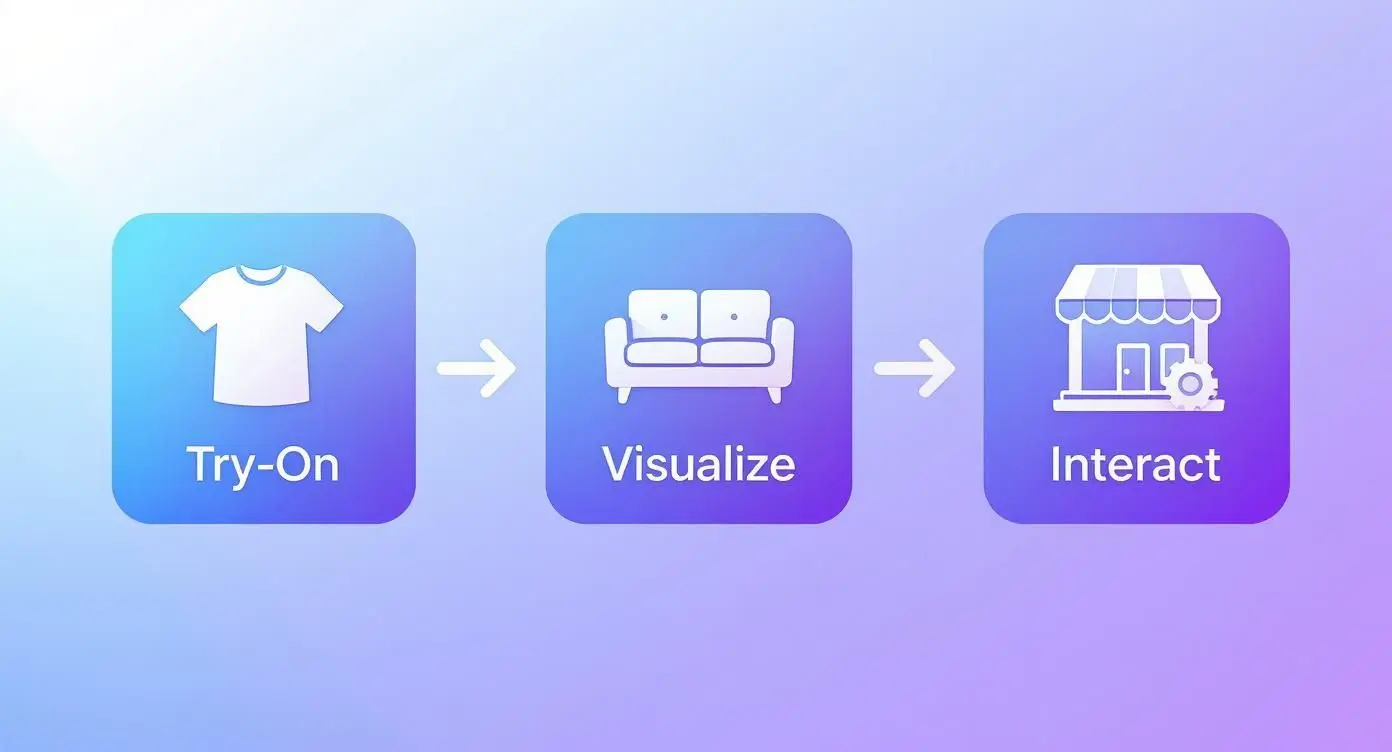
This diagram shows how different AR applications meet different customer needs, whether it's trying on a pair of trainers, seeing how a new lamp looks on their sideboard, or interacting with a product in-store.
Step 3: Build Your 3D Content Pipeline
The very heart of any AR experience is the 3D content. You simply can't compromise here, you need high-quality, realistic, and performance-optimised 3D models of your products. This is often the most time-consuming and resource-heavy part of the entire project. Your content pipeline is all about creating digital twins of your physical products. This could involve:
- 3D Scanning: Using specialised gear to capture the exact geometry and texture of your products.
- Photogrammetry: Taking hundreds of photos of an item from every conceivable angle and using clever software to stitch them together into a 3D model.
- Manual 3D Modelling: Getting skilled 3D artists to build the models from scratch using reference photos and product specs.
Step 4: Design an Intuitive User Experience
You can have the most mind-blowing AR technology in the world, but if it’s a pain to use, people won't. The user experience (UX) and user interface (UI) must be incredibly simple and guide the customer through the process without them even having to think about it. The goal is for the technology to feel completely invisible. Key things to get right in the UX include:- •Clear Instructions: Simple, on-screen prompts showing people how to scan their room and place an object.
- •Easy Manipulation: Letting users move, rotate, and resize the 3D object with the same familiar finger gestures they use every day.
- •Seamless Integration: The AR feature should feel like a natural part of the shopping journey, not some clunky, disconnected gimmick.
Test your interface relentlessly with real people. Find out where they get stuck or confused and fix it. The smoother the experience, the more likely they are to use it and, crucially, trust what it's showing them.
Step 5: Integrate and Launch
The final piece of the puzzle is integrating the AR functionality into your existing e-commerce platform or app. This is where you connect the AR viewer to your product pages, making sure that "View in your room" or "Try it on" button works flawlessly. The whole system needs to be stable and bug-free. A phased rollout is often a very smart move. You could start by launching the AR feature for a handful of your best-selling products. This lets you gather real-world data, get feedback from actual customers, and iron out any kinks before you commit to creating 3D models for your entire catalogue. Once it's live, watch the performance like a hawk, measuring it against the clear objectives you set right back in step one.
Measuring the ROI of Your AR Investment
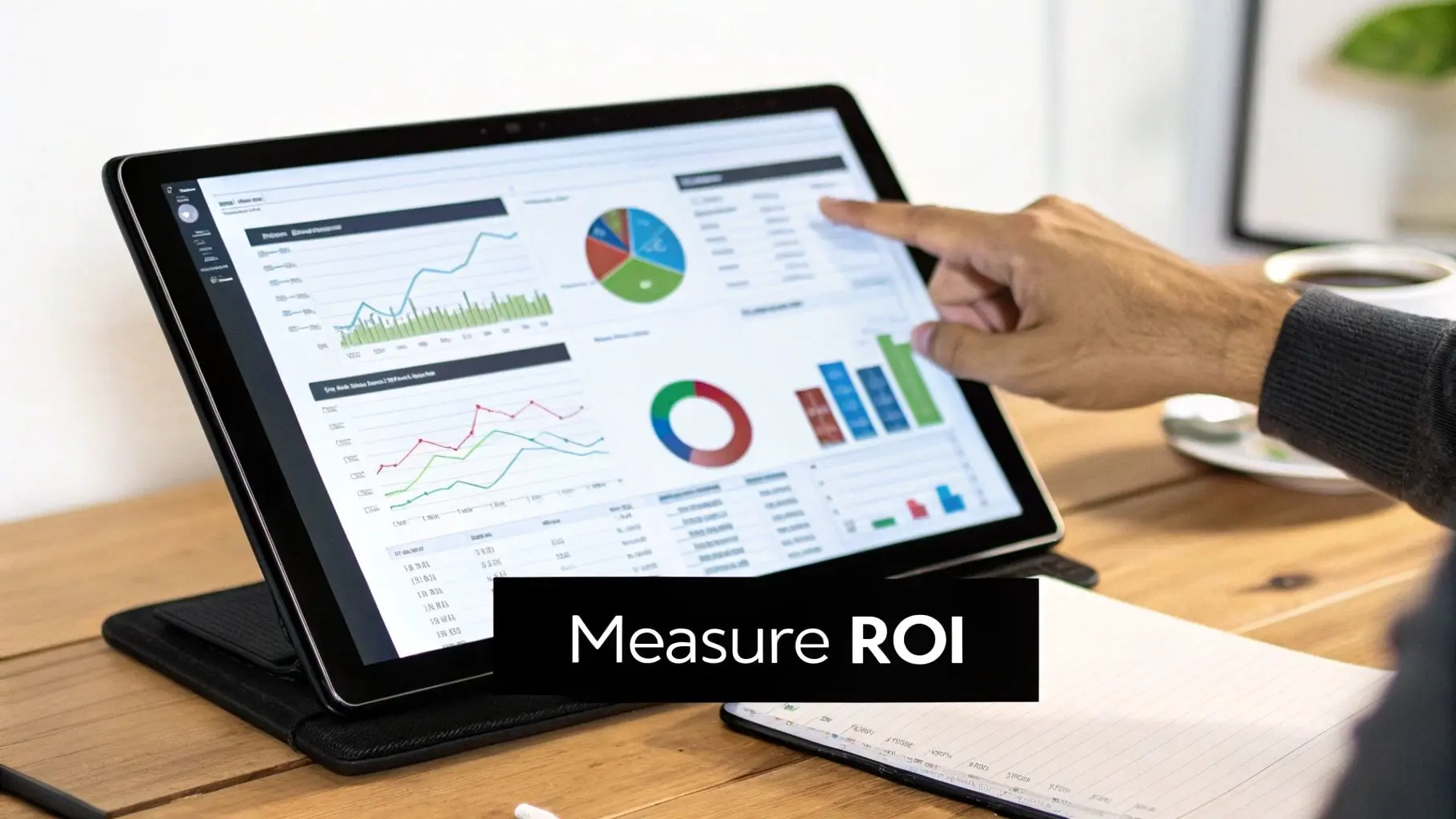
Rolling out a new AR feature is an exciting moment, but to really justify the investment and figure out what to do next, you need to prove it works. A great AR initiative isn't just about cool tech; it has to be backed by solid data showing its impact on your bottom line. Measuring the return on investment (ROI) isn't just for a victory lap. It's about getting under the skin of your customer's behaviour and making smarter decisions for the future. You need to look past the vanity metrics and focus on the numbers that tie your AR experience directly to business results. By setting up the right analytics from day one, you build a powerful case for the true value of augmented reality in retail.
Identifying the KPIs That Matter Most
Before you even think about launching, you need to define what success looks like in clear, measurable terms. This means picking KPIs that line up perfectly with the business goals you set in the planning stage. Don't try to track everything. Concentrate on the metrics that tell the most compelling story about your AR feature’s performance. Some of the most powerful KPIs for retail AR include:
- •Conversion Rate Uplift: This is the big one. Track the conversion rate for shoppers who use your AR feature versus those who don't. A big jump in that first group is the clearest proof of ROI you can get.
- •Reduction in Return Rates: AR is all about giving customers the confidence to click 'buy'. Keep an eye on the return rates for products bought after an AR interaction and see how they stack up against your average. A noticeable drop is a direct cost saving.
- •Increased Engagement Time: How long are people actually playing with your AR features? Longer engagement times usually signal a more valuable, immersive experience, which is often a great predictor of future sales.
- •Add-to-Basket Rate: This is a crucial step in the buying journey. How many users pop a product into their basket right after seeing it in AR? It's a clear link between the AR experience and their intention to buy.
By focusing on these core metrics, you can build a clear narrative that shows exactly how your AR investment is paying off.
Setting Up Your Analytics for Clear Insights
To get hold of this valuable data, your analytics setup needs to be spot-on. This usually means setting up custom event tracking in your website or app analytics platform, like Google Analytics. Every important interaction within the AR experience should trigger its own event. For instance, you'll want to track events like:
- AR Feature Initiated: When someone clicks "View in your room" or "Try it on".
- Object Placed Successfully: When a 3D model appears correctly in the user's space.
- Screenshot Taken/Shared: When a user saves or shares a picture of the product in their home.
By tracking these specific actions, you can piece together a detailed picture of the customer journey. You're not just seeing if people use the feature, but how they use it. That's gold dust for making future improvements.
Illustrating the Tangible Impact of AR
When it comes to showing the impact to stakeholders, nothing beats a simple before-and-after. A data table is a fantastic way to show the ROI of a well-run AR campaign by highlighting concrete improvements across your key metrics. It turns abstract numbers into a powerful story of success. Here’s a look at what a business might typically see after launching an AR virtual try-on feature for a product line.Example ROI Impact of an AR Virtual Try-On Feature
| Metric | Before AR Implementation | After AR Implementation | Percentage Change |
|---|---|---|---|
| Conversion Rate | 2.5% | 4.8% | +92% |
| Product Return Rate | 22% | 14% | -36% |
| Average Session Duration | 2 minutes, 15 seconds | 4 minutes, 30 seconds | +100% |
| Add-to-Basket Rate | 8% | 15% | +87.5% |
Finding the Right Partner for Your AR Project
Bringing an augmented reality vision to life isn't just about code; it's a creative partnership. All the ideas we've covered, from virtual try-ons to seeing how a new sofa looks in your living room, need a delicate mix of technical wizardry and artistic flair. The right partner gets your business goals and has the track record to turn them into an AR experience that feels intuitive, looks incredible, and just works. That’s exactly where we at Studio Liddell come in. Our roots are in high-end 3D animation and broadcast production, which gives us the creative muscle to build digital assets that are stunningly realistic. This is the absolute bedrock of any great augmented reality in retail experience. If the 3D models don’t look the part, the whole illusion falls flat.From 3D Assets to Immersive Experiences
But our expertise doesn't stop at making beautiful models. We have a deep, practical understanding of the entire production pipeline, from the first sketch to final deployment on powerful platforms like Unity and Unreal Engine. We design user experiences that feel natural, not clunky, and can be woven seamlessly into your existing e-commerce setup. This blend of creative and technical skill is what it takes to build AR solutions that actually move the needle for your business. We've sharpened this process over countless projects, creating everything from interactive product demos to fully-fledged virtual worlds.A successful AR project hinges on a partner who can deliver both exceptional 3D content and a flawless technical execution. It requires a studio that thinks like a retailer while creating like a world-class animation house.If you’re ready to explore how AR can genuinely change your customer's journey, we’re here to help. Our team has the hands-on experience to guide you through every stage, ensuring your project doesn’t just get launched, but smashes its business goals. To see what we can do, take a look at our VR & AR production services.
Got Questions About AR in Retail?
Jumping into any new technology brings up a few questions. It's completely natural. So, let's tackle some of the most common queries we hear from UK retailers who are thinking about bringing augmented reality in retail into their business.What’s the Typical Budget for an AR Feature?
This is the big one, and the honest answer is: it varies massively. Think of it like building a house. A simple, elegant extension is one thing; a multi-storey custom build is another entirely. For AR, a straightforward WebAR experience that uses a handful of your existing 3D models could start from just a few thousand pounds. On the other end of the scale, a bespoke app with hyper-realistic virtual try-on technology for hundreds of products is a much bigger investment, potentially running into the tens of thousands. The main things that influence the cost are the platform you choose (web vs. dedicated app), how many 3D models you need, and just how interactive you want the experience to be.Do My Customers Really Need to Download Another App?
Not at all! This is one of the biggest misconceptions about AR. While a dedicated app can certainly offer a richer, more powerful experience, WebAR is a game-changer here. WebAR lets your customers jump straight into an augmented reality experience right from their phone's web browser. No download, no friction. It's perfect for quick, one-off interactions, like checking if that sofa really fits in the living room. The choice boils down to what you want to achieve: maximum reach and accessibility (go with WebAR) or maximum features and performance (an app might be your best bet).How Hard Is It to Get 3D Models of Our Products?
Creating stunning, realistic 3D models is definitely a specialised skill, and it's often the most hands-on part of any AR project. But it's far from impossible. There are a few different ways to get it done:- •Photogrammetry: This is a clever process where hundreds of photos of a product are stitched together to build a digital 3D version.
- •3D Scanning: This involves using special hardware to capture a product's precise dimensions and textures, creating a perfect digital twin.
- •Manual Modelling: Here, skilled 3D artists build the models from scratch, using design files and reference photos as their guide. It's pure digital craftsmanship.
While it does require a specific kind of expertise, the good news is you don't have to become an expert overnight. Partnering with a studio that already has a well-oiled 3D pipeline makes the whole process smooth and ensures your digital products look every bit as good as the real thing. Ready to bring your products to life with a bespoke AR solution? The team at Studio Liddell has the creative and technical expertise to guide your project from concept to launch. Book a production scoping call with our experts.