Animation Jobs London: Your Guide to Landing Roles
Trying to break into the London animation scene can feel like a huge undertaking, but it’s still one of the world's great powerhouses for creative talent. The city is packed with a massive range of opportunities. You've got everything from the bustling VFX houses in Soho hammering away on the next Hollywood blockbuster to tiny boutique 2D studios crafting award-winning commercials. It's a vibrant, sprawling hub, and figuring out this landscape is your first step to finding where you fit in.
Mapping the Landscape of London's Animation Industry
London's reputation as a creative capital is well-earned, especially when it comes to animation and visual effects. The city is a dense ecosystem of studios covering just about every specialism you can think of. There are the large-scale operations focused on feature film VFX, the mid-sized studios pumping out beloved kids' TV shows, and the nimble creative agencies delivering slick motion graphics for global brands. This sheer variety creates a dynamic job market with roles for every kind of animator out there. The economic muscle behind this industry is pretty hefty, too. The UK's animation sector has grown into a real economic force, contributing around £1.6 billion to the national economy. While it directly employs about 1,000 highly skilled professionals, its impact ripples out much further. Once you factor in the whole value chain, the industry supports something like 20,000 jobs across the country, with London right at the epicentre. The folks at Animation UK have some great resources if you want to dig deeper into the workforce stats. This infographic breaks down the headline figures.
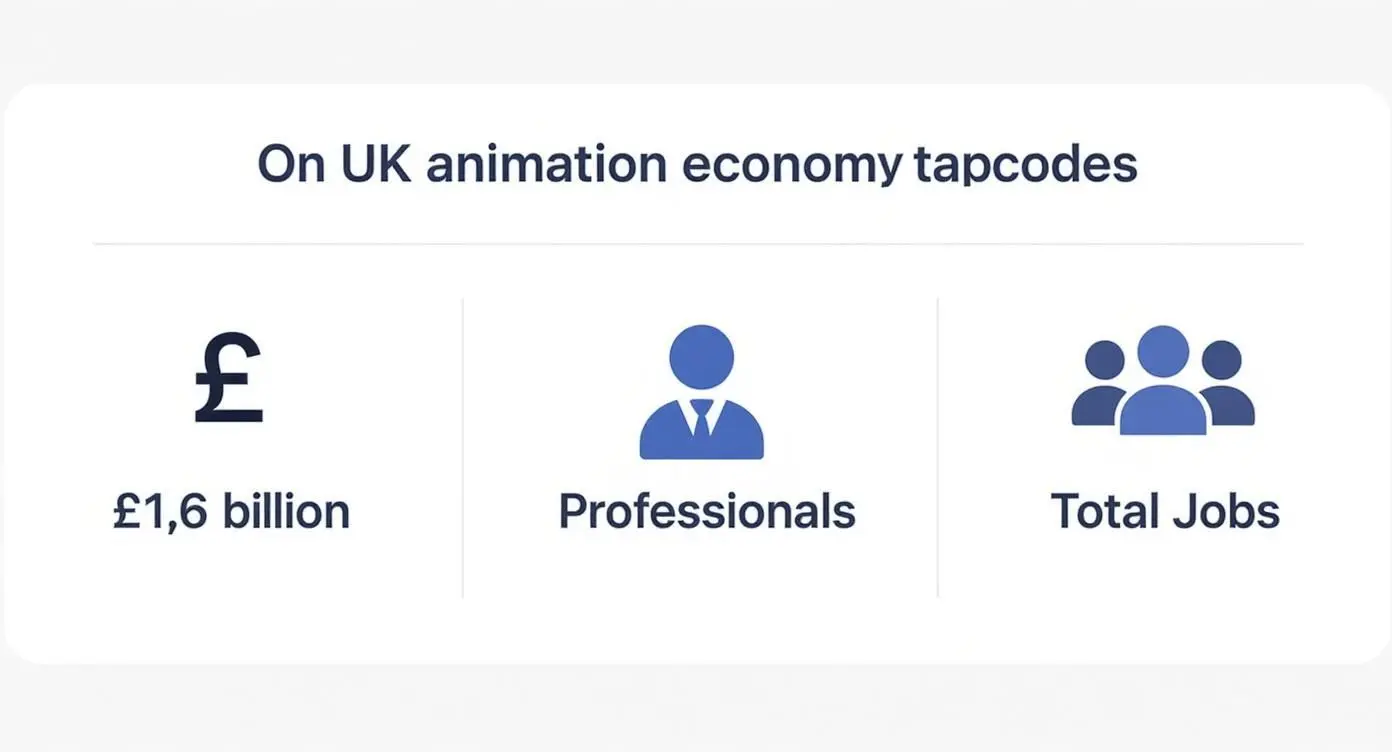
These numbers aren't just trivia; they confirm that animation isn't just a creative passion but a major, thriving contributor to the UK's economy, with London at its heart.
Key Sectors and Opportunities
To really get a feel for the market, you need to know where the demand is. London's animation jobs tend to cluster in a few key areas, each with its own flavour and set of opportunities.
- •Film and Television (VFX & Animation): This is the big one, home to world-renowned studios. These companies are perpetually on the hunt for talent in CGI, character animation, and compositing for major international productions. It's well worth checking out the top VFX companies in London to get a sense of the major players.
- •Advertising and Commercials: This world is fast-paced and intensely creative. It needs animators for everything from motion graphics and 2D explainers to slick CGI product visuals. Roles here often demand a versatile skill set and the ability to hit tight deadlines.
- •Children's Media: London is a proper hub for creating kids' content, from episodic TV series to interactive apps. Studios in this space are looking for brilliant character animators, storyboard artists, and designers with a real knack for storytelling.
- •Gaming and Immersive (XR): The boom in real-time engines has triggered a huge demand for animators with experience in games and interactive experiences. If you have skills in Unity or Unreal Engine, you're in a very good position to find work creating content for VR, AR, and video games.
Navigating the London scene is less about finding a job and more about finding the right type of job for you. Your specialism, be it nuanced character performance, technical wizardry, or sharp motion design, will point you toward the studios that are desperate for your specific skills.
In-Demand Skills Right Now
While the core principles of animation never change, technology is constantly shaping the specific skills that studios are hiring for today. Right now, there's a huge appetite for artists who are comfortable working in real-time pipelines. Expertise in Unreal Engine and Houdini is popping up on job descriptions all over the place, as studios adopt these tools for everything from virtual production to mind-bending visual effects. That doesn't mean the old guard is obsolete; a rock-solid understanding of Maya, 3ds Max, and the Adobe Creative Suite is still fundamental. The trick is to blend those timeless artistic fundamentals with up-to-the-minute technical knowledge.
Crafting a Showreel That London Studios Notice
In London's fiercely competitive animation scene, your showreel does all the talking. It's your handshake, your CV, and your elevator pitch, all packed into one. Recruiters at the big studios are drowning in reels, watching hundreds a week, so yours has to cut through the noise instantly. Forget generic advice; you need a strategy built for a London audience, one that respects their time and proves you've got the goods. First, let's kill the idea of a long, chronological montage. The golden rule here is less is more. You're aiming for a razor-sharp reel, no longer than 60-90 seconds. More importantly, the first 15 seconds are everything. That's your entire window to make an impression. Don't build up to a climax; start with your single best piece of work. No excuses. A hiring manager in London isn't looking for a jack-of-all-trades; they're looking for a specific solution to their problem. A generic reel that tries to please everyone will impress no one. You have to customise it.

Tailoring Your Reel for Specific Roles
The content of your reel has to directly answer the job title. A VFX studio in Soho couldn’t care less about your cute 2D character work, and a children's TV studio has no need for photorealistic fluid simulations. Be specific. Here’s how you should be thinking for different specialisms:
- •Character Animators: Your reel is all about performance. You need to show shots that prove you understand weight, believable physics, and subtle acting. A character lifting a heavy box with genuine strain is far more impressive than another generic walk cycle.
- •VFX Artists (Comp, FX, Lighting): We need to see your technical brain at work. Show us shot breakdowns. We want to see the journey from the raw plate to the final composite. Always label exactly what you were responsible for in each shot. It’s not just about the pretty picture at the end; it’s about your problem-solving process.
- •Motion Graphics Designers: This is about design, timing, and rhythm. Your reel should show a variety of styles, from slick corporate logo stings to complex data visualisations. A strong grasp of typography and composition is non-negotiable.
- •3D Generalists / Modellers: Show off that clean topology with wireframe overlays. We want to see a range of models, organic creatures, hard-surface vehicles, all presented with professional lighting and texturing.
For anyone working with characters, the real magic is in making them feel alive. It's worth digging into the subtleties, so check out these 10 hidden secrets to bring your 3D characters to life to give your work that extra spark.
Your showreel's job is to make the recruiter's job easy. They should be able to watch the first 20 seconds and say, "Yes, this person is a character animator," without any doubt. Ambiguity is the enemy.
Common Mistakes That Get Reels Deleted
London recruiters are busy. Certain mistakes are immediate red flags, and they will get your application binned before it's even seen properly. Avoiding these pitfalls is just as crucial as showing off your best work. Be absolutely ruthless with your edit. A killer 45-second reel is infinitely better than a two-minute one diluted with weaker, older stuff. If you have any doubt about a shot, cut it. Here are the top offenders we see all the time:
- Poor Music Choice: Avoid anything distracting, clichéd, or obviously copyrighted. Go for something instrumental and atmospheric that supports your visuals without screaming over them. Honestly, silence is better than a bad soundtrack.
- Including Group Project Work Without Clarity: If you show work from a team project, you must use on-screen text (a "chyron") to state exactly what you did. For example: "Animation," "Rigging," or "Lighting." Otherwise, we'll assume you did the easiest part.
- No Contact Information: It sounds obvious, but you’d be surprised. Your name, email, and a link to your full portfolio or website must be crystal clear at the start and end of the reel. Don't make people hunt for it.
- Overly Long Intros or Outros: Just get straight to the work. We don't need to see your fancy animated logo for five seconds. A simple, clean title card with your name and specialism is all it takes.
Finding Your Opening: Where to Look for Animation Jobs in London
Right, you've got a killer showreel. What's next? Getting it in front of the right people. This is where the real work begins, but it's not about endlessly scrolling through generic job sites until your eyes glaze over. That’s a fast track to burnout. The key to a successful London animation job hunt is a targeted approach. You need to be smart, focusing on the platforms and people that are the beating heart of the city's animation industry. It's about working smarter, not harder, to find those roles that genuinely match your skills and get you excited.Industry-Specific Job Boards
First things first: forget the massive, all-purpose job aggregators. Your time is far better spent on the websites and communities dedicated purely to animation and VFX. These are the places where studios post their best roles because they know they'll attract the right kind of talent. Make a habit of checking these platforms daily:- •Animation UK: As the official trade body, they often list openings from their member studios. This is a direct line to some of the most respected and legitimate companies in the business.
- •Skwigly Online Animation Magazine: It's more than just a great source for industry news. Skwigly has a well-regarded jobs section with a strong focus on London-based roles.
- •3dtotal: A global powerhouse with a huge UK following. If you're into 3D modelling, texturing, or generalist CGI work, this is an essential bookmark.
- •The Rookies: An absolute must for juniors and recent graduates. Studios specifically head here to find fresh, emerging talent.
These specialised sites cut through all the noise. For a deeper dive, we've put together a full list of the top resources for animation jobs in London.
Specialist Recruitment Agencies
Recruiters can be incredible allies in your job search, but you have to connect with the right ones. A generalist recruiter won't get the difference between a rigger and a modeller. You need a specialist who lives and breathes this world. Agencies like those connected to Escape Studios or Access VFX, along with dedicated creative headhunters, have deep roots in London's studio network. They often handle roles that you'll never see advertised publicly. A good recruiter is your advocate, they know what studios are really looking for and can champion your work directly to the hiring manager.
A strong relationship with a specialist recruiter can be a game-changer. They provide invaluable market insight, salary guidance, and a direct introduction to hiring managers, saving you the effort of cold outreach.
To get your job search organised, it helps to have a quick-reference guide to the best places to look. Here are some of the key players we recommend keeping on your radar.
Key Resources for Your London Animation Job Hunt
| Resource Type | Examples | Best For |
|---|---|---|
| Job Boards | Animation UK, Skwigly, 3dtotal | Finding roles posted directly by top UK studios. |
| Recruiters | Escape Studios, Access VFX | Getting exclusive access to unadvertised jobs and expert advice. |
| Portfolio Platforms | The Rookies, ArtStation | Showcasing your work to a global community and finding junior roles. |
| Networking Sites | Connecting directly with studio recruiters and key personnel. |
Having this mix of resources in your toolkit ensures you're covering all your bases, from passive browsing to active networking.
The Art of the Speculative Application
Not every job opening gets a formal listing. Many studios, particularly the smaller boutique ones, hire when the right person comes along. This is where a speculative application, reaching out when there’s no open role advertised, can really pay off, but only if you do it right. A generic, copy-pasted email is a waste of everyone's time. Your message needs to be personal, targeted, and straight to the point.
- Do Your Homework: Research studios whose work genuinely inspires you and fits your style. Don’t just spam every company in Soho.
- Find the Right Person: Address your email to a specific person. A Head of Production, Recruitment Manager, or a senior producer is usually your best bet. LinkedIn is your friend here.
- Craft a Clear Subject Line: Keep it simple and professional. Something like “Character Animator Reel - [Your Name]” works perfectly.
- Keep the Email Short and Sweet: Introduce yourself in one sentence. Tell them why you admire their work (mention a specific project!). Then, provide a direct link to your showreel and sign off by saying you’d love to be considered for any future opportunities.
Understanding Salaries, Contracts, and Visas
Let's talk about the less glamorous, but absolutely essential, side of your animation career: the money and the paperwork. Getting your head around salaries, contracts, and visa rules in London is what separates a passion project from a sustainable, long-term career. Knowing your worth and understanding the legal bits gives you the confidence to negotiate properly and handle the logistics of working in one of the world's biggest creative hubs. Let's break down what you actually need to know.London Animation Salary Benchmarks
Salaries in London can feel like a bit of a moving target. They shift based on your experience, your specialism (a 3D Rigger's day rate might differ from a 2D Animator's), and the kind of studio you're working for. But we can definitely map out some realistic benchmarks to get you started.- •Junior Animators (0-2 years): Fresh out of uni or early in your career, you're looking at a salary somewhere between £24,000 and £30,000. Your main goal here is soaking up as much production experience as you can and beefing up that showreel.
- •Mid-Level Animators (3-6 years): Once you've got a few solid projects under your belt, your value shoots up. The range here is typically £32,000 to £45,000. You'll be trusted with more responsibility and have a bigger creative say.
- •Senior/Lead Animators (7+ years): For the seasoned pros who can lead a team and define the creative vision for a project, salaries start climbing from £50,000 to £70,000+.
These are just guidelines, of course. The current economic climate has put a squeeze on budgets across the creative industries. A recent industry survey found the median salary for UK animators is around £40,000, but it also highlighted some of the challenges everyone is facing. It’s worth a read to get the full picture.
PAYE Contracts vs. Freelancing
When an offer lands in your inbox, it'll usually be one of two types: a permanent PAYE (Pay As You Earn) contract, or a fixed-term freelance gig. Knowing the difference is crucial for your bank account and your sanity.
| Feature | PAYE Employee | Freelance Contractor |
|---|---|---|
| Tax & NI | Your employer sorts this out for you. | It's all on you. Get ready for self-assessment! |
| Benefits | You get paid holidays, sick pay, and a pension. | Nope. No paid time off or employer pension. |
| Job Security | More stable. They have to give you notice. | Project-based, so less security once it's done. |
| Pay Rate | A set annual salary. | A higher daily or weekly rate to make up for the lack of benefits. |
A massive red flag to watch out for in any contract is a "zero-hour" clause or wishy-washy terms about who owns the intellectual property (IP). Always read the fine print. If you're not sure, it's worth getting advice from a union like BECTU.
Navigating UK Visa Requirements
For animators dreaming of London from overseas, the UK's immigration system is the first big hurdle. The main path for creative professionals like us is the Skilled Worker visa. To get one, you need a confirmed job offer from a studio that's approved by the Home Office to sponsor employees. It’s not just any job, either, the role has to meet specific skill and salary thresholds. The good news is that animators, VFX artists, and similar roles are almost always on the UK's eligible occupations list, so it’s a well-trodden path. The process kicks off when your new employer gives you a 'Certificate of Sponsorship' (CoS). You'll use this document to formally apply for your visa. It’s a bit of a paper trail, so getting your documents in order is key. For a deep dive into the whole process, this complete guide to UK visa and application tips is an excellent resource that walks you through everything step-by-step.
How to Succeed in Your Animation Interview
Landing an interview for an animation job in London is a massive win. Well done. Now, the real work begins. This isn't just going to be a casual chat; it’s often a multi-stage process designed to test your skills, your personality, and frankly, how you handle a bit of pressure. From the first call with a recruiter to a practical art test, every step is a chance to prove you’re the right person for the studio. Your prep starts long before you walk through the door or log into the video call. First things first: become an expert on the studio. Don't just skim their homepage. You need to dive deep into their portfolio, watch their past work, and get a feel for their style, their storytelling, and their technical execution.

Prepare Your Narrative
One of the first things you'll almost certainly hear is: "Talk me through your showreel." This isn’t just a cue to press play. It’s an open invitation to tell the story behind your work. Be ready to break down each shot, explaining your exact contribution, the creative brief you were working from, any technical hurdles you had to overcome, and what you learned along the way. This is your moment to show off your problem-solving skills and articulate your workflow. A big part of your interview prep should be to master common behavioral interview questions. Practising your answers using a framework like STAR (Situation, Task, Action, Result) can help you structure your thoughts clearly and confidently.
Ask Insightful Questions
Towards the end of the interview, the tables will turn with the inevitable, "Do you have any questions for us?" Having a few thoughtful questions ready shows you're genuinely interested and have done your homework. Steer clear of basic questions you could have found with a quick search. Instead, focus on their creative process and the team culture. Try something like:
- •"I really admired the character performance in [Project Name]. Could you tell me a bit about the animation pipeline for that production?"
- •"What does the feedback and review process look like for animators on your team?"
- •"How does the studio support professional development and learning new software?"
Questions like these open up a real conversation and show you’re already thinking like a member of the team, not just someone looking for any old job.
Remember, an interview is a two-way street. You're interviewing them just as much as they're interviewing you. Asking smart questions helps you figure out if the studio's culture and workflow are the right fit for you to really thrive.
The Technical Art Test
For many roles, especially in London’s fiercely competitive market, a technical art test is a standard part of the hiring process. This isn’t just another chance to flash your raw talent; it’s a simulation of a real-world assignment. Studios are looking for a few key things here, and it’s not just about your technical chops. They want to see how you interpret a brief, how you manage your time under a deadline, and, most importantly, how you respond to feedback and direction. You might be given a simple rig and asked to animate a short scene, or maybe a model to light and render. Whatever the task, follow the instructions to the letter. If they ask for a two-second animation, don't deliver a five-second epic. The goal is to prove you're a reliable professional who can deliver quality work within the given constraints. Show your working, name your files cleanly, and present the final result professionally. It’s a test of your process just as much as it is of your final pixels.
Your London Animation Career Questions Answered
Getting a foot in the door of London's animation scene can feel like navigating a maze. It’s a fast-moving, competitive world, and it's completely normal to have a ton of questions about the nuts and bolts of actually landing a job. We’ve pulled together some of the most common queries we hear from animators trying to break in, with some straight-up answers to help you map out your next move.
Do I Need to Live in London to Get a Job There?
This is the big one, isn't it? Especially if you're based outside the UK. While remote work has definitely shaken things up, the honest answer is that for most animation roles, being in or near London is a huge plus. The vast majority of studios run on a hybrid model at the very least; they still thrive on the creative buzz and quick-fire collaboration that only happens when people are in the same room. For junior roles, being local is pretty much a must. So much of your growth comes from mentorship and just absorbing knowledge from the senior artists around you, something that’s incredibly difficult to replicate over Zoom. There’s more wiggle room for mid-level and senior animators, but you’ll find that many of the most important creative chats still happen face-to-face. Landing a fully remote gig from outside the UK is rare, mainly due to the headache of international tax and employment laws.
What Is the Most In-Demand Animation Skill in London?
Right now, if you've got skills in real-time engines, you're sitting on a golden ticket. Expertise in Unreal Engine is massively sought after. Its use is exploding across film, TV, advertising, and all sorts of immersive projects, and studios are scrambling to find artists who can keep up with its fast-paced workflow. But here’s the thing: software is just a tool. What studios are always looking for are rock-solid fundamentals. A deep, intuitive grasp of the principles of animation, timing, weight, spacing, appeal, is what separates a decent artist from a truly great one. Your technical skills might get your showreel a first look, but your artistic foundations are what will land you the job.
A studio can teach a talented animator a new piece of software in a few weeks. They can't teach the innate sense of performance and timing that takes years to develop. Your artistic core is your greatest asset.
How Important Is a University Degree for an Animation Job?
Your portfolio and showreel are everything. A degree certificate? Not so much. A killer reel that shows off exceptional talent and a sharp understanding of the craft will always, always win out over a first-class degree attached to a lacklustre portfolio. London's animation scene is a meritocracy. Your work speaks for itself. That being said, a degree from a top-tier institution like Escape Studios or the National Film and Television School (NFTS) can give you a serious leg up. These courses offer incredibly focused, industry-aligned training and access to pro-level kit. But more importantly, they provide connections. Their industry showcase events are often crawling with recruiters from London's top studios, giving you a direct line in that’s tough to get on your own. So, it's not the piece of paper that matters, it's the specialised training and the network that comes with it. At Studio Liddell, we're always on the lookout for exceptional talent to join our team. We're passionate about nurturing creativity and pushing the boundaries of animation and immersive experiences. Book a production scoping call