8 XR Examples: Projects, Tactics and Tech Stacks
Strong XR projects rarely succeed because the technology is novel. They succeed when the interaction fits the audience, the hardware suits the context, and the delivery model matches a real commercial or learning goal. That matters even more in the UK now, where the immersive economy was estimated at 2,106 immersive technology companies by 2022, with around £1.4 billion in turnover, according to a UKRI-funded sector study on the post-COVID ecosystem UK immersive economy sector study. That scale changes how clients should read XR examples. The useful question isn't whether XR is interesting. It's whether a given format works for your audience, your venue, your staff, and your production timeline. The best xr examples also tend to be less theatrical than people expect. UK evidence shows higher uptake outside entertainment in areas such as engineering and manufacturing, retail and consumer, and professional services, while many public roundups still over-focus on gaming PwC on how UK organisations use XR. In practice, buyers want to know four things: what was built, how it works, which technology supports it, and what another team can replicate without inheriting avoidable risk. These eight examples answer those questions from a production angle. They connect concept, engine choice, optimisation, deployment, safety, story, and measurement across entertainment, retail, events, training, and transmedia. That's the level where XR becomes useful.
1. VR Production Studio in Manchester. Designing Immersive Experiences with Real Impact
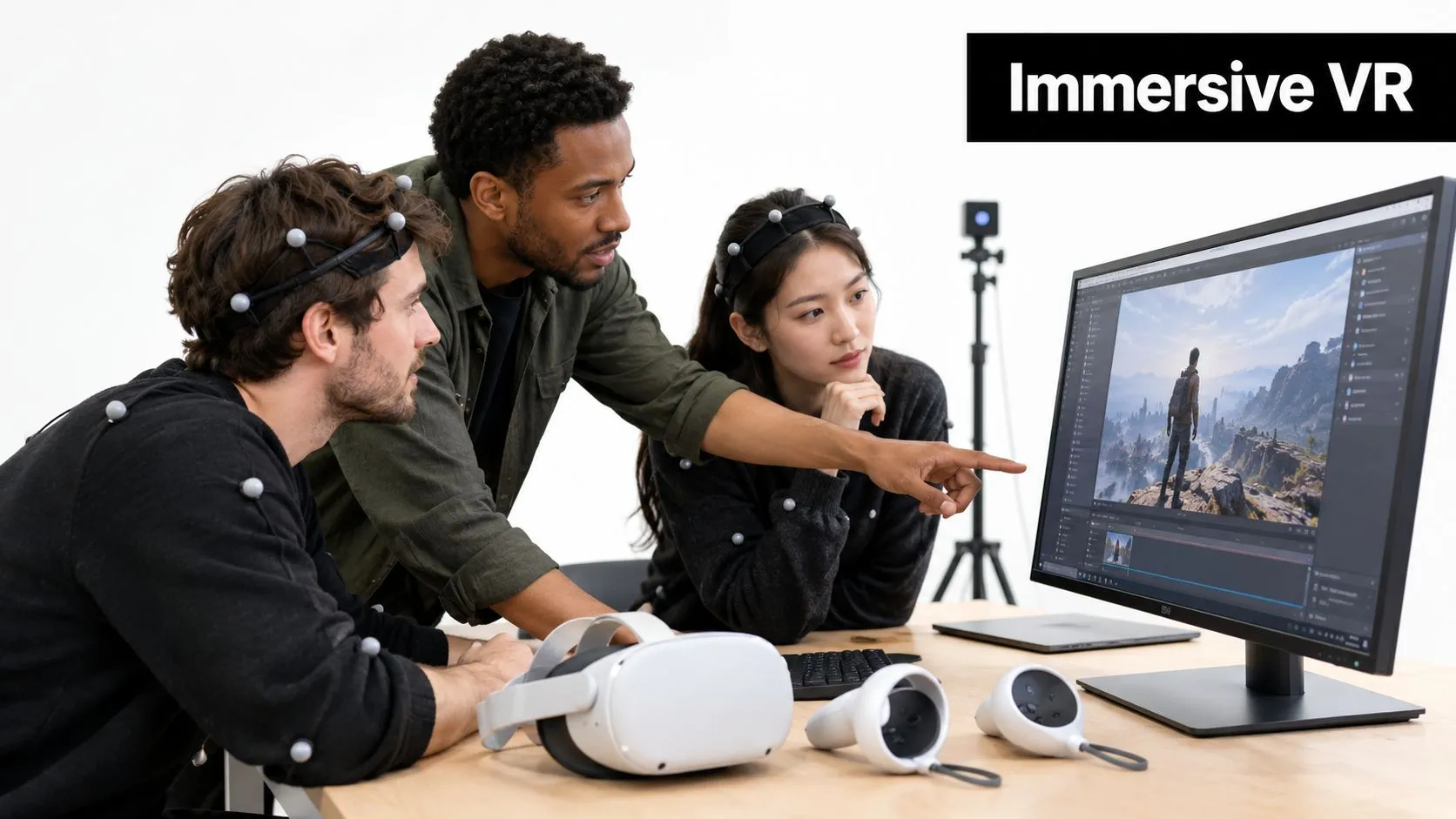
A good VR build starts long before anyone puts on a headset. The early decisions, interaction model, headset target, play duration, input method, comfort profile, usually decide whether the project feels clean and convincing or awkward and expensive. Studio Liddell's Manchester-facing VR work sits in that full-cycle space: concepting, spatial design, Unity or Unreal implementation, then deployment across exhibitions, location-based installs, and app-based experiences. If you're comparing regional partners, their view on virtual reality in Manchester is useful because it reflects a production-first mindset rather than a trend piece. Dance! Dance! Dance! is a strong example of event-friendly mixed reality because the design challenge isn't only visual polish. It's repeatability. Players need to understand the rules quickly, staff need to reset the experience fast, and the game loop has to work even in noisy public environments. Aurora points in a different direction. A VR short lives or dies on pacing, spatial sound, and how the viewer's attention is directed inside the scene.
What tends to work
- •Concept sprints first: Validate the core mechanic or narrative beat before full asset production.
- •Hardware-first design: Quest optimisation is a different job from building for tethered PC VR.
- •Spatial audio as structure: Audio shouldn't arrive late. It guides attention and supports comfort.
- •Operational analytics: Track where users hesitate, quit, or replay.
Practical rule: If the headset target changes halfway through production, budget and scope usually change with it.
For filmed or hybrid VR shoots, practical staging still matters. Teams prototyping composited content or live-action plates often benefit from an affordable green screen backdrop, especially during previs and pickup work.
2. AR for Exhibitions and Retail. Increase Stand Dwell Time with Spatial Content
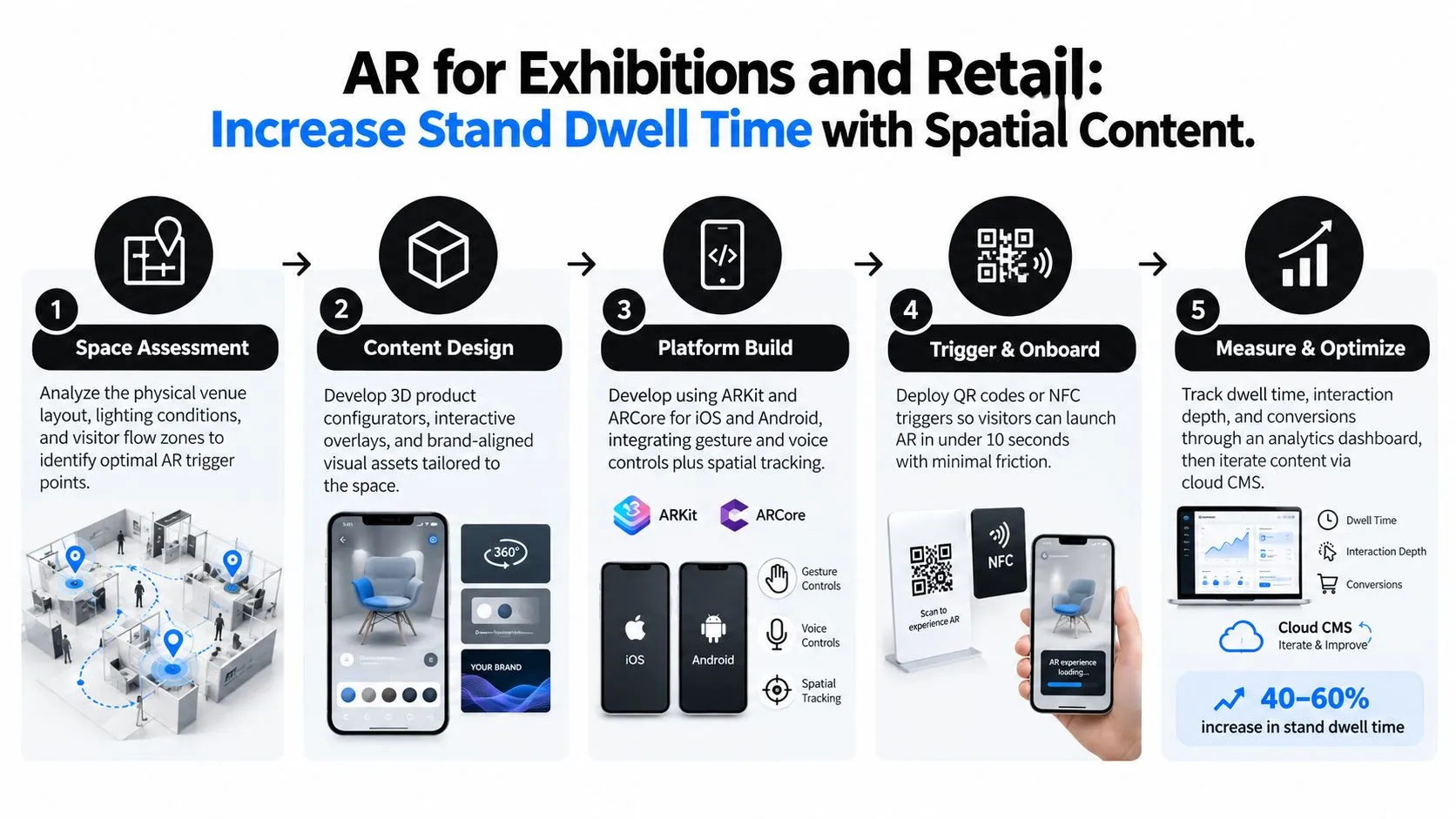
AR works best when it removes friction from a real buying moment. That could be previewing a product in a home, showing a configurable finish at a trade stand, or letting a visitor access product layers that would be impossible to display physically. In exhibitions and retail, the strongest xr examples aren't the ones with the flashiest overlay. They're the ones that answer a practical question quickly. Furniture preview, automotive customisation, and branded festival lenses all work because the user already understands why they're there. For event teams, Studio Liddell's guide to augmented reality events is aligned with that commercial reality. The production challenge is usually less about 3D modelling alone and more about onboarding, tracking conditions, and making the payoff obvious inside a busy physical environment.
Where AR earns its keep
A retail configurator is valuable when it helps someone compare options in context. A stand-based AR activation works when people can launch it instantly, orient themselves fast, and get to the branded moment without a tutorial. IKEA Place remains a category-defining reference because the utility is clear. Snapchat AR activations succeed for a different reason. They make the branded interaction lightweight, social, and easy to share.
- •Fast onboarding: QR or NFC entry beats complex download flows.
- •Lighting tolerance: Exhibition halls are rarely ideal for stable tracking.
- •Shareable outputs: Still images and short clips extend the moment beyond the stand.
- •Commercial alignment: Tie the interaction to a quote request, product shortlist, or follow-up action.
AR for exhibitions is strongest when the digital layer clarifies the physical offer, not when it competes with it.
3. Location-Based VR (LBVR). Throughput, Safety, and ROI. A Producer's Guide
LBVR is where XR stops being only a content problem and becomes an operations problem. You're not just making an experience. You're running a timed system with staffing, resets, hygiene, queue management, and public safety built into the business model. That's why game loop design matters so much. A location-based attraction needs a clean onboarding phase, readable objectives, and a reset pattern that staff can manage without technical improvisation. Studio Liddell's perspective on location-based entertainment is useful because it frames the work around feasibility, not just spectacle. Dance! Dance! Dance! fits this format well because mixed reality event games live under pressure. Visitors arrive in groups, attention is fragmented, and the content must tolerate uneven player confidence. The Void demonstrated another side of the category, where environmental design and venue integration become part of the attraction itself.
Production realities buyers often underestimate
The strongest LBVR concepts minimise avoidable friction. Artificial locomotion can hurt comfort. Overly long briefings slow throughput. A title that looks impressive in a test room can fail in a crowded venue if staff need too many manual steps between sessions.
- •Staffing model: Operators need safety, hygiene, and onboarding scripts.
- •Comfort design: Teleportation, room-scale movement, or fixed-position interactions are easier to scale.
- •Audience ladder: Entry-level sessions and deeper challenge modes can coexist.
- •Social hooks: Leaderboards and visible spectator moments help replay and word of mouth.
The commercial question in LBVR isn't only “Is it fun?” It's “Can venue staff run it cleanly all day?”
4. Medical and Training Simulations in XR. Accuracy, Assessment, and Compliance
Some of the most valuable xr examples are the least visible to the public. They sit inside training rooms, hospitals, industrial programmes, and technical onboarding, where the priority is repeatable skill development rather than spectacle. That direction matches wider UK adoption. NHS-focused reporting describes XR uses across education and training, mental health and wellbeing, physiotherapy and rehabilitation, pain management, 3D visualisation, surgical planning, and remote support techUK on how the NHS is approaching XR and metaverse technologies. For producers, that means the work often needs domain experts, version control, and secure data handling as much as it needs a polished real-time scene.
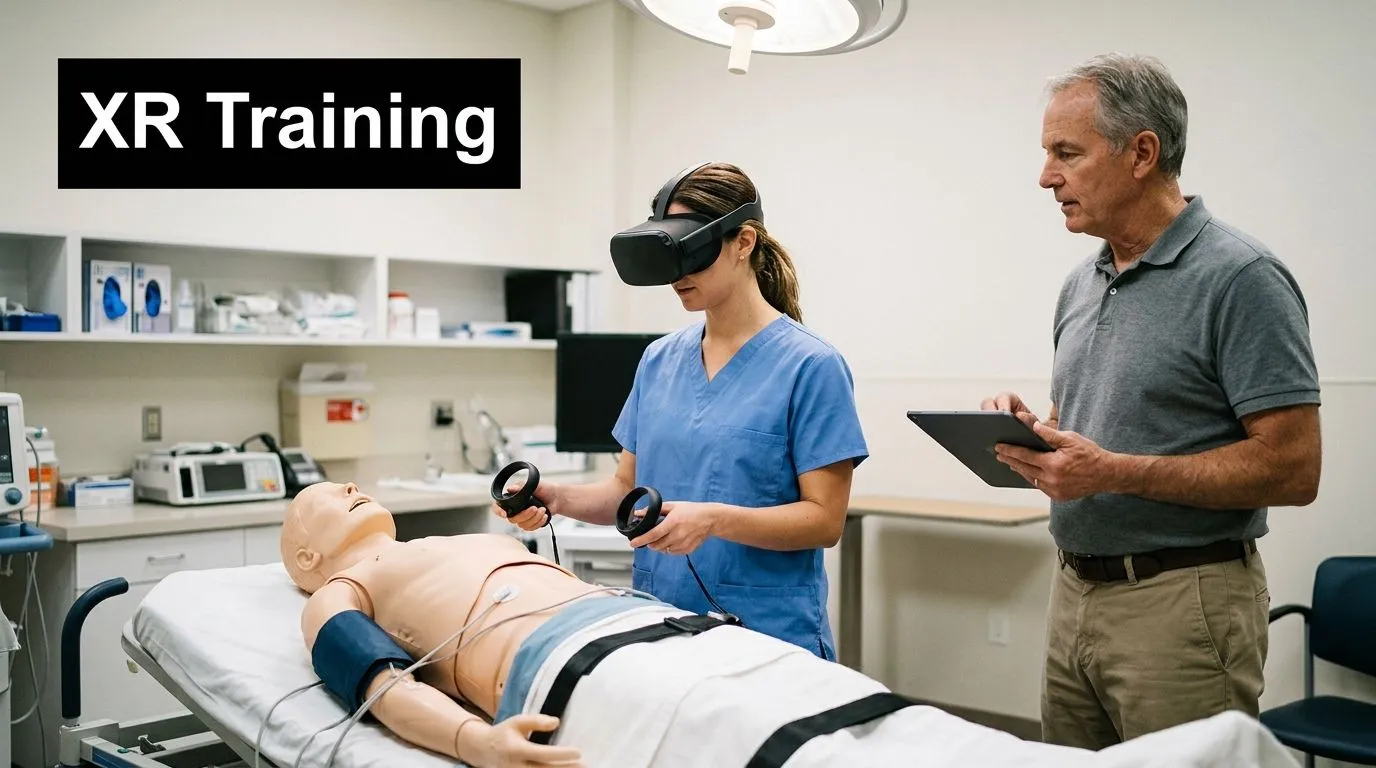
GeoEnergy NI is a useful analogue here because technical communication and stakeholder understanding often sit upstream of hands-on simulation. In other training contexts, platforms such as Osso VR and Fundamental Surgery show how XR can support procedural learning when scenario logic, expert review, and assessment design are tightly aligned.
What makes simulation credible
Training simulations fail when the interaction is engaging but the scoring is vague. They also fail when subject matter experts are brought in too late, after key assumptions are already embedded in the build.
- •SME input from day one: Accuracy isn't a polish pass.
- •Assessment in parallel: Rubrics should be authored with the scenario, not after it.
- •Instructor controls: Supervisors need to intervene, branch, or repeat moments.
- •Update pathways: Clinical guidance and equipment specs change.
UK higher education offers a related signal. In Jisc's 2023/24 survey of more than 150 members across 110 FE and HE institutions, 78% said their institution had invested in XR and 55% said they were already getting moderate to extensive use from it Jisc extended reality in learning and teaching report. That suggests buyers are increasingly ready for production-grade learning content, but they still expect implementation discipline.
5. 3D Animation Services in the UK. Studio-Quality Production from Pitch to Delivery
Not every immersive brief needs a headset. Some of the most effective xr examples start with adjacent production capability: 3D animation, cinematic previs, technical visualisation, and asset pipelines that can later move into interactive formats. Studio Liddell's animation work reflects that overlap. Series production, commercials, trailers, and branded content all rely on the same core disciplines: clear brief interpretation, visual development, previz, lighting, compositing, and delivery planning. Projects such as BooSnoo for Sky Kids, Daleks, and Kingdom of Fighters show different strengths. One is franchise-building series work, one is character-led screen craft, and one leans into action and campaign energy.
The pipeline decisions that save pain later
Previz is where expensive confusion should die. If camera logic, scale, staging, and timing are agreed early, later departments can move with confidence. If they aren't, downstream revisions spread across animation, lighting, comp, edit, and audio. UK production guides provide a useful benchmark for buyers. A straightforward 60-second 2D or motion-graphics video is commonly placed around £1,500 to £8,000 with delivery in roughly 4 to 8 weeks, while 3D animation is typically costlier and slower at about £8,000 to £20,000+ per minute over 8 to 16 weeks UK animation production cost guide.
In 3D, vague briefs don't save money. They move cost into revisions.
That's why production scoping matters. Teams should agree format, render expectations, aspect ratios, review cadence, and sound requirements before shot work ramps up.
6. Character and Creature Animation. Rigging, Performance, and Pipeline Best Practices
Character work is where technical structure and creative judgement meet. A beautiful model with a weak rig will bottleneck the whole schedule. A flexible rig with unclear animation conventions will create inconsistency across shots. BooSnoo is a strong reference point because character appeal has to survive scale. Broadcast animation needs rigs that support expressive posing, dependable facial systems, and efficient iteration across multiple episodes or deliverables. Creature work raises a different challenge. Deformations, contact points, and secondary motion can become expensive fast if the rig wasn't tested under real performance conditions.
Where pipelines usually break
Teams often rush from modelling into animation before proving the rig in production poses. That's risky. Shoulder collapses, facial drift, and eye-line problems become much harder to solve once scenes are in progress.
- •Modular rig architecture: Reusable systems reduce rebuild work across cast members.
- •Pose testing early: Push extreme poses before animation starts in earnest.
- •Motion capture selectively: It helps with broad action. Dialogue and nuance often need keyframe craft.
- •QA for facial performance: Lip sync, blink rhythm, and gaze direction deserve their own pass.
UK animation workflow guides describe pre-production as about 15 to 20% of budget, production as roughly 60 to 70%, and post-production as around 10 to 15%, with standard 2D projects often needing 6 to 8 weeks. The same guide notes that rush delivery under 4 weeks can add a 20 to 30% premium animation production rates and workflow breakdown. The exact split varies by project, but the principle holds for character-heavy work. Compress the schedule too hard and rigging, testing, and polish are usually the first casualties.
7. Motion Graphics Services for Brands. From Logo Stings to Title Sequences
Motion graphics are often treated as the lightweight end of production. In reality, they're one of the quickest ways to expose weak briefing. If the message hierarchy is muddy, no amount of slick transitions will fix it. Brand motion needs to decide what kind of asset it is. A logo sting, title sequence, social cut-down, conference opener, explainer package, and broadcast ident all behave differently. Sky Kids branding and BBC title work are useful reference points because they show how motion can carry tone, structure, and channel identity in very little screen time.
Deliverables matter as much as design
Social and broadcast specs shouldn't be left to the end. File prep, aspect ratio planning, frame rate, and audio settings all influence layout and finishing choices. If a client wants one master adapted everywhere, the design system needs to account for that from the first boards. BBC social-video guidance is clear on some practical requirements for UK delivery. Videos under 60 seconds should be supplied in 9:16, or 4:5 when converting from 16:9, with no bars or pre-roll material, at 25 frames per second, H.264 in MP4, a target data rate of 20 Mbps, and stereo AAC audio at a minimum of 192 Kbps and 48 kHz BBC social video delivery specification.
Design the main asset and the cut-downs together. Retro-fitting social versions usually weakens both.
A strong brand pack helps here. Logo files, type rules, palette, usage constraints, and reference moodboards let motion designers spend time on rhythm and communication rather than avoidable guesswork.
8. From TV IP to Games and XR. Extending Children's Brands Across Platforms
Transmedia is one of the most promising areas for XR, and one of the easiest to mishandle. A children's property that works on television doesn't automatically become a good game, a strong AR activation, or a durable VR experience. BooSnoo is a practical example because the underlying question isn't only artistic extension. It's platform fit. Characters, environments, and interaction styles need to hold their shape when they move from passive viewing into play. Pokémon remains the obvious long-view reference for cross-platform brand growth. Fortnite shows the reverse path, where a game-first identity expands into events, cosmetics, and wider media culture.
The tactical decisions that protect the IP
Audience age gates matter. So do licensing constraints, asset reuse plans, and the governance around who can evolve a character across channels. XR can be powerful for brand extension, but only if the mechanics honour the original appeal rather than smother it in novelty. The UK's immersive technology sector was estimated to include around 1,000 specialist companies in 2018, employing about 4,500 people and generating £660 million in sales. The same Nesta report also identified 253 immersive technology projects worth £160 million across UK Research Councils, Innovate UK, and EU Horizon 2020 datasets, with public support in 2016 to 2017 nine times higher than in 2009 to 2010 Nesta on the immersive economy in the UK. For IP owners, that matters because there's now a broad enough supply ecosystem to source specialist partners across animation, interaction, and technical prototyping.
- •Design for portability: World rules and character logic should survive format changes.
- •Build modular assets: Shared models and animation sets reduce duplication.
- •Plan rights early: Broadcasters, toy partners, and platform holders rarely want the same thing.
- •Test mechanics against the brand: Not every property wants competitive play or headset immersion.
8 XR Examples, Side-by-Side Comparison
| Solution | 🔄 Implementation complexity | ⚡ Resource requirements | ⭐ Expected outcomes | 📊 Ideal use cases | 💡 Key advantages / tips |
|---|---|---|---|---|---|
| VR Production Studio in Manchester: Designing Immersive Experiences with Real Impact | High, end-to-end real-time pipeline, multi-platform optimization, spatial design | High, specialist talent (Unity/Unreal, spatial audio), headset testing, longer timelines | ⭐⭐⭐⭐, broadcast-quality immersive experiences that drive engagement & ROI | LBEs, exhibitions, consumer apps, corporate training | Full creative control and rapid iteration; start with a VR concept sprint and design for target hardware early |
| AR for Exhibitions and Retail: Increase Stand Dwell Time with Spatial Content | Medium, spatial tracking, UX onboarding, realtime content placement | Low, Medium, mobile-first deployment, cloud CMS, analytics dashboard | ⭐⭐⭐, measurable dwell-time and conversion uplift (benchmarks 40, 60%) | Retail activations, trade shows, product visualization, museums | Low barrier (smartphones) and shareable content; keep onboarding <10s and use QR/NFC triggers |
| Location-Based VR (LBVR): Throughput, Safety, and ROI, A Producer's Guide | Very high, venue ops, throughput engineering, safety protocols | Very high, capex for venue/equipment, staffing, maintenance | ⭐⭐⭐⭐, high-margin recurring revenue if venue & footfall align | VR arcades, theme parks, event pop-ups, experiential retail | Eliminates consumer hardware barrier; design 15, 20 min loops, train staff and plan hygiene/safety rigorously |
| Medical & Training Simulations in XR: Accuracy, Assessment, and Compliance | Very high, SME collaboration, regulatory validation, secure data handling | Very high, clinical SME time, haptic hardware, compliance overhead | ⭐⭐⭐⭐⭐, objective competency assessment, high retention, risk-free repetition | Surgical training, military/emergency response, industrial safety, corporate compliance | Embed assessment rubrics early, log secure metrics to LMS, validate procedures with regulatory review |
| 3D Animation Services in the UK: Studio-Quality Production from Pitch to Delivery | Medium, High, full pipeline (previz → render → delivery), creative approvals | Medium, High, rendering farms, artists across disciplines, licensing costs | ⭐⭐⭐⭐, broadcast-quality deliverables for TV, ads, trailers | TV series, commercials, trailers, explainers | Invest in previz and clear briefs; plan deliverables & sound in parallel to avoid costly revisions |
| Character & Creature Animation: Rigging, Performance, and Pipeline Best Practices | High, advanced rigging, mocap integration, facial performance | Medium, High, technical animators, mocap facilities, iterative polishing | ⭐⭐⭐⭐, high-fidelity character performance suitable for broadcast & games | Feature/TV character work, game cinematics, creature VFX | Use modular rig architecture, test rigs early, reserve mocap for large actions and keyframe for subtlety |
| Motion Graphics Services for Brands: From Logo Stings to Title Sequences | Low, Medium, concept to final motion delivery, platform formatting | Low, fast turnaround teams, fewer hardware demands | ⭐⭐⭐, cost-effective, fast brand impact and repurposing across platforms | Logo stings, title sequences, social cuts, broadcast graphics | Provide brand pack and specs early; design with modular repurposing and audio considerations |
| From TV IP to Games & XR: Extending Children's Brands Across Platforms | High, cross-platform strategy, licensing, platform-specific adaptation | Medium, High, multidisciplinary teams, IP/legal resources, asset adaptation | ⭐⭐⭐⭐, multiplies revenue streams and audience lifetime value when executed well | Transmedia children's IP, franchise extensions, merchandising, games/XR | Validate TV metrics first, design assets for reuse, map age-gating and license terms early |
Turn XR Inspiration Into a Production Brief
The most useful way to read these xr examples is by decision path, not by novelty. Choose VR when presence, embodiment, or repeatable simulation is central to the outcome. That usually applies to immersive storytelling, technical training, and controlled interactive experiences where headset use is part of the value. Choose AR when the physical setting already does part of the work. Exhibitions, retail, wayfinding, product visualisation, and lightweight branded activations all benefit from that model because users stay anchored in their environment. It lowers friction and often makes discovery easier than a fully enclosed experience. Choose LBVR when throughput is part of the business model. In that scenario, the content has to survive public use, staff handover, resets, comfort demands, and queue pressure. A technically impressive build that ignores those realities won't hold up commercially. Choose animation or transmedia development when the core challenge is scale across channels. If you need a story world, a technical concept, or a brand system to travel between broadcast, social, apps, games, and immersive formats, asset strategy and pipeline design matter as much as creative direction. The next step should be concrete. Define the audience first, then the outcome. After that, choose the target hardware, test the core interaction in a concept sprint, confirm whether Unity or Unreal is the right production route, and decide how you'll measure success after launch. Most weak XR projects skip one of those decisions or bury it too late. A short planning document helps. If your team needs a clean way to turn ambition into scope, this guide to writing a product requirements document is a useful starting point because it forces clarity around users, constraints, dependencies, and acceptance criteria. Studio Liddell is one option for teams that need both creative development and production delivery across animation, games, and XR. The practical advantage of that model is continuity. Strategy, asset design, real-time development, and final delivery can be discussed as one production system rather than as disconnected vendor tasks. If you're evaluating partners, ask simple questions. What exactly will the user do? On which device? In what environment? What does success look like after deployment? The better the answers, the better the build. --- Studio Liddell develops animation, VR, AR, games, and immersive content for broadcasters, brands, and enterprise clients, with work that spans character-led storytelling, event experiences, and technical visualisation. If you want to turn these XR examples into a scoping conversation, references, or a production-ready brief, visit Studio Liddell.