3D Medical Animation: How It Is Made and Where It Helps
You have a script, a deadline and a clinician who has already said the last draft "looks nice". That is not the same as a patient knowing what will happen to their knee, or a student being able to name the structures they just watched. A 3D medical animation earns its place when someone can recall the steps, the risks and the reason for the treatment after the film has stopped. Polish and view counts do not tell you that. Treat the film as a communication intervention. Name the question the viewer must answer, build only the anatomy that question needs, and test whether people still know the answer a week later. The sections below walk through where these films are used, when 2D is the better choice, how a production is built, what the evidence supports, and how to brief and budget one without guessing.
Where 3D Medical Animation Is Used Today
A patient reads a consent form for a knee replacement and still cannot picture the joint. Three minutes of a moving model, with the bones separated and the implant seated, often does what two pages of prose did not. 3D medical animation is a computer-generated, moving model of anatomy, cells, a device or a physiological process. It is built for communication and education, not for diagnosis. The same craft serves very different jobs. The audience, the goal and the measure of success should be agreed before anyone models a bone.
| Use | Main audience | Goal | Measure of success |
|---|---|---|---|
| Patient information and consent | Patients and families | Explain procedure, risks and recovery | Recall and understanding after a delay |
| Undergraduate anatomy teaching | Medical and health students | Show spatial anatomy and processes | Assessed knowledge and practical participation |
| Pre-operative planning and rehearsal | Surgical teams | Plan approach and sequence of steps | A signed operative sequence the team can rehearse |
| Drug mechanism explainers | Clinicians and sales teams | Show how a treatment acts in the body | Comprehension in a test audience |
| Public health and infection control | General public and frontline staff | Change a behaviour or practice | Observed change in the targeted practice |
| Continuing professional development | Clinical staff | Refresh procedures and protocols | Completion and assessed knowledge |
Buyers now commission this work as a regular communication tool, not a one-off showpiece. The UK held 22.3% of the European medical animation market in 2025, according to Market Data Forecast.
Pick the job before the look
A consent film and a theatre-planning model should not share a script. Consent needs plain language, risks and recovery. Planning needs angles, sequence and instruments. Training needs a question the learner can fail. If you are also building assessed scenarios in a headset, our guide to medical training simulations in XR sets out how accuracy, scoring and compliance change the brief. Teams who want a wider view of how algorithms sit beside clinical judgement can look at the Premiere Education AI healthcare course, which frames current tools without treating a film as a diagnostic device.
Practical rule: choose one row in the table before you talk about length, realism or review. The goal decides all three.
Choosing 2D or 3D for a Medical Message
Use 3D when the message depends on space and movement. Use 2D when it depends on a clear schematic. A spinal fusion or a joint replacement suits 3D because the surgeon's approach, the depth of the cut and the angle of the implant are the point. A signalling pathway, or how a vaccine primes an immune response, often reads faster as a flat diagram with fewer moving parts.
| Criterion | 2D animation | 3D animation |
|---|---|---|
| Best use | Mechanisms, diagrams and patient leaflets | Spatial anatomy, surgical approaches and walkthroughs |
| Spatial detail | Schematic, limited depth | Full volumetric detail and camera angles |
| Interactivity | Usually linear | Can support camera control, layers and toggles |
| Production effort | Lower modelling and lighting load | Higher modelling, texturing, lighting and review |
| Typical lead time | Shorter | Longer, driven by clinical review rounds |
| Typical cost | Generally lower | Generally higher, depending on detail |
What you trade
A 3D film can show a true spatial relationship: the camera can orbit a joint, peel a layer, or sit inside a vessel. That truth costs modelling, texturing, lighting and extra clinical review, so the schedule and the fee usually rise. A 2D film is easier to revise when a guideline changes a label or a dose step, and viewers often parse it in a single pass. Patient leaflets and short social clips usually work better in 2D because people process them quickly, often on a phone, between other tasks. Clinician training and pre-operative briefings usually need 3D, because "where" is the lesson. A hybrid is common and often the honest choice: a 2D overview of the disease, then 3D only for the anatomy that would be misleading as a flat drawing. If you are still weighing the formats for a non-clinical spot as well, this comparison of 2D and 3D animation sets the same trade-off in a broader production context.
Does the viewer need to understand where something is, or what is happening? Answer that before you choose a format.
How a Medical Animation Is Produced, Step by Step
A checked model is an asset. An unchecked pretty shot is a liability. Build in this order, and do not start modelling until the script has a clinical signature.
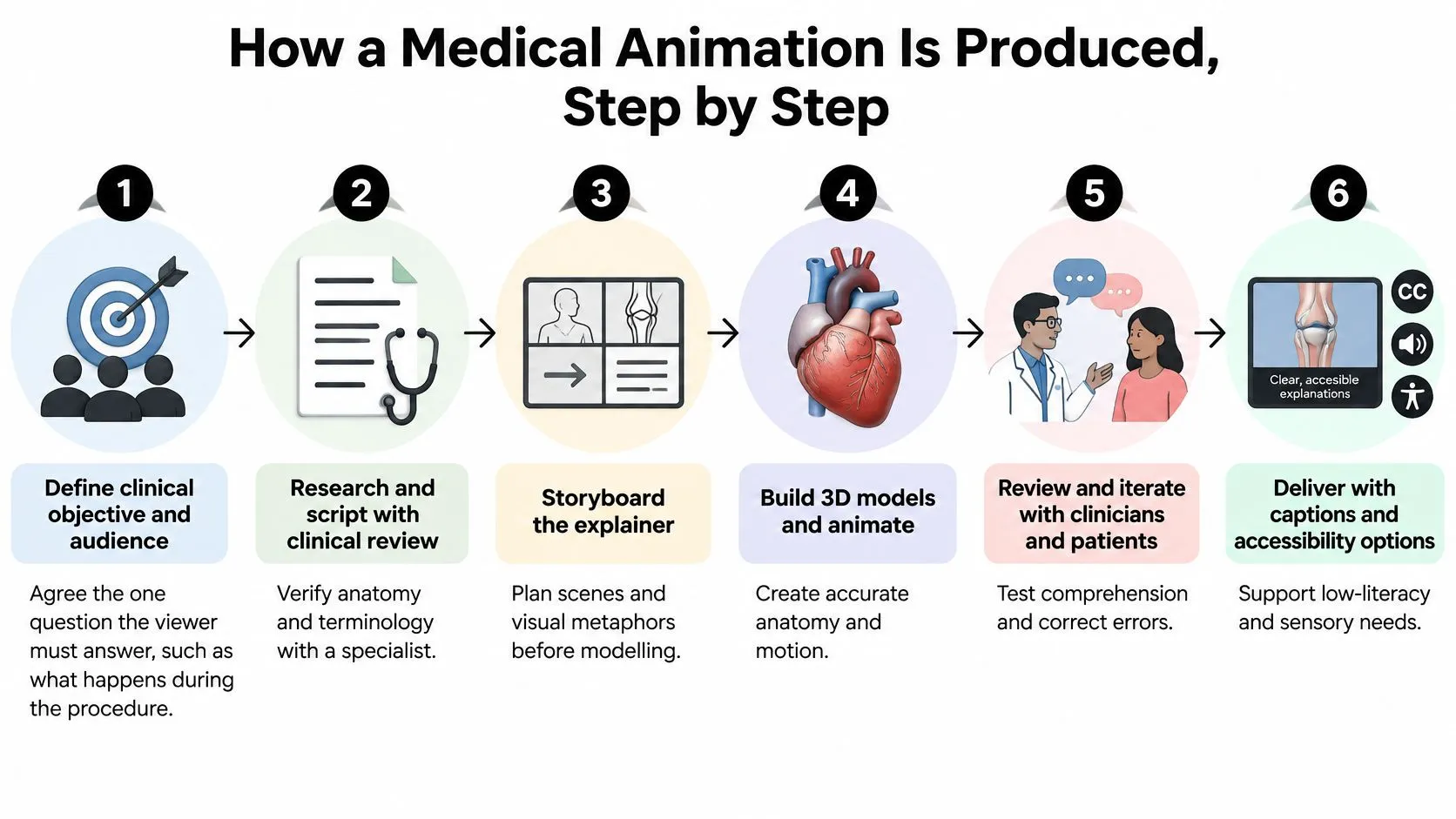
- Define the clinical objective and audience. Name the one question the viewer must answer, such as what happens during the procedure. If you cannot write that question in a sentence, the film will wander.
- Gather source material. Pull the relevant clinical guideline, anonymised CT or MRI where the story needs real proportions, and the patient-information standard that applies to the setting. Do not invent a vessel that the scan does not support.
- Write the script and storyboard, then get clinician sign-off. Late anatomical changes are the most expensive fix, because they ripple through models, lighting and labels. Sign-off here is cheaper than sign-off in the grade.
- Model only the anatomy the storyboard needs. Organs, tissues and devices should match the reference, at the level of detail the camera will show. Extra vessels that never appear still have to be reviewed.
- Rig, animate and texture. Motion should follow real biomechanics: a joint does not bend past its range, and a device does not pass through bone. Surfaces need to read under the lighting you will use, not only in a turntable.
- Light, composite and render. Add labels, captions and any interactive layers. If a label fails on a phone, it fails for most patients.
- Review accuracy and test comprehension with the people who will watch it, not only with the steering group.
One model, several teaching sites
Scotland built an early coordinated base for this work. In 2006 the Scottish Funding Council awarded £95,000 for a feasibility study, and the resulting Scottish Medical Visualisation Network, backed by the Royal College of Surgeons of Edinburgh and the Royal College of Physicians and Surgeons of Glasgow, linked 22 medical disciplines across 44 organisations, as set out in this REF impact case study. A 3D head-and-neck model from that programme was used for undergraduate anatomy teaching at the University of the Highlands and Islands in Inverness, Stornoway and Dumfries. One checked asset served more than one campus. A cut is ready when three things are true: a named clinician has signed the anatomy, labels stay legible on a phone, and the key message is clear within the first thirty seconds.What Research Shows Medical Animation Improves
In a systematic review of animation-based health-information studies, 11 of 15 studies, or 73%, reported statistically significant improvements in recall compared with usual information delivery, according to a 2024 review in the Journal of Medical Internet Research. Video durations in that review ranged from 1 to 15 minutes, and 10 of the 15 studies used formats between 1 and 8 minutes. Four studies used computer-generated 3D animation for informed consent and patient understanding, covering operative laparoscopy, coronary angiography, Mohs surgery and cataract surgery. The review mixes animation styles and healthcare settings, so 73% is an evidence benchmark, not a guaranteed effect size for your next film.
Turn the finding into a cut
Do not ship one long explainer and hope. Split a complex subject into short, task-focused sequences, staying inside that 8-minute upper range where most of the evidence sits.- •Open on the clinical objective. Say what the viewer should be able to do or explain when the sequence ends.
- •Reveal anatomy progressively. Show the landmark, then the pathology, then the intervention. Dumping every structure in frame one overloads working memory.
- •Show cause and effect. Connect the step to the outcome, including the risk that step is meant to reduce.
- •Close with a check. A two-line recall question, or a key-risk summary, beats a logo sting.
Measure recall and comprehension after a delay, and whether consent understanding improved. Views and completion rates only tell you that the file played.
A test you can run this month
Write five questions for each sequence. Ask a small sample of the intended audience straight after viewing, and again a week later. Compare those scores with the leaflet the film is meant to replace. If the delayed score does not beat the leaflet, the film is not ready, however clean the render looks.
Designing for Literacy, Consent and Uncertainty
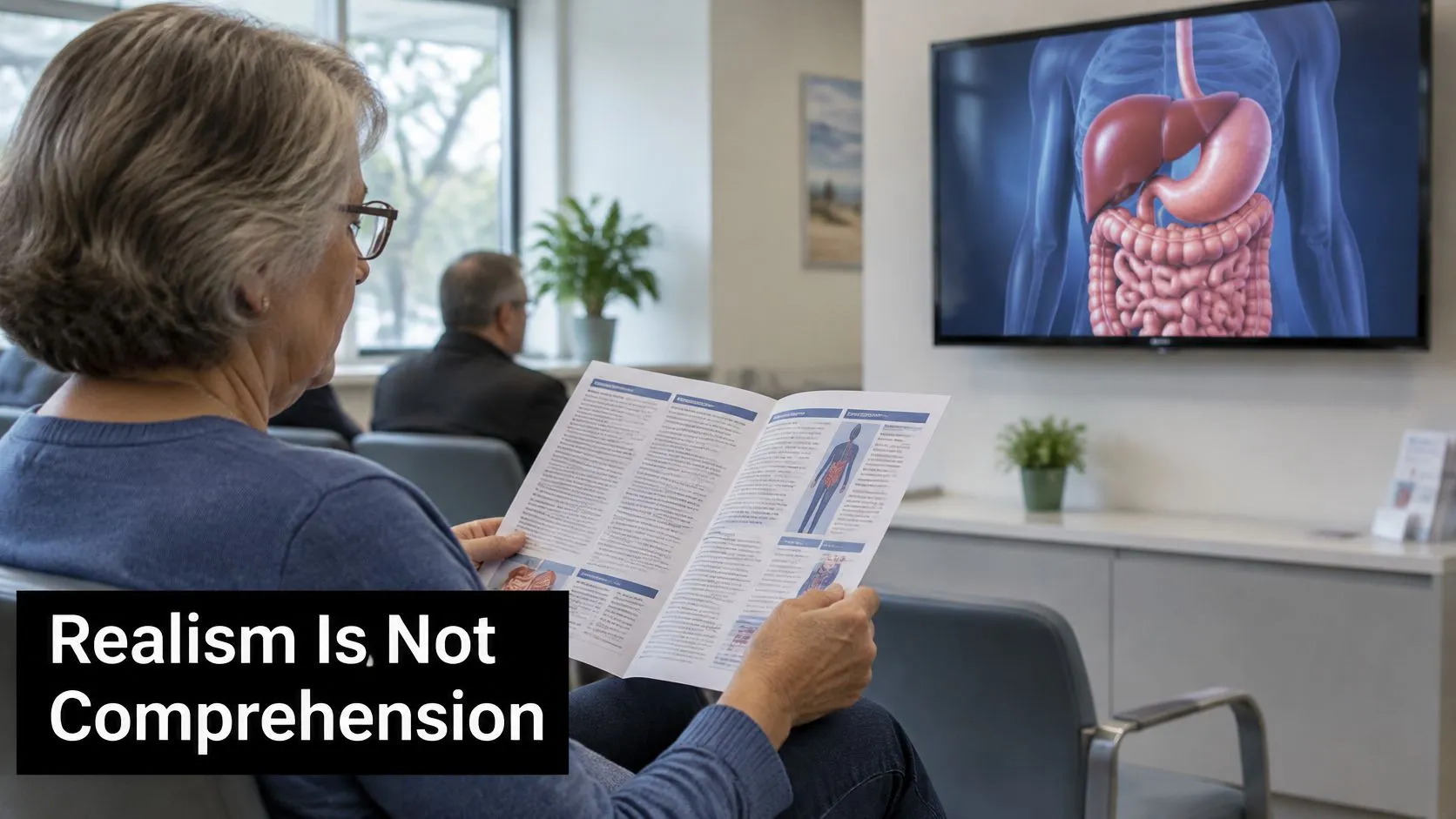
Photoreal detail can still fail the viewer. A dense film can shut people out as surely as a dense leaflet, especially when someone is anxious, tired or reading in a second language. The gap is large. A UK Health Research Authority summary cites UK estimates of up to 27% of adults with very low literacy, dyslexia affecting up to one in ten people, and 40% with poor health literacy. The same summary describes an NHS-linked randomised evaluation that compares standard written leaflets with augmented-reality 3D explanations of sarcoma surgery, including tumour resection, flap reconstruction and post-operative gait. It measures usability, comprehensibility and recall, so the film is treated as a communication tool whose value sits in what viewers understand.
The false certainty problem
One smooth surgical journey implies an outcome the theatre cannot promise. Viewers read a polished path as the likely path. That is a consent problem before it is a style problem. The wider risk-communication lesson is the same: whether a film explains surgery or a school uses guidance for communicating school illness clusters to parents, a tidy visual that hides uncertainty does more harm than a plainer one that states the range.
Build the film so it can carry doubt:
- •Branching pathways: show the options that exist, rather than one hero route.
- •Uncertainty and recovery variation: show a range of outcomes, including a slower recovery, rather than one ideal result.
- •Contraindications: say when someone would be unsuitable, in the same visual language as the procedure.
- •Access formats: add captions, audio description, plain language and the languages your clinic uses.
- •The human loop: keep the clinician's explanation and the patient's choice in the conversation. The film does not sign the form.
Include people with low literacy in draft testing, and judge the cut by comprehension and consent understanding rather than meeting-room approval. The film supports the consent conversation, while the decision and the discussion still belong in the clinical notes.
What a Medical Animation Costs and How Long It Takes
For educational content in the UK, 3D animation production typically costs £15,000, £50,000 or more, according to Educational Voice in 2025. Set that band before you write a brief. Then expect the figure to move with length, the number of anatomical models, interactive layers, languages and captions, clinical review rounds, and any XR delivery. The band is a starting point, not a quote. Two films of the same running length can sit far apart once you count the things that make a medical film worth paying for: anatomical accuracy, clinical sign-off and evidence that viewers can recall the message afterwards.
| Project type | Typical cost band | What drives the figure |
|---|---|---|
| Short patient information clip of 1 to 2 minutes | Lower end of the educational band | Clinical review rounds and number of languages |
| Educational 3D animation | £15,000, £50,000 or more | Length, anatomical detail and review rounds (Educational Voice, 2025) |
| Interactive or XR medical module | Above the educational band | Build, testing and device-specific work |
| Multi-part series | First module in the band, later modules lower | Shared models reduce the cost of each part after the first |
How to budget without a surprise
Put clinical review and comprehension testing on their own lines. They are the items teams most often leave out, then discover in week six. Allow more calendar time for review than for modelling, because a specialist who can only look on a Thursday will stall a perfect pipeline. Budget a second version if you need another language or another screen shape: a phone crop is not a free extra. A three-minute patient film with two full clinical review rounds costs more to get right than a 90-second explainer with one round, even when the shorter film looks busier. The rounds, not the camera moves, are the expensive part. That is also where the money earns its keep, since the film is judged by what a patient can repeat back in the consent conversation rather than by how polished the render looks. UK reliefs are written for animated television and film, not for every clinical explainer. The Audio-Visual Expenditure Credit gives animated television productions and animated films a 39% taxable credit on qualifying expenditure, as set out in the creative industries statistics commentary. It applies to programmes certified as British and intended for broadcast or streaming. Budget for it only after a tax adviser confirms your clinical film qualifies. For a wider look at fees, schedules and warning signs, see our buyer's guide to choosing an animation studio. Ask every supplier three questions: who signs off clinical accuracy, how many review rounds are included, and what testing is priced in. A cheaper quote that skips those lines buys a better-looking film and a weaker communication tool.
Commission Your First Medical Animation with a Clear Brief
Write a one-page brief before you contact any studio. A vague "make the knee look premium" produces a premium guess. A specific brief lets a studio price the actual job and avoids the rework that blows both the fee and the consent deadline.
- •Clinical objective: the single question the viewer must be able to answer.
- •Audience and literacy: who watches, and what reading or language support they need.
- •Where it plays: a clinic screen, an app, or a QR code on a leaflet.
- •Sign-off route: the named clinician who can approve anatomy.
- •Consent and testing: how you will check recall, and that the film will not replace the conversation.
- •Access: languages, captions and audio description.
- •Money and rounds: the budget band and how many reviews are included.
- •Delivery: the formats and the date they are needed.
We are a UK studio, and we work with clients all over the world. We have completed an AR and VR project for Merck Pharmaceutical, so pharmaceutical accuracy and immersive delivery are familiar territory, not a side experiment. Use the checklist on us the same way you would use it on anyone else. Ask how clinical review and recall testing would run on your project, and what you would receive at each stage, from script lock to the file a patient watches. If the brief names an audience and a measurable outcome, book a scoping call. If it does not, spend one more week on the question the film must answer. That week is cheaper than a reshoot. --- Studio Liddell builds 3D medical animation, explainers and VR and AR training from a clear clinical brief through to delivery, for healthcare, education and brand partners in the UK and abroad. If you have a procedure, a device or a training scenario that people still do not understand from the leaflet, bring the one-page brief. Visit Studio Liddell and book a production scoping call so we can test the question, the audience and the review route before any modelling starts.